

pandanus
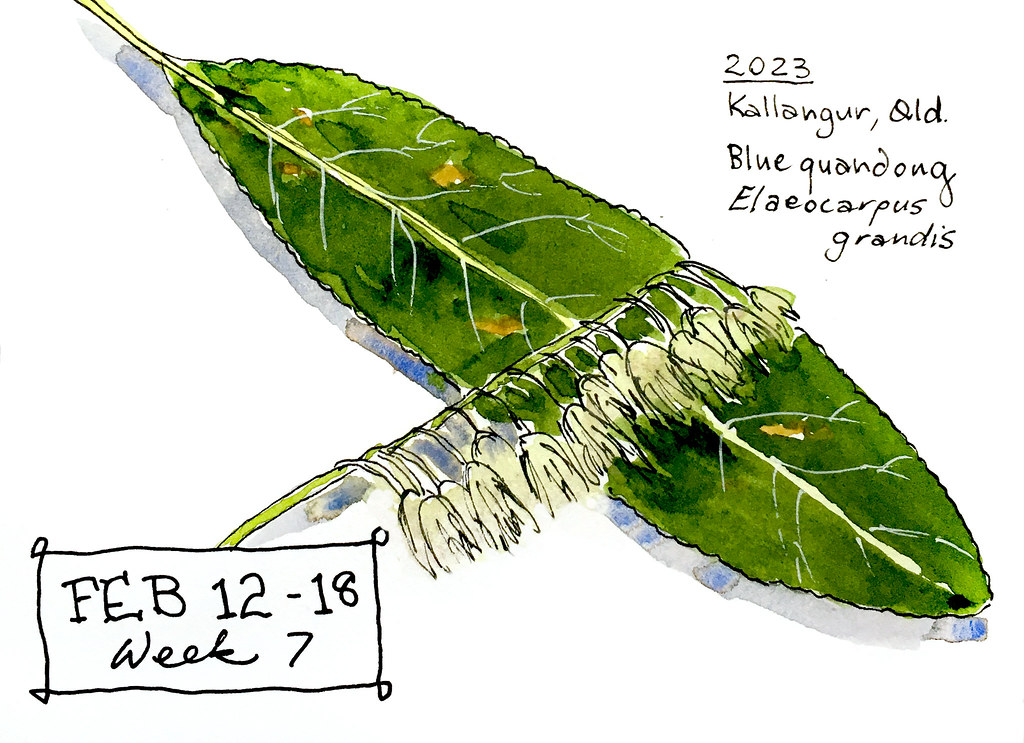
There’s a huge Elaeocarpus grandis tree in full flower in the park near my daughter’s house.
This rainforest tree commonly known as white quandong, blue quandong, silver quandong, blue fig or blueberry ash, is endemic to eastern Australia. It is a large tree with buttress roots at the base of the trunk, oblong to elliptic leaves with small teeth on the edges, racemes of greenish-white flowers and more or less spherical blue fruit, which are edible but bitter.
Indigenous Australians ate the fruit raw or buried the unripe fruit in sand for four days to make it sweeter and more palatable. Early settlers used the fruit for jams, pies and pickles. The fruit of E. grandis is eaten by birds, including the wompoo fruit-dove, southern cassowary and Australian brushturkey.
I have a vintage (1940s) Chinese Checkers set that belonged to my mother; the “marbles” are painted quandong seeds. It looks like this one. I am not sure if they are E. grandis seeds as there are at least a couple of dozen trees called quandong.

The lemon tree continues to cause me some head-scratching. I’m hoping that rock dust will help normalise its growth. Gardening is an experiment and an adventure!

Several of the coast live oaks along High Road in Malibu Creek State Park broke and toppled in the recent storms. I hung out with one of them for a while this afternoon, enjoying its glowing heart.


The blue gum Eucalyptus globulus, native to southern Australia, is one of the most widely planted eucalypts in the world*. The bark is mostly smooth, seasonally cream to pale grey to orange-tan, shedding in long strips which often remain hanging in the canopy. The trees are very fast growing (up to 60m tall), and tolerant of salt-laden coastal winds and cold temperatures.
The species has naturalised in California and become invasive in coastal areas. We have several advanced trees on our block; I don’t know whether they self-seeded or were planted by the original owner. Even though they don’t ‘belong’ here, and they drop fire fuel, we kind of love them …
*Source: Taller Eucalypts for Planting in Australia by Dean Nicolle

My daughter gifted me the four pan mineral suite from The Art of Soil. The pigments behave a little differently to regular watercolours, so I’m enjoying playing with them to learn their properties and how best to use them. They are very muted and grainy, which I love. They can be mixed with other brands to good effect. (The bright green above includes some Daniel Smith green gold.)


Waiting for these beauties to ripen.

Curly wet eucalyptus bark found on the driveway.

