

Kim and I sat by the creek and watched the ants. What a lovely way to pass an hour.
Kim and I sat by the creek and watched the ants. What a lovely way to pass an hour.

A long time MCSP docent discovered a rare Interior Live Oak and brought us a twig to admire.

Now that the sycamores have dropped their leaves, it’s easy to see the parasitic plants. I wondered how mistletoe seeds can get a hold on the underside of their hosts’ branches. Turns out the seeds are sticky!

Lovely winter’s morning hike with many moments of delight. Lots of shades of buff, tan, and grey, but also some surprising new green popping up, despite the lack of rain so far.
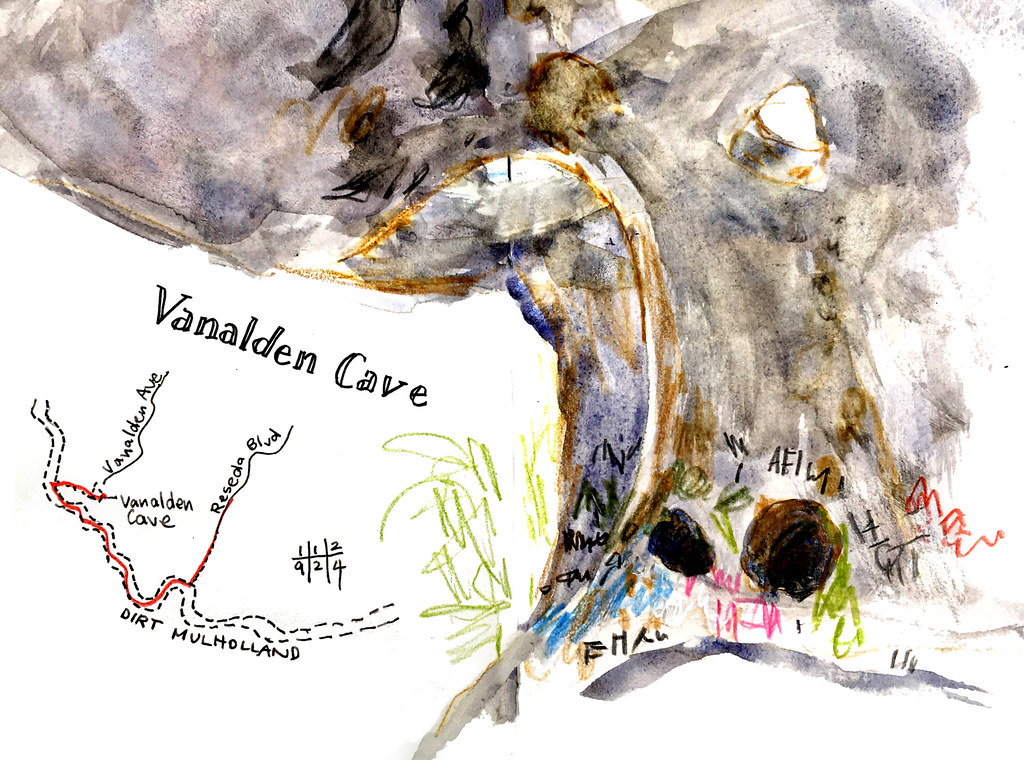
What motivates some people to take spray paint to a site of awesome natural beauty? I will never understand how that can feel good. I thought this part of the cave looked like a sad or angry face frowning down on the graffiti.

Today I returned to an old favourite, dog-friendly, fossil-laden canyon for a lovely winter hike. The landscapito at the top was sketched from the turnaround point, looking east.

The lower parts of Solstice Creek are well-visited, but not many people climb Sostomo Trail to enjoy the gorgeous crossing on the upper creek. The three of us settled into a bed of fallen sycamore leaves and enjoyed the quiet shade. I liked seeing the little backswimmers (Notonectidae family) — I’d also observed these aquatic insects in Australia.
Backswimmers, as the name implies, swim inverted, using their long hind legs to paddle vigorously. They prey on organisms as large as tadpoles and small fish and can deliver a painful “bite” to humans—actually a stab from their sharp proboscis. These insects inhabit still freshwater in lakes, ponds, and marshes, and can also be found in garden ponds and occasionally in swimming pools. Despite being primarily aquatic, backswimmers are effective fliers, allowing them to easily disperse to new habitats.

Secret Trail has been on my to-hike list for a while. It’s got some really pretty parts, wending as it does through chaparral, oak woodland, grassland and riparian habitats before arriving at the dramatic rock formations in the upper reaches. I’d like to go back in spring to see all the purple sage in flower.

There are about 800 species in the Eucalyptus genus; correct identification can be tricky, as features may vary with genetics, environment and tree age. I’m making an educated guess* that the ones at Peter Strauss Ranch in Agoura Hills are manna/ribbon/white gums, native to south-eastern Australia.
One thing I find intriguing is the huge variation in gumnut (fruit) size from species to species, from 3mm to 60 or more mm wide. There’s no correspondence with the tree’s height; I wonder what factors determine this feature. These ones are definitely at the small end of the spectrum.
*Ref: Taller Eucalypts for Planting in Australia by Dean Nicolle

Lemonadeberry is native to these parts; we have a LOT growing on our block. It occurs in both chaparral and coastal sage scrub communities, enduring heat and windy conditions well.
The fruit are eaten by many birds, and the nectar feeds both birds and butterflies. The berries make a pleasingly tart snack if popped in the mouth right off the bush, and sucked for their juice. They can also be dried, then soaked in water and heated to make a kind of hot pink lemonade.

