

One of our three native larkspurs, this perennial member of the buttercup family blooms from May to July in chaparral and coastal sage scrub. I don’t see a lot of it, so it’s always a treat to find one of the tall displays of bright red flowers.
One of our three native larkspurs, this perennial member of the buttercup family blooms from May to July in chaparral and coastal sage scrub. I don’t see a lot of it, so it’s always a treat to find one of the tall displays of bright red flowers.

This week in the PerpJo: Humboldt’s Lily. We SMM hikers look forward to these all year, and exchange notes on where they are blooming. So nice to see some today!

A & I returned to the Backbone Trail after more than a month’s break, and hiked the penultimate and longest section. It was so pretty, especially between Tri-Peaks and Sycamore Canyon. We had Chamberlain Trail to ourselves; it seems that only thru-hikers go there, as it isn‘t a convenient loop or out-and-back hike. I’d like to return with my birding binoculars; I *think* I saw my first Phainopeplas.

Quick sketch after a loooong hike.

California native Heucheras, commonly referred to as Coral Bells or Alum Root, consist of about 15 different species and sub-species that grow naturally in a variety of habitats in elevations from less than 500 feet up to 10,000 feet. I’m not sure of the exact species growing in the King Gillette Ranch native garden, but it sure is pretty.

This week in the PerpJo … We have a local, native thistle, the cobwebby thistle Cirsium occidentale. The plant is widespread and fairly common across most of California; unlike many introduced thistles, this native species is not a troublesome weed.
What a handsome plant! The leaves are a soft grey-green. The flower head is somewhat spherical, covered in large phyllaries with very long, spreading spines which are heavily laced in fibers resembling cobwebs. The ones were saw today had gathered dew drops on the thin threads — so pretty! The crown on top was a dense head of crimson florets.

Wild cucumber is the first annual growth to appear with the winter rains, and it’s still going strong now, five months later, with fresh vines, flowers, and maturing fruit all festooning whatever they can scramble over. I cut a fruit open to see how the seeds are going; they are still very soft. When the fruit ripens, it will explode and spray the large, hard seeds out in all directions.
Marah macrocarpa has an unusual germination method. The initial shoot emerges from the seed and grows downward into the earth. This shoot then splits, one part swelling to form a tuber, while the second part grows back to the surface and becomes the vine. The large, hard tuberous root can reach several meters in length and weigh in excess of 100 kilograms, leading to one of the plant’s common names, manroot.

Another beautiful day in the Santa Monica Mountains.

Yerba santa (“holy herb”) is a hairy perennial shrub that‘s found in chaparral and coastal sage scrub, most often at higher elevations. The very aromatic leaves are lance-ovate to oval, 5 to 15 cm (2 to 6 inches) long, with a scalloped margin. Soft woolly hairs grow on both sides. In traditional medicine, it has been used to treat respiratory infections. I don’t often hike in the highest parts of the Santa Monica Mountains, so it was a treat to get up there and encounter this plant growing in profusion along the trail yesterday.
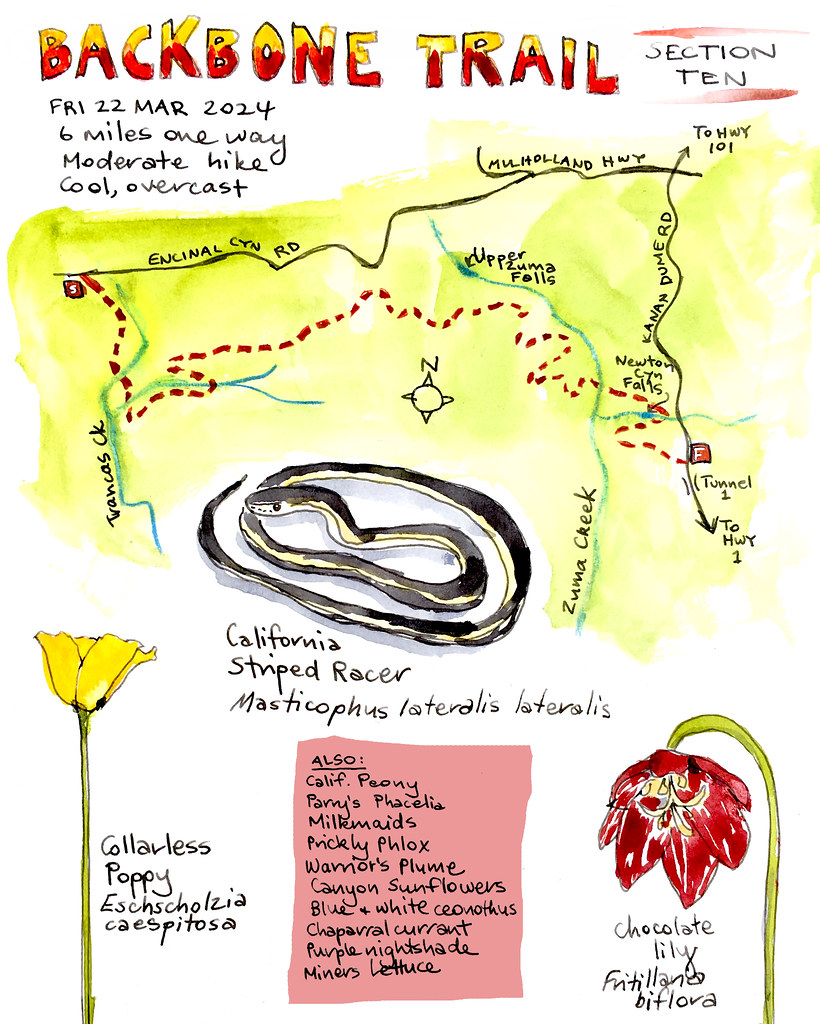
Lovely day out on the trails. Still plenty of water in the creeks and waterfalls, and the wildflowers are really starting to pop. Feeling very grateful to live in these beautiful mountains.

