

sad bee tale

Large milkweed bugs are seed-feeders; their main diet is, not surprisingly, milkweed seeds. So I’m not sure what this lady was doing on the sweet potato vine.

The cabbage whites (Pieris rapae) are all over my brassicas, of course, but I’m also seeing them in the Park and on ornamentals in the neighbourhood. They seem to especially like purple lantana flowers. Do they also lay their eggs on the plant? Do their larvae eat the leaves, as they do my kale?
On the subject of lantana, it’s highly invasive where I‘m from. It covers an estimated four million hectares in eastern Australia, often to the exclusion of wildlife, people and livestock. So it’s taken me a long while to get used to seeing it as a cultivated garden plant here in Southern California.
Eat up, cabbage whites—lantana not kale!

Nature journaling very tiny things, with the help of a microscope. I was interrupted by the grosbeak strike, so got no further with this page.

It’s fun to come across living organisms in unexpected places.

Interesting that this insect has a mouth, and palps, even though it doesn’t eat. Evolution hasn’t caught up!
When drawing the legs, I suddenly remembered reading, and loving, Tom Robbins’ Skinny Legs and All decades ago. I should re-read it and see if I’m still a fan.
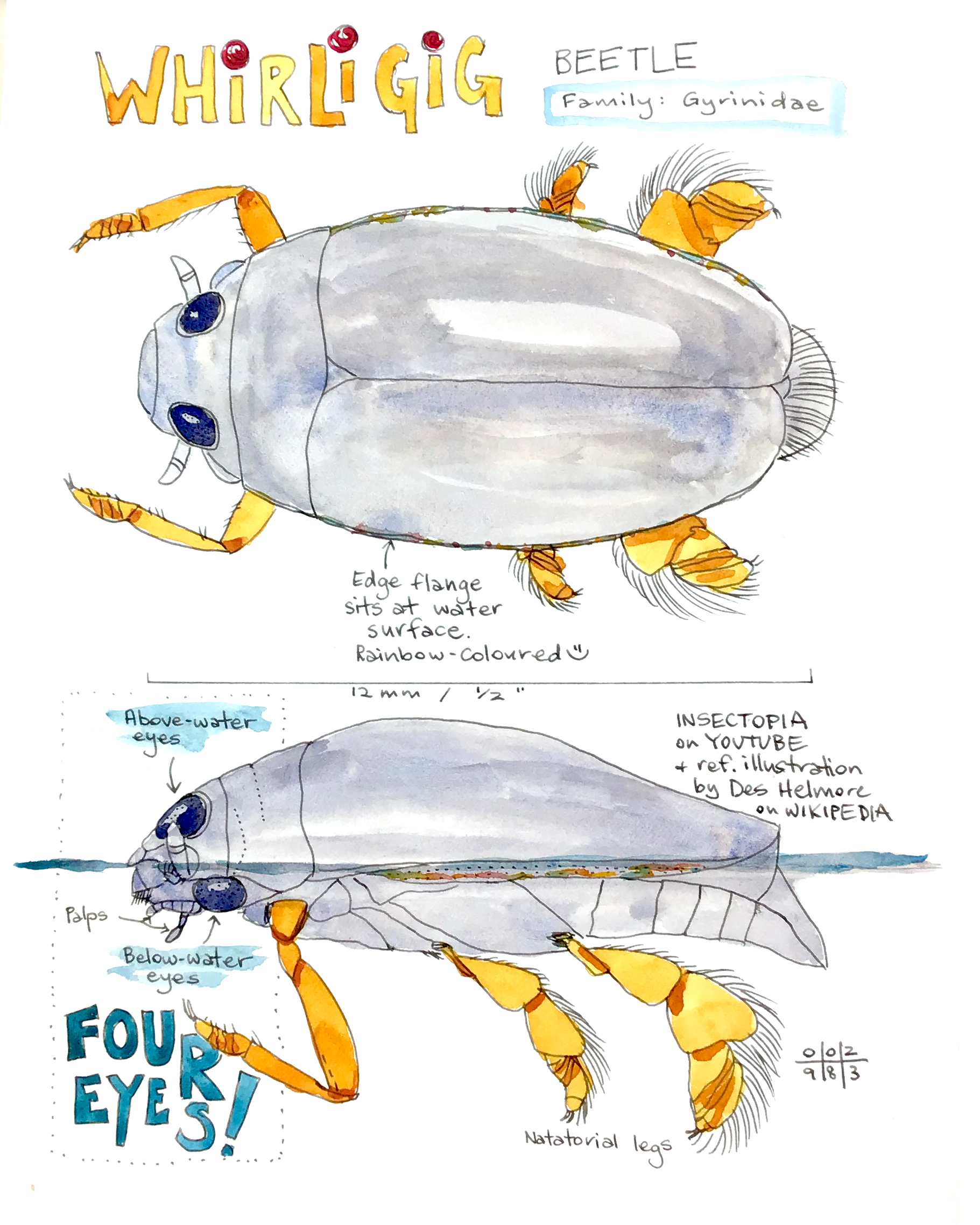
Here’s something strange: the compound eyes of a whirligig beetle are divided into a higher part that is above water level when the beetle is floating passively, and a lower part that sits below water level. Gyrinidae are the only type of beetle with this feature.
The antennae are also unusual among beetles, being short and plump, and placed about at water level.
Whirligigs get their common name from their habit of swimming rapidly in circles when alarmed. Adults carry an air bubble under the elytra at the tip of their abdomen, allowing them to breathe underwater. They are very social creatures, often found in large numbers swimming around on the water’s surface. There are about 700 species worldwide.

I had fun watching a couple of flame skimmer dragonflies cavorting over the pool while I ate my lunch.

Here’s something interesting: hornworms’ hemolymph (blood) is blue, coloured by a protein called insecticyanin. The foliage they eat contains carotenoids, which are primarily yellow in hue. The resulting combination (blue + yellow) gives them their green colouring. If fed a wheatgerm-based diet in a lab, these caterpillars are turquoise due to the lack of carotenoids in their diet.
Both tobacco hornworms and the very similar tomato hornworms are big fans of Solanaceae (nightshades like tomatoes, potatoes, peppers, tobacco), but they also eat crucifers, legumes, eucalyptus, ficus, and other plants.

