

This week in the perpetual journal … I’ve been seeing a lot of swallowtails recently — big and beautiful!
This week in the perpetual journal … I’ve been seeing a lot of swallowtails recently — big and beautiful!

Now I have Thin Lizzy on the brain.
Guess who just got back today?
Them wild-eyed bees that’d been away …

It’s National Moth Week again, so we sketched moths (and their larvae) on Draw With Me.
Halysidota tessellaris, the banded tussock moth, is found in North America from southern Canada south through Texas and central Florida. Adult moths are attracted to decaying plants with pyrrolizidine alkaloids. They regurgitate on them, then drink the fluids, and thus acquire defensive chemicals that offer protection from predators.
Megalopyge crispata, the black-waved flannel moth, is found along the east coast of the United States, and as far inland as Oklahoma. The caterpillars produce a venom, delivered through hollow hairs that penetrate the skin, that can cause pain, headache, inflamed lymph glands and dermatitis. They may look cute and furry, but don’t go petting them!

Digger bees, although solitary, nest in large aggregations. Each female digs her own tunnel, which can be up to a foot deep and have several branches. Each branch terminates in a chamber where the female lays a single egg, providing it with pollen and nectar collected from flowers. The larvae hatch and consume the stored food, then grow into pupae and then into adult bees, all while underground.
Next spring or early summer the adults will emerge, mate, and do it all over again … Right now we‘re at the mating stage, by the looks of things! I don’t know if they will re-use the existing tunnels or dig new ones. I‘ll keep checking on them.
There are also a few bee flies (possibly tribe Villini) hovering about at ground level. The larval stages of bee flies are predators or parasitoids of the eggs and larvae of other insects. The adult females usually deposit eggs in the vicinity of possible hosts, quite often in the burrows of beetles or wasps/solitary bees. So I’m pretty sure that’s what they’re looking to do! It’s a fly-eat-bee world.

We’ve all been excited about the digger bees at the Park, but we also have digger wasps actively nesting quite close to the Visitor Center.
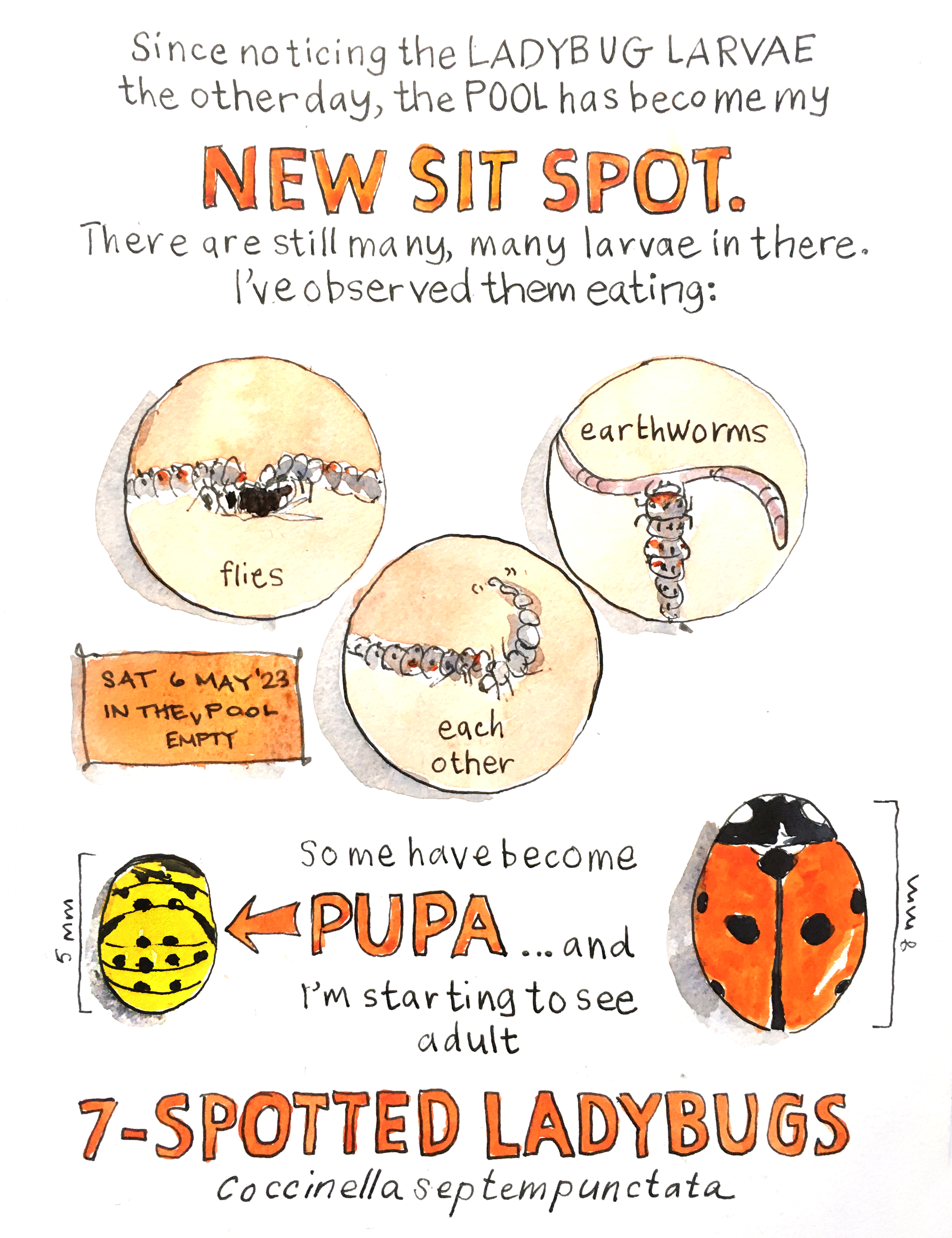
Who knew that sitting inside a huge concrete tub could be so interesting? Grateful for my extremely close focusing binoculars and my macro lens.

I’m pretty sure these are native, not invasive, ladybug larvae. I think the invasive Asian ones are orange all the way down their sides.

The myoporum thrips is an invasive species that’s causing a lot of damage to Myoporum laetum and M. pacificum plants in landscapes and nurseries along the California coast. We have five M. laetum trees alongside our driveway; one of them has been infested with this insect for a couple of years now.
Last year we tried introducing lacewing larvae to the tree for natural pest control, but we had storms soon afterwards and never saw evidence of adult lacewings. I’d like to try that again this year, after the winter rains are done.
The thrips can kill even well-established trees so it would be good to get them under control.

It was good to be back with Trisha on Youtube last Thursday night. I learned some new words and cicada body parts. She also told us about the Massospora cicadina fungus that turns cicadas into “flying salt shakers of death”. Amazing(ly gross).
The citrus cicada is found in the south west US (CA-AZ-UT-NV). (Trisha’s specimen was collected in Mesquite, NV.) They are not one of the 13- or 17-year cicadas; these ones have a life span of 3-4 years from egg to adult death.

Today we took the kids to the Museum of Brisbane (we all loved the PlayMoves installations), then to SparkLab at the Queensland Museum, then for a swim at South Bank. It was a long, fun day, and we’re all tired.
This has been an absolutely wonderful vacation. I fly home tomorrow ✈️.

