I’d seen a tuning fork used to trigger pollen ejection from nightshade flowers, but an electric toothbrush is cheaper and more accessible for demonstration purposes. I might add one to my school walks kit.

I’d seen a tuning fork used to trigger pollen ejection from nightshade flowers, but an electric toothbrush is cheaper and more accessible for demonstration purposes. I might add one to my school walks kit.

Ichneumons are a diverse group of parasitic wasps. Female ichneumons lay their eggs on or in a living host, usually an insect or spider. When the larvae hatch, they begin to feed on the host, frequently eating it in such a way as to allow it to remain alive for as long as possible, permitting the larvae to complete their development. The host is literally eaten alive.
In 2019, a group of international entomologists suggested the name “Darwin wasps” for this family, in reference to a famous letter that Darwin wrote in 1860 to American botanist Asa Gray. He wrote: “I cannot persuade myself that a beneficent and omnipotent God would have designedly created the Ichneumonidae with the express intention of their feeding within the living bodies of Caterpillars, or that a cat should play with mice.” (Darwin solved this vexing issue by saying that there is no solution. Nature is not cruel or evil, and does not exist to offer us moral lessons; it just exists.)
Gross as endoparasitism sounds, these wasps play an important role in regulating insect populations. This specimen was in my dining room … looking for caterpillars??

The deerweed on the hills at Leo Carrillo is being absolutely denuded by Western Tussock Moth larvae. Shrub after shrub along the trail has been stripped to bare stems, while others show a thick population of caterpillars munching away with abandon.
Orgyia vetusta is native to western North America, and is considered a pest by many because of the speed at which the caterpillars can defoliate a tree. They‘ve been reported on virtually all California oak species as well as various fruit and nut trees, ceanothus, hawthorn, manzanita, toyon, walnut, and willow. And deerweed!
The defoliation wrought by these caterpillars can trigger a chain reaction in ecosystems. Trees and plants serve as vital resources for numerous organisms, and their decline can throw food chains into disarray and diminish biodiversity. Tussock moth caterpillars have several natural predators, including birds, parasitic wasps and predatory beetles. Here’s hoping that the population reaches a healthy stasis at Leo Carrillo.


At first I thought I had the answer, but all I got was more questions. The joys of nature journaling 💚

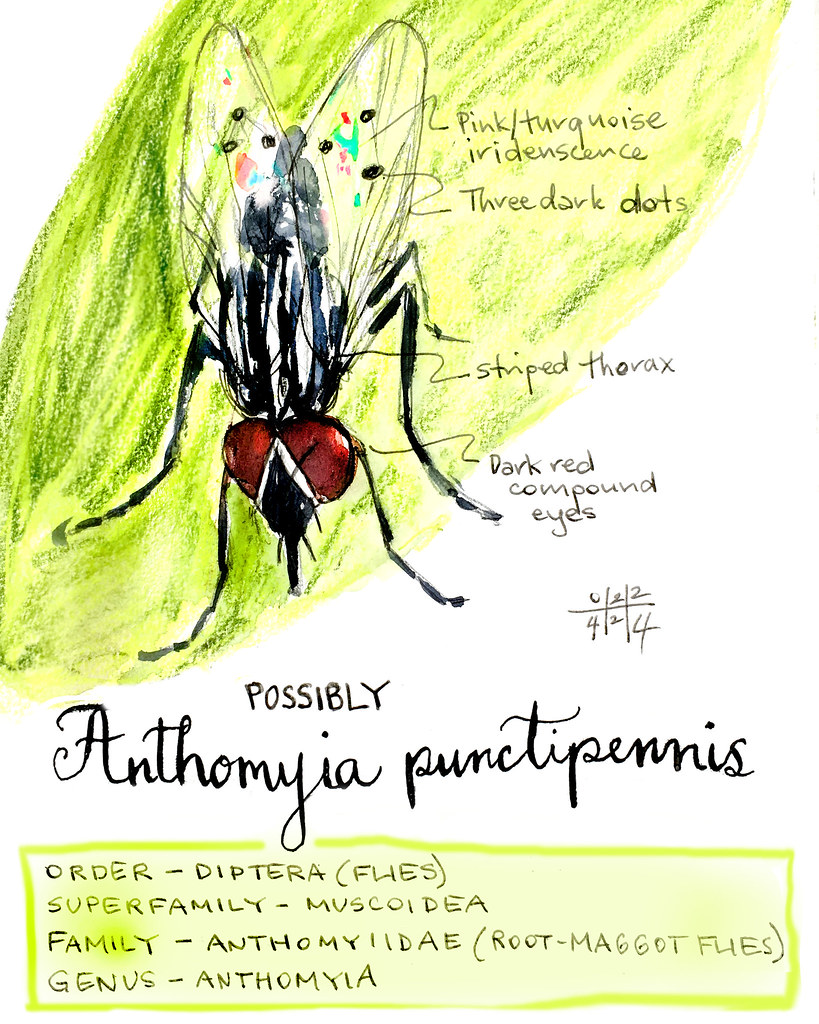
After picking sixty (60!) snails off our little orange tree this morning, I noticed this handsome fly on one of the ravaged leaves. I am no entomologist, so the ID could be wrong. Looking at the distribution map in iNaturalist, Anthomyia species are far more common in the Southern Hemisphere than the northern, so possibly I’m way off. I was attracted to the strong dark dots on the wings; I suspect that are a key feature for identification.

A rainy day is a perfect time to take a John Muir Laws class on drawing insects. Isn’t this guy kooky? Trachelophorous giraffa is endemic to Madagascar, and shouldn’t be confused with the New Zealand Giraffe Weevil (Lasiorhynchus barbicornis). In both species, the males have extremely long heads.

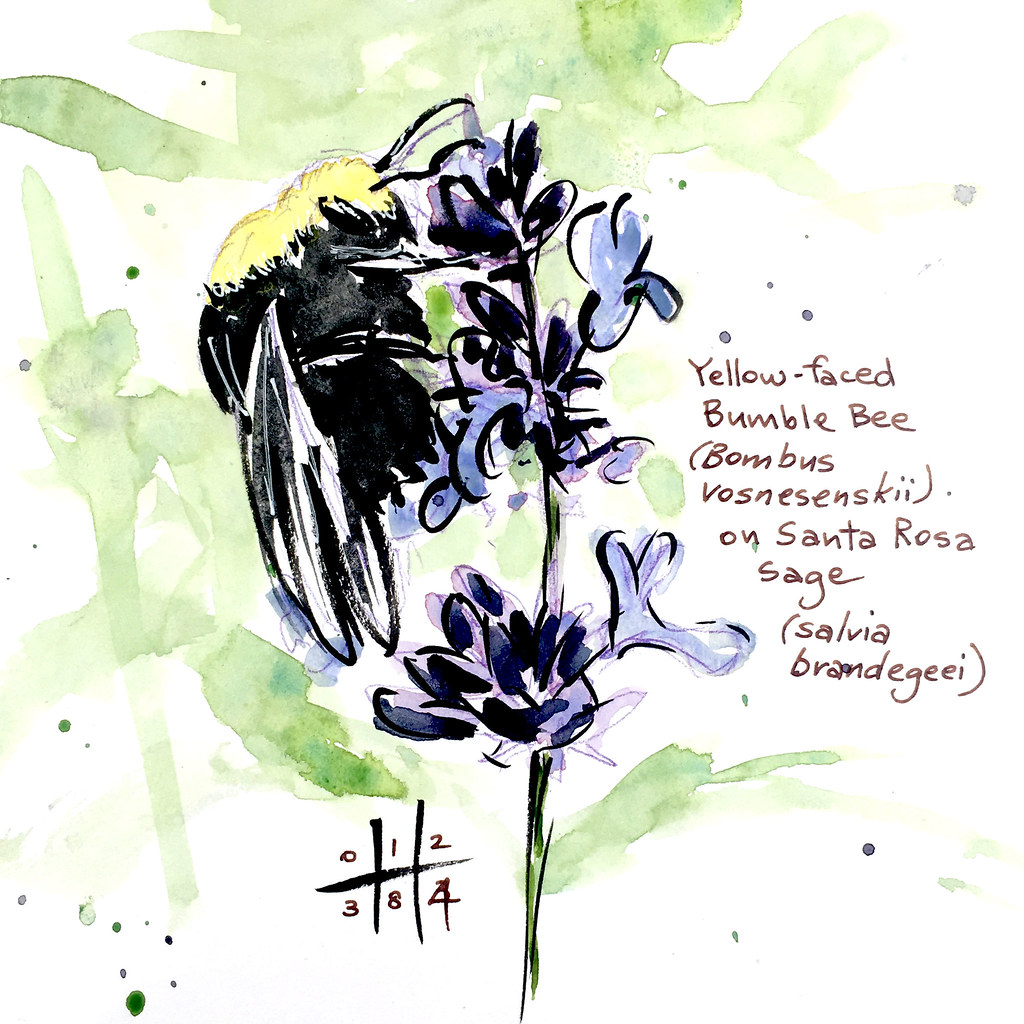
According to iNaturalist, there are 24 species of bumblebees in California. The one that is busily pollinating our sage is the Yellow-faced Bumblebee. Bombus vosnesenskii is among the most common bee species on the West Coast of the United States, and the most common bumblebee from Oregon northward. The bee nests underground, usually in colonies of 200-300 workers.


Large milkweed bugs are seed-feeders; their main diet is, not surprisingly, milkweed seeds. So I’m not sure what this lady was doing on the sweet potato vine.