Deinandra minthornii

I went on a Geology field trip with the California Native Plant Society. Besides learning a lot about our local rock formations, I was introduced to a federally endangered plant that I would have walked right past if I hadn’t been with native plant geeks. We have LOTS of tarweed growing in our mountains, but it’s the common annual type, Deinandra fasciculata. This one is a perennial woody shrub. Happy to have met it!

Heteromeles arbutifolia

I’ve blogged about toyon before, but here’s something new: The plant has been used as a treatment for Alzheimer’s by indigenous people of California, and 2016 research backs this up. Toyon contains compounds that are known to protect the blood-brain barrier, prevent the infiltration of inflammatory cells into the brain and prevent neuronal damage. This plant medicine may provide new leads for drug therapy in the disease. Cool!

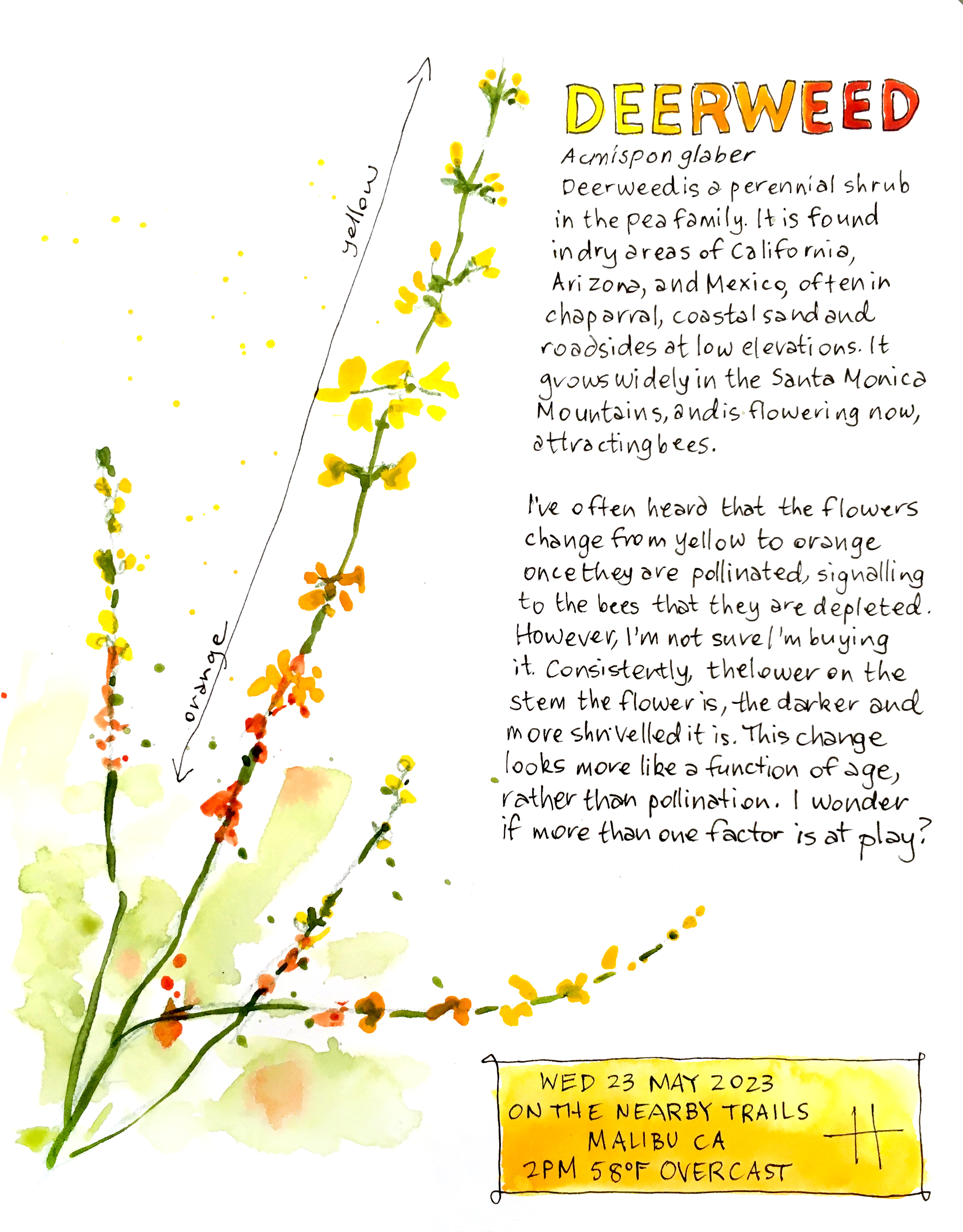
Acmispon glaber

I’ve been looking at a lot of deerweed flowers, and I’m not convinced by the prevailing wisdom about their varying colours. If an individual flower turns orange after pollination, as I’ve often heard, then I would expect to see a more random distribution of orange flowers. But it’s very consistent — the further down the stem, the darker (and more shrivelled) the flower. There are no yellow flowers down low — am I to assume that every single blossom was pollinated? And there are no orange flowers up high — why not? I see bees up high.

It really seems to me that every flower gets darker as it gets older; that it’s age, not pollination, that makes the colour change.

whodunnit

I thought this illustration might be less confronting if I left it black and white. This tidy arrangement, about half the length of my foot, was on the road near our house. I didn’t notice it on my way out for a walk, just on my way back. Could a predator have dragged it there in the middle of the morning, between my two passings? That seems pretty unlikely; I guess I just wasn’t paying attention the first time, even though our road is very narrow. I have so many questions! Who/what/when/where/why?

lizard fun

I was thrilled to see my first horned lizard on this morning’s hike with Vic and Annette. Huge kudos to A. for spotting this guy in the shadows. The Blainville’s Horned Lizard is a flat-bodied lizard with a wide oval-shaped body. Adults can vary in length from 2.5-4.5 inches / 6.3-11.4 cm (snout to vent) and have enlarged pointed scales scattered on the upper body and tail, and a large crown of horns on the head. Their biggest claim to fame is that they can squirt an aimed stream of blood from the corners of the eyes for a distance up to 5 ft / 1.5 m.

We also spotted a pair of side-blotched lizard having a cuddle in the middle of the trail. Ah, spring!

Viola pedunculata

Viola pedunculata, the Johnny jump-up, California golden violet, or yellow pansy, is a perennial yellow wildflower of the coast and coastal ranges in California and northwestern Baja California. The plant grows on open, grassy slopes, in chaparral habitats, and in oak woodlands. We see its cheerful yellow flowers in the Santa Monica Mountains from early to late spring.