

We failed to find newts, but we did come across a tiny rattlesnake coiled in the grass.
We failed to find newts, but we did come across a tiny rattlesnake coiled in the grass.

It’s been a while since I hiked Piuma Ridge Trail. Not a whole ton of wildflowers, but this one bush poppy shrub/tree was stunning.

The Wallis Annenberg Wildlife Crossing—the largest of its kind in the world—is currently under construction nearby. I climbed the hill out back and saw it in the distance, spanning the 10-lane 101 freeway. Decades in the planning and fundraising, this vital structure will protect biodiversity across the region by linking undeveloped land that‘s currently fractured by major roads. It’s hoped that it will help prevent the extinction of our threatened mountain lion population. The crossing is due to be completed some time next year.

Kim and I sat by the creek and watched the ants. What a lovely way to pass an hour.

A long time MCSP docent discovered a rare Interior Live Oak and brought us a twig to admire.

Now that the sycamores have dropped their leaves, it’s easy to see the parasitic plants. I wondered how mistletoe seeds can get a hold on the underside of their hosts’ branches. Turns out the seeds are sticky!

Lovely winter’s morning hike with many moments of delight. Lots of shades of buff, tan, and grey, but also some surprising new green popping up, despite the lack of rain so far.
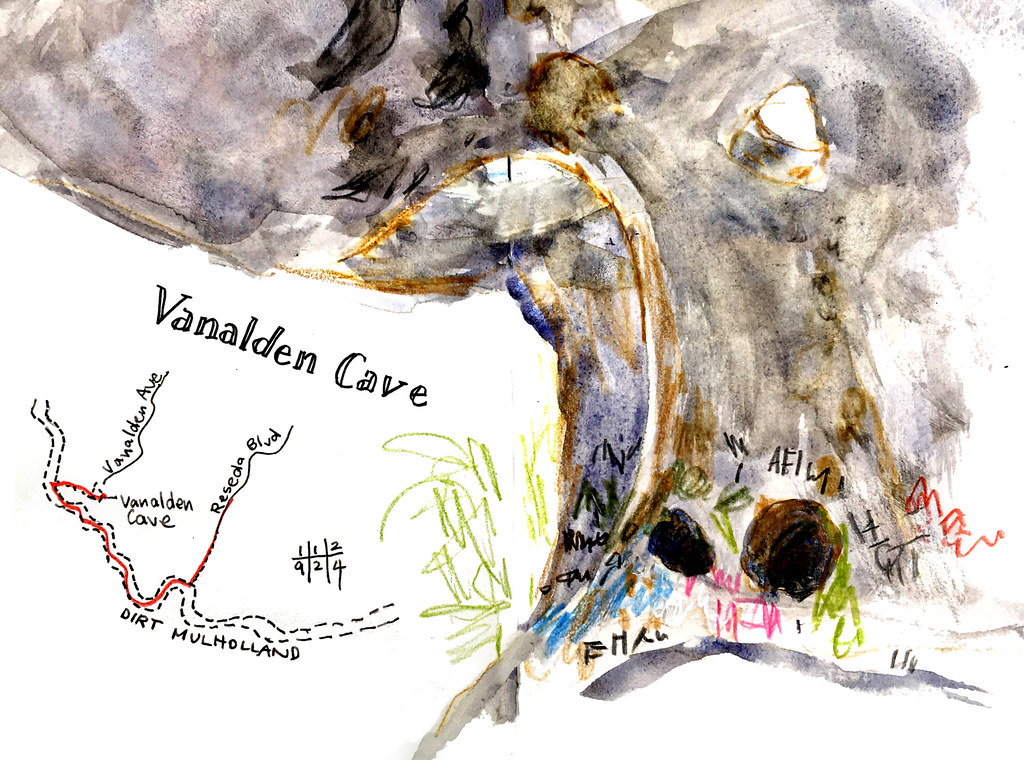
What motivates some people to take spray paint to a site of awesome natural beauty? I will never understand how that can feel good. I thought this part of the cave looked like a sad or angry face frowning down on the graffiti.

Today I returned to an old favourite, dog-friendly, fossil-laden canyon for a lovely winter hike. The landscapito at the top was sketched from the turnaround point, looking east.

The lower parts of Solstice Creek are well-visited, but not many people climb Sostomo Trail to enjoy the gorgeous crossing on the upper creek. The three of us settled into a bed of fallen sycamore leaves and enjoyed the quiet shade. I liked seeing the little backswimmers (Notonectidae family) — I’d also observed these aquatic insects in Australia.
Backswimmers, as the name implies, swim inverted, using their long hind legs to paddle vigorously. They prey on organisms as large as tadpoles and small fish and can deliver a painful “bite” to humans—actually a stab from their sharp proboscis. These insects inhabit still freshwater in lakes, ponds, and marshes, and can also be found in garden ponds and occasionally in swimming pools. Despite being primarily aquatic, backswimmers are effective fliers, allowing them to easily disperse to new habitats.
 hashiworks