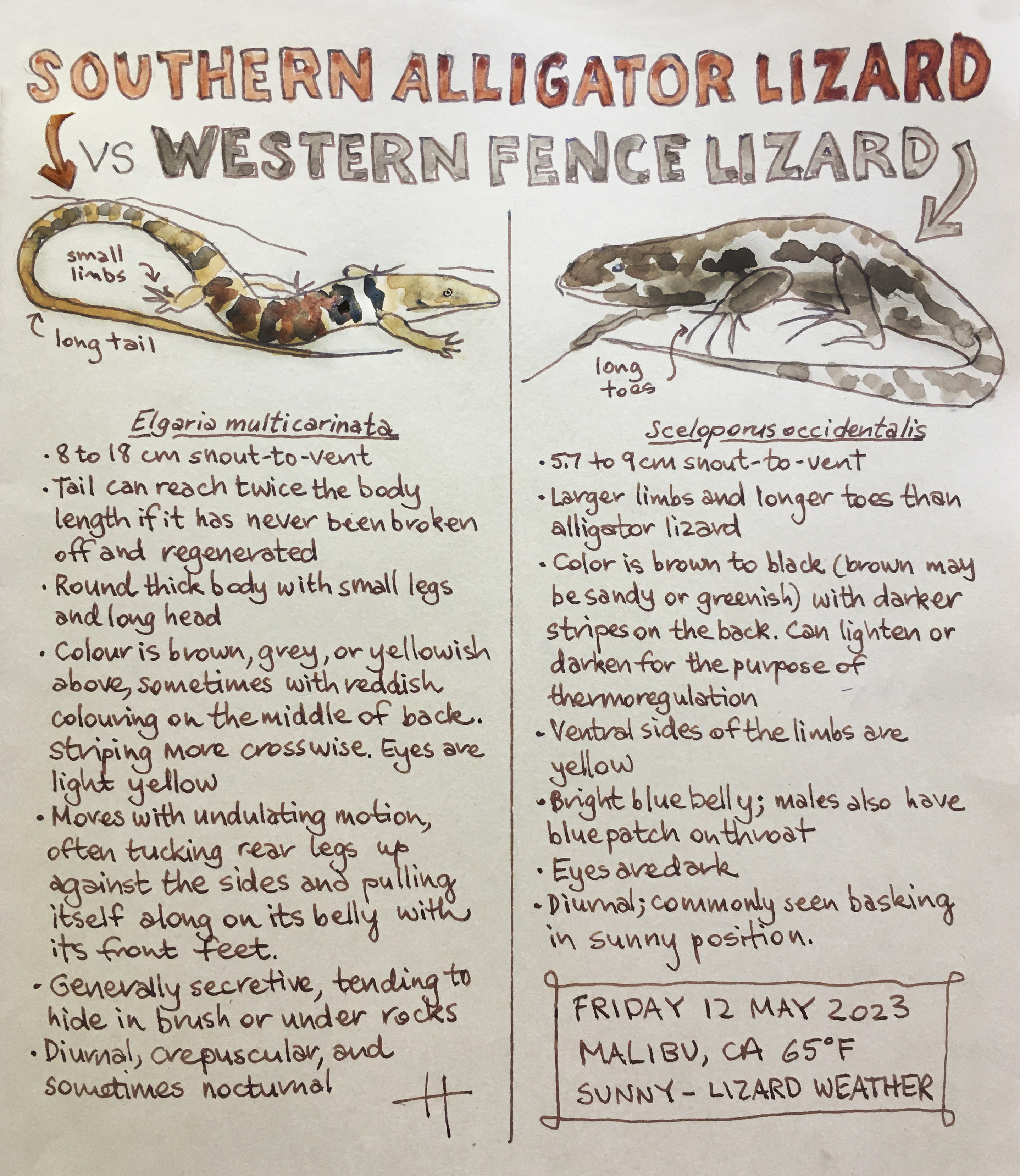
With our local lizards having such variable colouration, telling them apart is more about shape and behaviour than it is about colour or patterns. Our most commonly-seen reptile is the western fence lizard, who loves to bask in the sun, gripping with long toes or doing pushups. Alligator lizards are seen less frequently. They have long, slightly prehensile tails and a snake-like way of slithering. Now that I’ve journaled the differences, I don’t think I’ll ever get them confused.
Our friends Lola and Lynne have a Desert Tortoise (Gopherus agassizii) which they inherited from their neighbour. The species is native to the Mojave and Sonoran Deserts of the southwestern United States and northwestern Mexico. It is the official state reptile in California and Nevada.
G. agassizii lives for 50 to 80 years. Stallone is in his mid-twenties, healthy and strong. I hung out with him on their back lawn today while he munched on rose petals, his favourite snack.
I was thrilled to see my first horned lizard on this morning’s hike with Vic and Annette. Huge kudos to A. for spotting this guy in the shadows. The Blainville’s Horned Lizard is a flat-bodied lizard with a wide oval-shaped body. Adults can vary in length from 2.5-4.5 inches / 6.3-11.4 cm (snout to vent) and have enlarged pointed scales scattered on the upper body and tail, and a large crown of horns on the head. Their biggest claim to fame is that they can squirt an aimed stream of blood from the corners of the eyes for a distance up to 5 ft / 1.5 m.
We also spotted a pair of side-blotched lizard having a cuddle in the middle of the trail. Ah, spring!
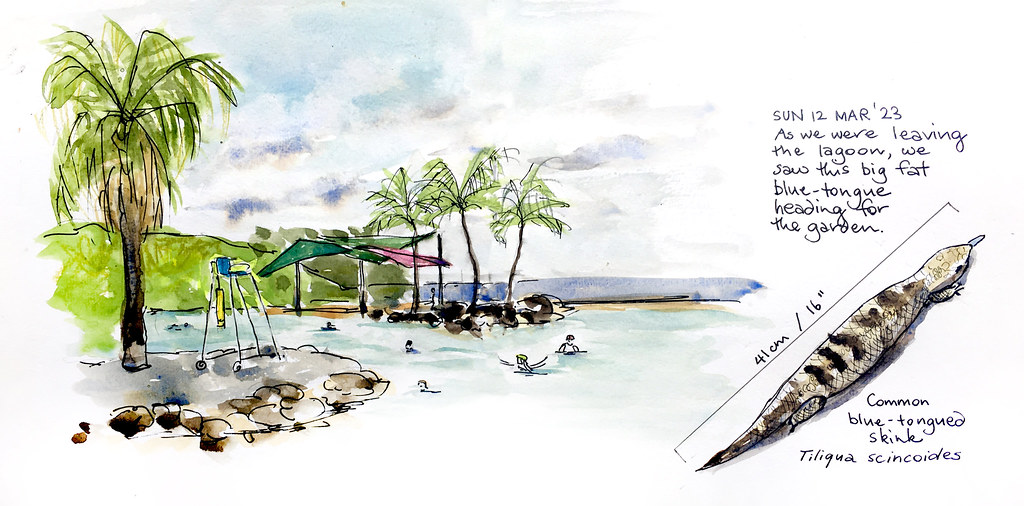
Took the kids swimming again today. I was blasé about the brushturkey and bin chickens wandering around the pool area, but was quite thrilled by the big fat bluey.
Frog photo reference: Reptiles and Frogs of the Australian Capital Territory by Ross Bennett
After identifying the frog calls from the dam — my sister is a bit of an expert — we went out and had a lovely morning walk around the Australian National University, enjoying the historic buildings, public art, and green spaces. I recognised very little from my misspent teenage years when I would illegally drink in the Union Bar.
Then we spent some time at the National Museum of Australia, always worth a visit. The café lunch was delicious and the Great Southern Land gallery impressed us both.
Miss Ten’s chosen birthday treat was a train ride to the Museum and the Gallery of Modern Art, and a picnic at South Bank. A good time was had by all.
Re the sketched reptiles (seen at the museum): Green tree pythons (Morelia viridis) occur in rainforests on Cape York Peninsula, and also in New Guinea and Indonesia. Juveniles are bright yellow but change to emerald green as adults, coinciding with a shift in diet from ground-dwelling skinks to mammals. Primarily arboreal, M. viridis has a particular way of resting in the branches of trees; it loops a coil or two over the branches in a saddle position and places its head in the middle.
The perentie (Varanus giganteus) is Australia’s largest lizard, growing up to 2.5 metres (over 8 feet) long. Perenties are powerful diggers and shelter in extensive, complex burrows when they are not out and about hunting prey. They feed on reptiles (including their own species), small mammals such as bats, young kangaroos & other small marsupials, and rodents. Prey is typically swallowed whole, but if the animal is too large, chunks are ripped off for ease of consumption. Coastal and island individuals may eat a large number of sea turtle eggs and hatchlings, and hide under vehicles to ambush scavenging gulls. Wily!
The grandkids and I took an hour and a half to walk home from school (it usually takes them about half an hour). We saw lots of interesting things on the way, including a water dragon with two tails!
I painted this for a much-loved sailor, then realized that this is not the type of turtle that lives in their waters. Oops. Hopefully the gift will still be appreciated 😊
A Southern Pacific rattlesnake came calling, but we didn’t want what he was selling. So we popped him into a lidded bucket and took him for a short ride to a better location.
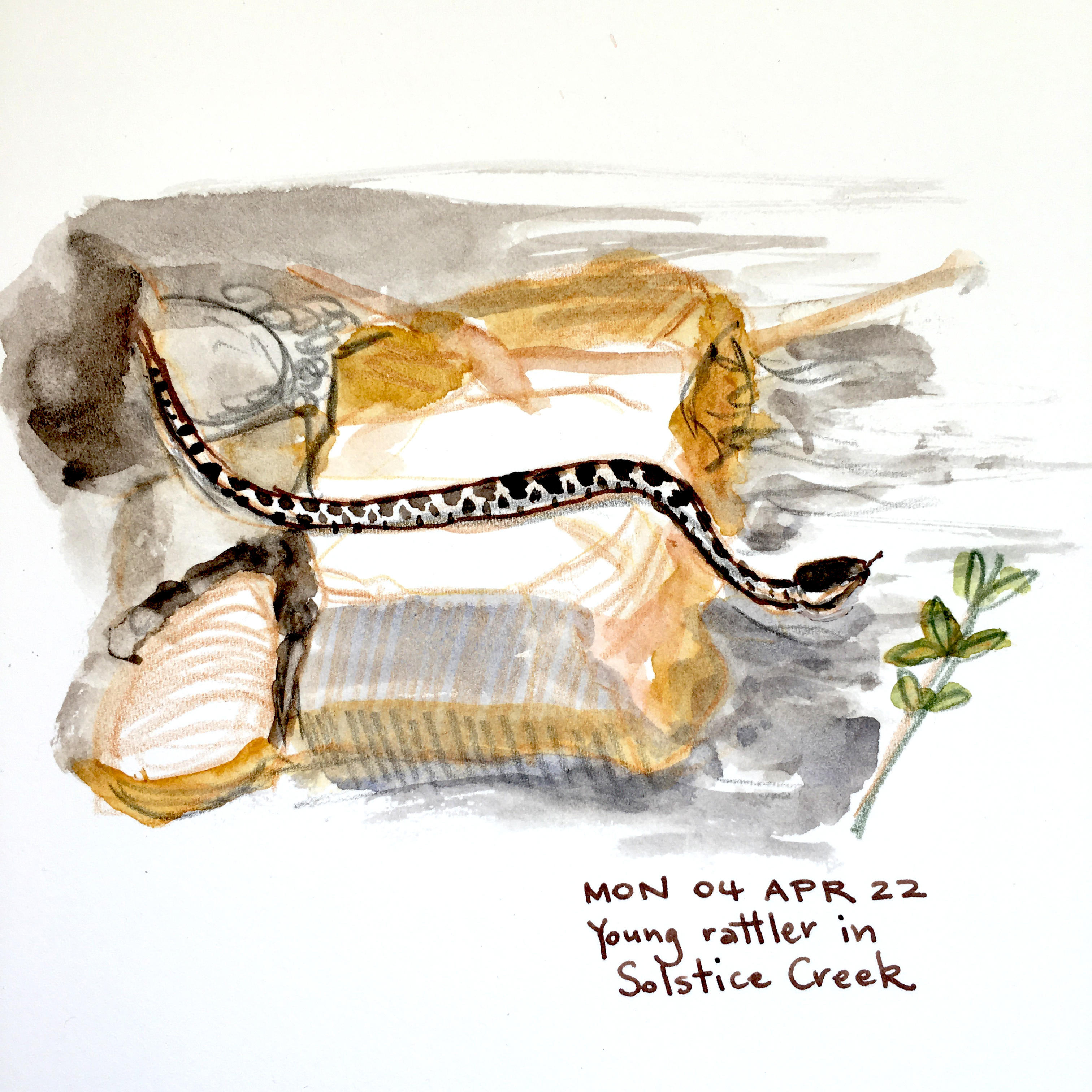
After my hike in Solstice Canyon, I had a little sit down on a rock by the creek. This fella saw me before I saw it, and froze while I took photos and did a rough sketch (completed at home). Then we both went on our merry ways.