
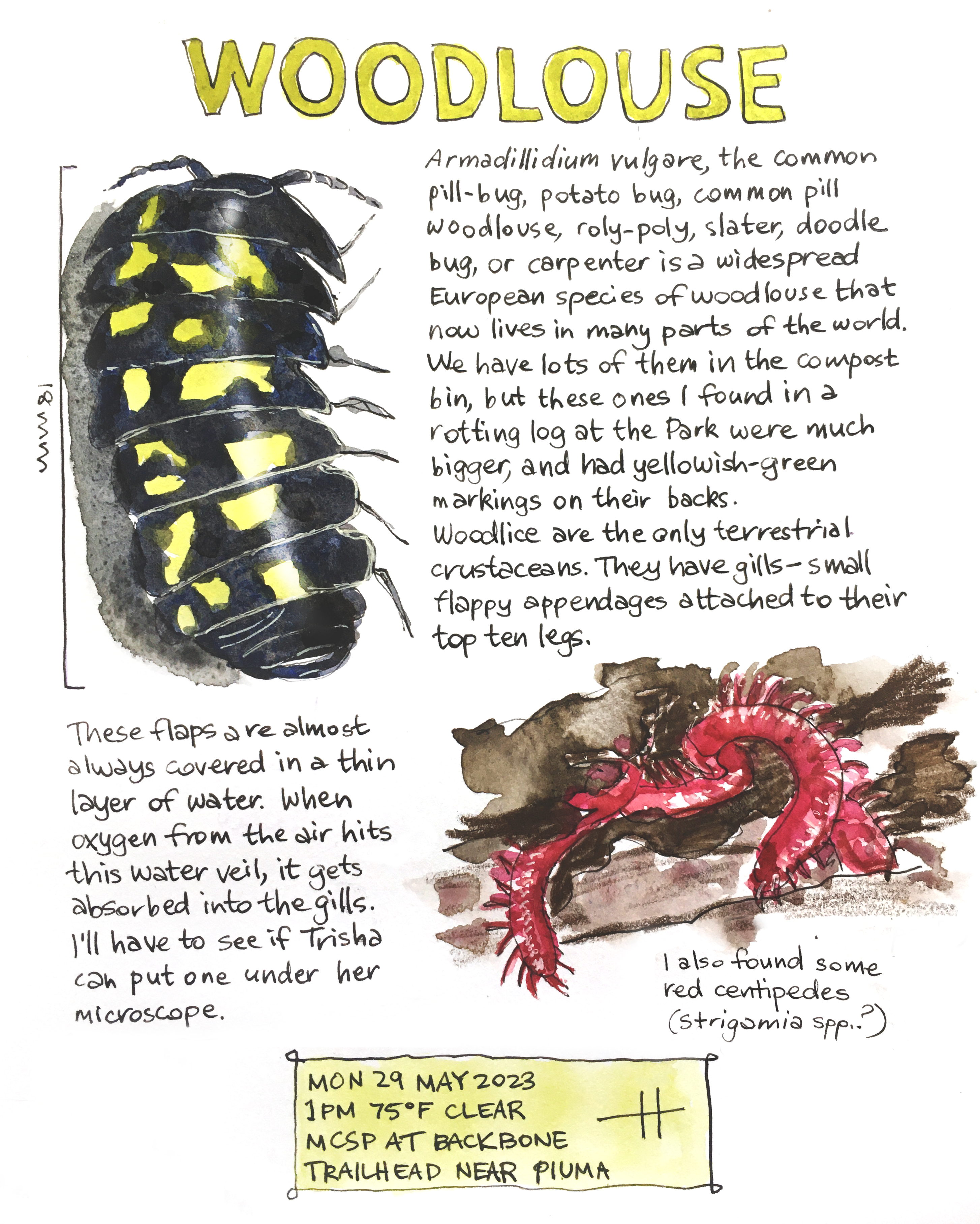
Poking around in some rotting logs, I found large woodlice and little red centipedes. Woodlice are crustaceans! They have gills! Learn something new every day.
Poking around in some rotting logs, I found large woodlice and little red centipedes. Woodlice are crustaceans! They have gills! Learn something new every day.

Having observed ladybug larvae and pupae all month, it was cool to check out an adult under Trisha’s microscope, and learn about diapause.

Happy to see Mr Hooded Oriole back in the ’hood. Is he raising a family nearby? Or was that all done elsewhere, before he arrived?

I am pretty ignorant when it comes to fungi. Fungignorant, you could say. I can’t even decide how to pronounce the word. Fun-guy? Fun-jee? Fun-gee? Funj-eye? How do YOU say it?
iNaturalist suggests this specimen might be in the genus Gymnopus, which contains about 300 species, generally found growing in leaf or woody litter. Seems plausible.
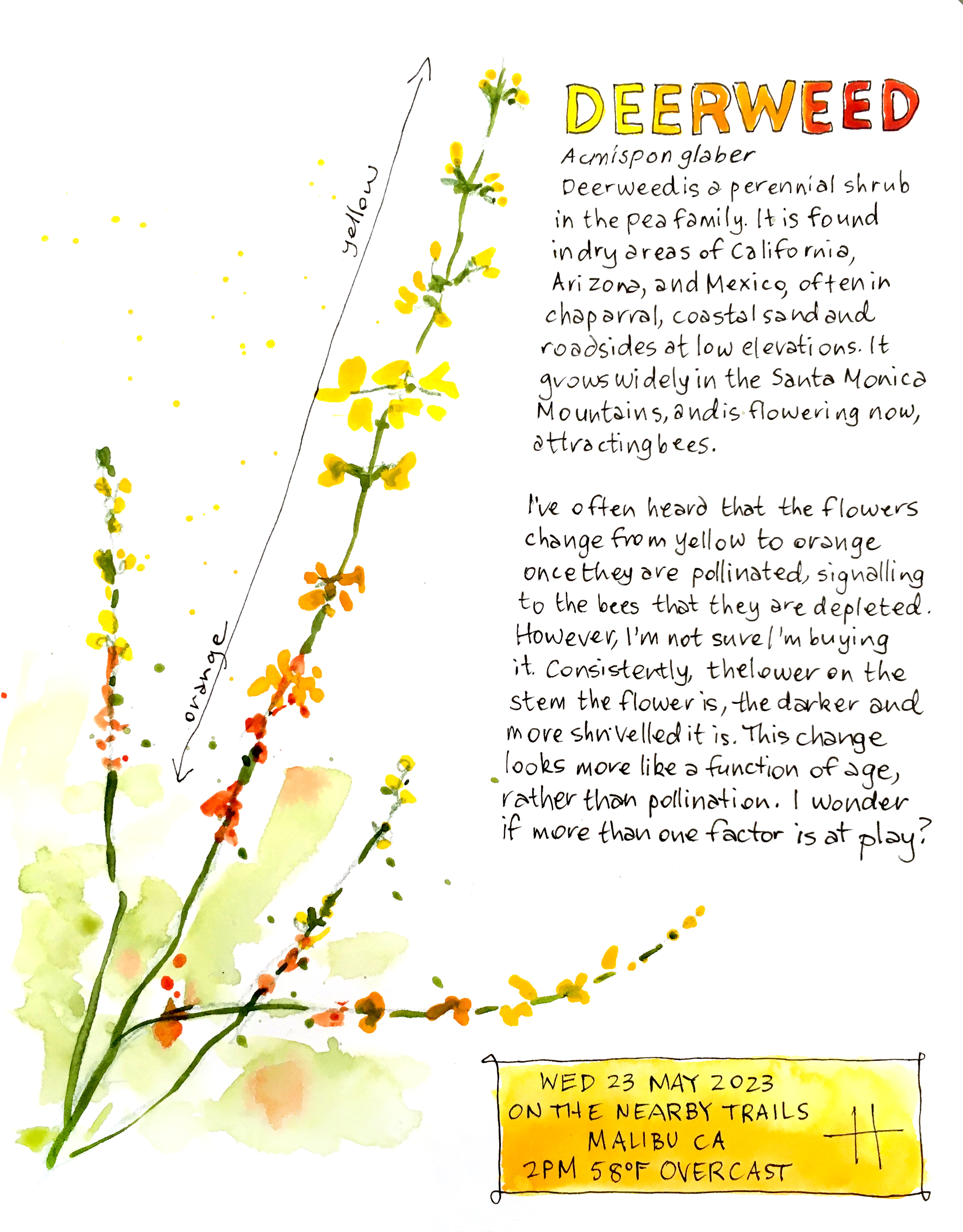
I’ve been looking at a lot of deerweed flowers, and I’m not convinced by the prevailing wisdom about their varying colours. If an individual flower turns orange after pollination, as I’ve often heard, then I would expect to see a more random distribution of orange flowers. But it’s very consistent — the further down the stem, the darker (and more shrivelled) the flower. There are no yellow flowers down low — am I to assume that every single blossom was pollinated? And there are no orange flowers up high — why not? I see bees up high.
It really seems to me that every flower gets darker as it gets older; that it’s age, not pollination, that makes the colour change.

I thought this illustration might be less confronting if I left it black and white. This tidy arrangement, about half the length of my foot, was on the road near our house. I didn’t notice it on my way out for a walk, just on my way back. Could a predator have dragged it there in the middle of the morning, between my two passings? That seems pretty unlikely; I guess I just wasn’t paying attention the first time, even though our road is very narrow. I have so many questions! Who/what/when/where/why?

In honour of International Day for Biological Diversity, here are the birds I’ve seen at home over the past couple of days. I made an attempt at relative sizing, but I think the oriole ended up a bit small.

Click to enbiggen.
We have a LOT of snails at the moment; they especially love the citrus. As I picked them off the trees this morning, I checked the whorl orientation, and yep, they were all dextral. It would be fun to see a sinistral snail! The idea makes the daily removal somewhat more interesting.

Digger bees, although solitary, nest in large aggregations. Each female digs her own tunnel, which can be up to a foot deep and have several branches. Each branch terminates in a chamber where the female lays a single egg, providing it with pollen and nectar collected from flowers. The larvae hatch and consume the stored food, then grow into pupae and then into adult bees, all while underground.
Next spring or early summer the adults will emerge, mate, and do it all over again … Right now we‘re at the mating stage, by the looks of things! I don’t know if they will re-use the existing tunnels or dig new ones. I‘ll keep checking on them.
There are also a few bee flies (possibly tribe Villini) hovering about at ground level. The larval stages of bee flies are predators or parasitoids of the eggs and larvae of other insects. The adult females usually deposit eggs in the vicinity of possible hosts, quite often in the burrows of beetles or wasps/solitary bees. So I’m pretty sure that’s what they’re looking to do! It’s a fly-eat-bee world.

Click to enbiggen.

