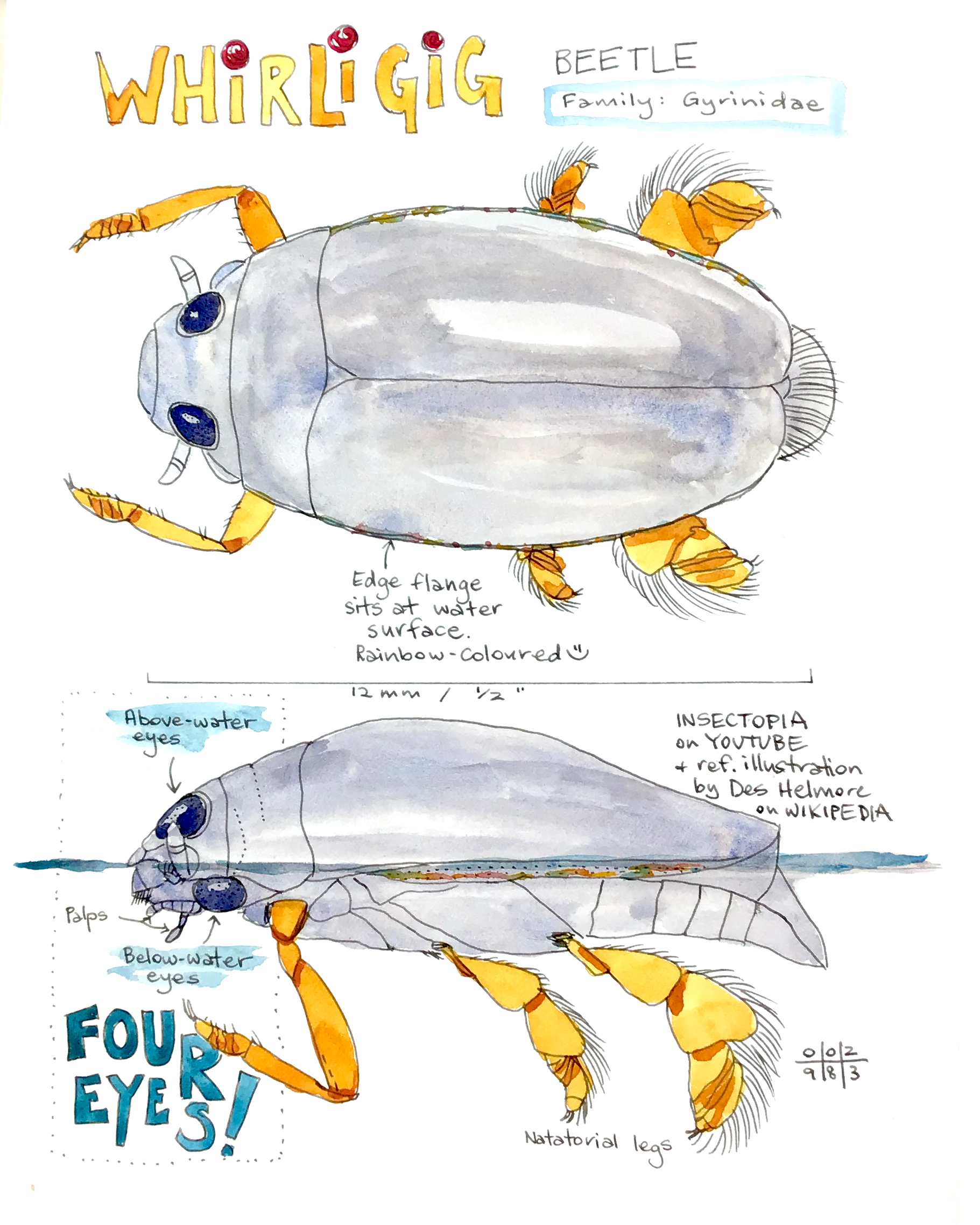
Interesting that this insect has a mouth, and palps, even though it doesn’t eat. Evolution hasn’t caught up!
When drawing the legs, I suddenly remembered reading, and loving, Tom Robbins’ Skinny Legs and All decades ago. I should re-read it and see if I’m still a fan.
Here’s something strange: the compound eyes of a whirligig beetle are divided into a higher part that is above water level when the beetle is floating passively, and a lower part that sits below water level. Gyrinidae are the only type of beetle with this feature.
The antennae are also unusual among beetles, being short and plump, and placed about at water level.
Whirligigs get their common name from their habit of swimming rapidly in circles when alarmed. Adults carry an air bubble under the elytra at the tip of their abdomen, allowing them to breathe underwater. They are very social creatures, often found in large numbers swimming around on the water’s surface. There are about 700 species worldwide.
Here’s something interesting: hornworms’ hemolymph (blood) is blue, coloured by a protein called insecticyanin. The foliage they eat contains carotenoids, which are primarily yellow in hue. The resulting combination (blue + yellow) gives them their green colouring. If fed a wheatgerm-based diet in a lab, these caterpillars are turquoise due to the lack of carotenoids in their diet.
Both tobacco hornworms and the very similar tomato hornworms are big fans of Solanaceae (nightshades like tomatoes, potatoes, peppers, tobacco), but they also eat crucifers, legumes, eucalyptus, ficus, and other plants.
Halysidota tessellaris, the banded tussock moth, is found in North America from southern Canada south through Texas and central Florida. Adult moths are attracted to decaying plants with pyrrolizidine alkaloids. They regurgitate on them, then drink the fluids, and thus acquire defensive chemicals that offer protection from predators.
Megalopyge crispata, the black-waved flannel moth, is found along the east coast of the United States, and as far inland as Oklahoma. The caterpillars produce a venom, delivered through hollow hairs that penetrate the skin, that can cause pain, headache, inflamed lymph glands and dermatitis. They may look cute and furry, but don’t go petting them!
Digger bees, although solitary, nest in large aggregations. Each female digs her own tunnel, which can be up to a foot deep and have several branches. Each branch terminates in a chamber where the female lays a single egg, providing it with pollen and nectar collected from flowers. The larvae hatch and consume the stored food, then grow into pupae and then into adult bees, all while underground.
Next spring or early summer the adults will emerge, mate, and do it all over again … Right now we‘re at the mating stage, by the looks of things! I don’t know if they will re-use the existing tunnels or dig new ones. I‘ll keep checking on them.
There are also a few bee flies (possibly tribe Villini) hovering about at ground level. The larval stages of bee flies are predators or parasitoids of the eggs and larvae of other insects. The adult females usually deposit eggs in the vicinity of possible hosts, quite often in the burrows of beetles or wasps/solitary bees. So I’m pretty sure that’s what they’re looking to do! It’s a fly-eat-bee world.




 hashiworks