

Happy to see Mr Hooded Oriole back in the ’hood. Is he raising a family nearby? Or was that all done elsewhere, before he arrived?
Happy to see Mr Hooded Oriole back in the ’hood. Is he raising a family nearby? Or was that all done elsewhere, before he arrived?

In honour of International Day for Biological Diversity, here are the birds I’ve seen at home over the past couple of days. I made an attempt at relative sizing, but I think the oriole ended up a bit small.

Fun morning sighting. I only ever see one thrasher at a time, usually dashing across the driveway, so I don’t know if there are multiples here. But I’m always happy to spot this mockingbird relative.

I’ve been seeing the osprey hanging about this month, but my eyes and camera aren’t up to the task of recording the finer details. Big thanks to local birder-photographer Chris Tosdevin for this great original image; I had fun sketching it.

Great-tailed grackles do indeed have great tails—they can fold them in half to make a vertical presentation. These birds are larger than starlings but smaller than crows. Males are iridescent black which sometimes has them simply called “blackbirds”. Females are brown with darker wings and tail.
It’s breeding season, and there’s a lot of grackle activity (and song!) going on at Legacy Park, where they are sharing space with red-winged blackbirds, another beautiful and melodious black bird.
Photo reference: Vivek Khanzodé

A stormy afternoon is the perfect time for an online art class.

Today we took the kids to the Museum of Brisbane (we all loved the PlayMoves installations), then to SparkLab at the Queensland Museum, then for a swim at South Bank. It was a long, fun day, and we’re all tired.
This has been an absolutely wonderful vacation. I fly home tomorrow ✈️.
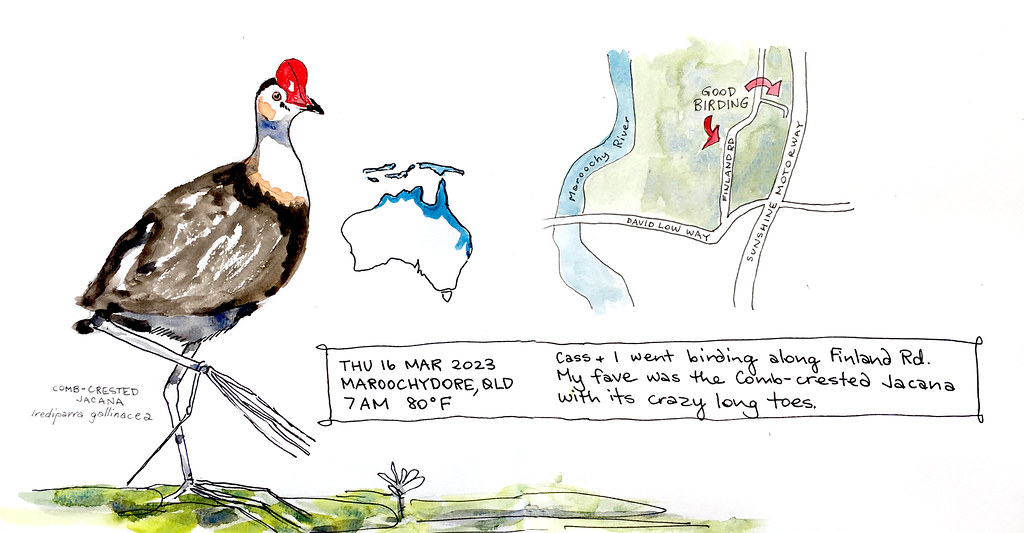
This morning, Cass took me to one of her favourite nearby birding spots, where I was delighted by the Comb-crested Jacanas, Irediparra gallinacea. Look at those feet, evolved for walking on water plants!
By late morning I was at Samford Conservation Park, meeting up with artist and environmental educator Bethan Burton. She’s a treasure! Our few hours together weren’t nearly enough. We observed an interesting butterfly whose forewings seemed to be transparent; she later texted me an ID: Cressida cressida, the Clearwing Swallowtail or Big Greasy — funny name! Gorgeous butterfly! Lovely woman!

I saw these ducks down by the lake today, and I’m not sure what they are. Yellow beak, black head, no white neck ring. Perhaps a hybrid of a mallard and something else? Or are they mallards in ‘eclipse plumage’?

The kids and I went for a wander by Freshwater Creek, them to play, me to count birds. We had some debate about whether the black-and-white bird whose mud nest Felix found was a peewee or a magpie-lark. We were both right.
We also saw (or heard) tawny frogmouths, pied currawongs, rainbow lorikeets, grey shrike-thrushes, spangled drongos, noisy miners, rock pigeons, brush-turkeys, crows, wood ducks and purple swamp hens.

