

I’ve been adding a whole romaine lettuce plant to my green smoothie every morning, trying to eat them all before they seed. Four left to go!
I’ve been adding a whole romaine lettuce plant to my green smoothie every morning, trying to eat them all before they seed. Four left to go!

Well, I actually enjoyed American Pastoral much more than I did back in 2008, when I gave it one star (I wrote then: “The premise of this book was interesting, but it was way, way too wordy … Roth just goes on and on and on with boring details about people that aren’t even seminal to the story. Unimpressed.”)
And, as always, my appreciation was enhanced by a two hour discussion with the smart, widely-read, cosmopolitan folks in my book group. I don’t always sketchnote our meetings, but I’m always glad when I do.

I’ve been working on this one-pager to use on our school walks — a limited field guide to the plants the kids might see year-round in the most accessible areas. It might have to expand to two pages; I have thought of more things to add!

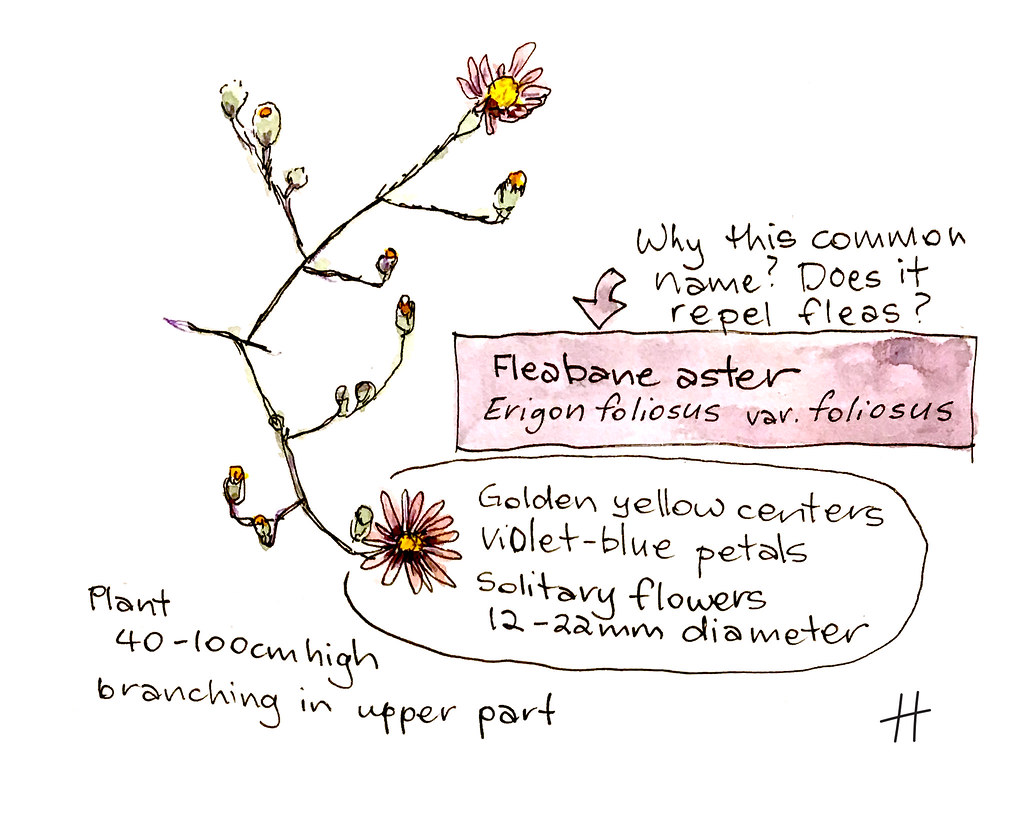
There are quite a few plants in the Asteraceae family with the common name ‘fleabane’. It was once thought that these daisies would rid your house of fleas; this belief apparently now lives in the realm of ‘superstition.’
There aren’t many wildflowers around here at this time of year, so it’s even more enjoyable to see these delicate beauties. Erigeron foliosus is native to western North America from Oregon, through California, into Baja California. It can be found in many habitats, including chaparral, oak woodlands, and rocky talus.

This handsome, clever, bossy corvid has been absent from our garden for a few months, but is back this week. California (formerly “Western”) Scrub-Jays are not migratory, so I’m not sure where ours have been hanging out of late. I’m guessing they were raising a brood on a neighbouring property.
Studies show that scrub-jays are among the most intelligent of animals. The brain-to-body mass ratio of adult scrub-jays rivals that of chimpanzees and cetaceans, and is dwarfed only by that of humans. Welcome back, smartypants!

Interesting that this insect has a mouth, and palps, even though it doesn’t eat. Evolution hasn’t caught up!
When drawing the legs, I suddenly remembered reading, and loving, Tom Robbins’ Skinny Legs and All decades ago. I should re-read it and see if I’m still a fan.

The Western Snowy Plover nests on open sand, so it’s extremely vulnerable to human impacts, both direct and indirect. For example, the kelp that is washed ashore is browsed upon by many insects and crustaceans. These invertebrates are a primary food source for plovers and other shore birds, so “cleaning up” the wrack removes a key element in the food chain. A more indirect impact: the population explosion of crows and ravens — caused by the abundant food sources offered by humans — has greatly multiplied a major plover predator.
At current counts, there are less than 2500 Western Snowy Plovers throughout their coastal range (a population of 3000 is the minimum goal) and their habitat continues to shrink. So if you see a cable fence on your local beach, be sure to stay out of the nesting zone to give these vulnerable (and adorable) birds a chance to breed and thrive.
Thanks to Kriss Neuman of Point Blue Conservation Science for a fascinating lesson. Thanks to John Muir Laws for his drawing tips.


A year-and-a-bit ago, I signed up to re-do all the internal signage in our state park visitor center, to make it consistent and professional. Today I installed Phase 2 of the project, including this new, double-sided sign on the door of the children’s nature room.
Working as a volunteer at Malibu Creek State Park is such a joy for me, a great fit for my skills and passions. Sometimes I can’t believe I get to live this life. So so lucky, am I.

I’ve really enjoyed seeing, and smelling, the vinegarweed that‘s now running riot at the State Park. This annual herb, a member of the mint family, is native to California, though it occurs in other parts of the western U.S. Its preferred habitats are coastal sage scrub, oak woodland, foothill woodland, and chaparral.
The volatile oils in its foliage have a strong vinegar odour, which grazing animals find unpalatable but I quite enjoy sniffing.
Vinegarweed is an important late summer pollen source for native bees and other insects. When a pollinating insect lands on the lower lobes of the corolla, and inserts its mouth parts into the nectar-containing section, the narrow corolla portion above is straightened and snaps rapidly downward brushing pollen onto the insect’s back. Nature never ceases to amaze.

