This little cutie has been hanging out on my desk for a few days. I’m not 100% certain of the ID but it’s my best guess. The red-backed jumping spider is one of the largest* and most commonly encountered jumping spiders in California. In 2012, NASA sent one into space!
I thought I’d learn a bit more about our most common spider, the ubiquitous daddy long-legs, also known as the cellar spider. As a synanthrope (an organism that lives near and benefits from humans and their environmental modifications), these spiders can be found on every continent in the world. They prefer the warmth inside human dwellings; daddy long-legs living outdoors can be found in the dimly-lit, calm environment of caves and in between rock crevices.
It takes about one year for these spiders to mature after they are born, and their life span can be two years or more post-maturity.
There is a common misconception that this spider’s venom is extremely dangerous but that their fangs are too short to pierce human skin. Neither statement is true. The fangs are longer (0.25mm) than the epidermis is thick (0.1mm); the venom has a negligible effect on mammals, including humans. So let’s put that urban legend to bed.
Even big Californian spiders are small by Australian standards, so it’s hard to get excited about them. But this one’s pretty cool, with its shiny mother-of-pearl cephalothorax.
There were a bunch of these tiny orb weavers inside a dead maguey leaf (Agave americana). One was green, but most were pretty well camouflaged. So cute!
Bodie is a herding dog, not a hunting dog. So it was very surprising when she sniffed in the grass beside the trail, then suddenly lunged and caught a rodent of some kind. It was bigger than a mouse, but smaller than a gopher, and its tail was shorter than a rat’s but not gopher-like. She ignored my commands to drop it, and crunched for a minute before swallowing it. Ugh! Sorry, little critter!
There are sooooo many golden orb weavers (Trichonephila edulis) here in the Australian sub-tropics at this time of year; every garden sports half a dozen or more, it seems. Their tangled webs are large, strong and sticky, so one needs to be careful when walking outside in the dark. The spider’s bite is not venomous, though it can cause pain and swelling. Perhaps you’d like to try biting back: edulis means edible. The spider has apparently been considered a delicacy in Papua New Guinea and New Caledonia, plucked by the legs from its web and lightly roasted over an open fire.
The koala (Phascolarctos cinereus) on the other hand, is much harder to spot. So I was pretty happy when all my neck-craning paid off this afternoon, down by the creek.
Even though Trisha is an entomologist, not an arachnologist, sometimes she treats us to a spider under the microscope.
Long-jawed orb-weavers vary in appearance, but those most commonly found are long-legged, thin-bodied spiders. When at rest, they may cling lengthwise along a twig or blade of grass, holding on with the short third pair of legs while the long pairs of legs are extended. They typically live in meadows near water, and around the banks of waterways (rivers, lakes, swamps), usually on low-hanging branches and reeds. These spiders will bite if threatened, but the bite is not harmful to humans.
Enjoying the rainbow lorikeets (Trichoglossus moluccanus) in the palm trees at dawn.
This guy was on the kitchen floor this morning, barely alive. I thought it was a leaf and picked it up, then noticed a leg waving weakly. I put it outside and it must have recovered somewhat because when I came back with my sketchbook, it was gone.
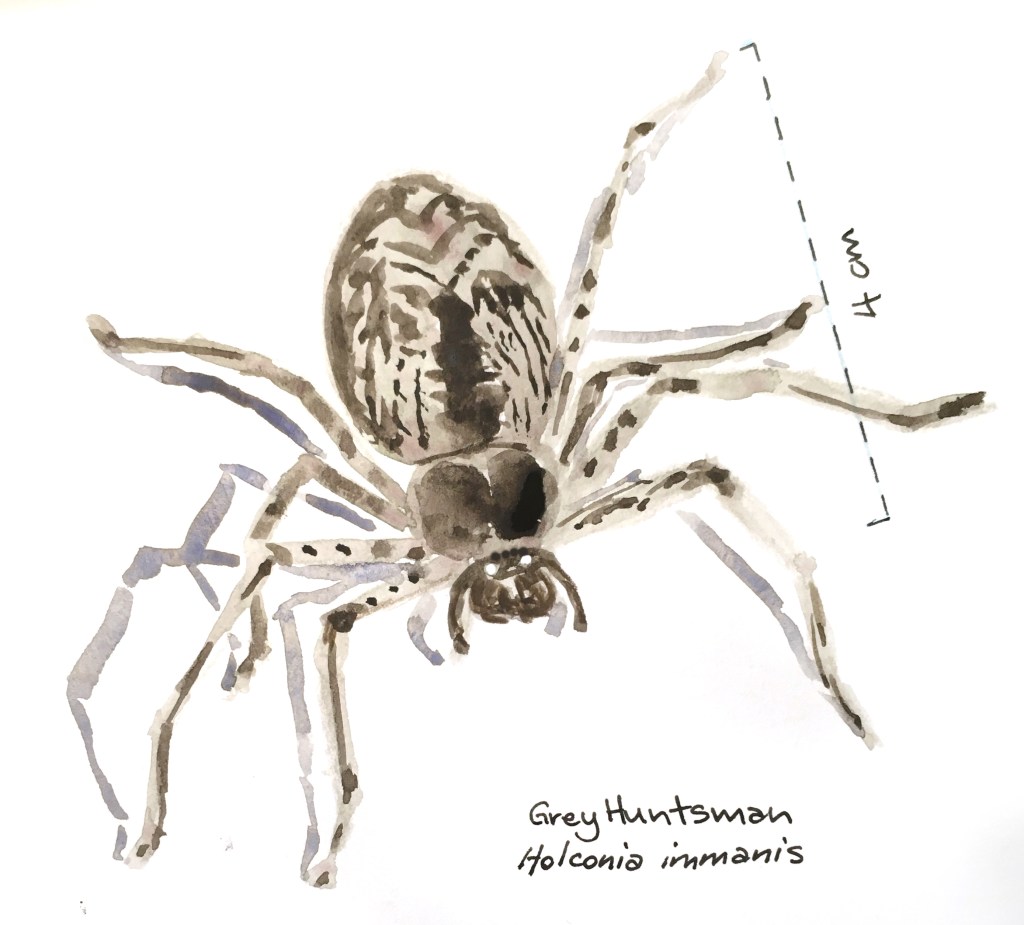
Only a few more days in Aus, so it may be my last honking big spider for a while.
This big beauty is high on the bathroom wall in our current lodgings, quietly minding her own business.
Lisa Vankula-Donovan (on Instagram as @wannabe_entomologist) is my hunstman-whispering hero. I don’t know how she gets them to walk calmly over her; they usually scoot rapidly away when approached.
I think this Golden Orb Weaver is Trichonephila plumipes, sometimes called a Tiger Spider. Its web glows yellow, and the legs are a light orange colour, black at the joints. Big spiders are so impressive! This type is not confined to the tropics, so I hope to see more when travel to the sub-tropics.
There are some 750 different types of pandanus; I have no idea which one I was sketching! I love their aerial prop roots.




 hashiworks