

This guy was poking his head out of the long grass as I went by. I hope he’s living up to his name and eating lots of gophers!
This guy was poking his head out of the long grass as I went by. I hope he’s living up to his name and eating lots of gophers!

During the rains we had a surprise visitor, a blind snake! It’s our first time seeing this earthworm-looking reptile. Rena humilis is found in the southwestern United States and northern Mexico. It lives underground, sometimes as deep as 20 metres (66 ft). Having no need for vision, its eyes are vestigial, just two light-detecting black spots. The skull is thick to permit burrowing.
Its diet is made up mostly of insects and their larvae and eggs. It is found in deserts and scrub where the soil is loose enough to work, so I’m not sure what it was doing in our living room! I moved it outside, and noticed that my hands smelled like mushrooms afterwards. Very earthy.

This was the second little snake in our empty pool before Hurricane Hilary blew into town. Two new-to-us reptiles in one night! Very cool.

Yesterday was our annual brush-clearing day. Sadly, the labourers did not share our respect for rattlesnakes.

I asked my herpetologist buddy about this pulsing behaviour, and he said he had observed it in several species, including gopher snakes. No good theory on why they do it. He added that there’s a ton we don’t know about snake behaviour.

K was exercising in the living room, when he suddenly yelped. It seemed he had somehow squashed a side-blotched lizard. Sad for the lizard, but good for me! If I get the opportunity to closely examine a critter, I’ll take it.
This little guy is named for the dark blue smear behind the front legs. More impressive is the iridescent turquoise speckling on the back.

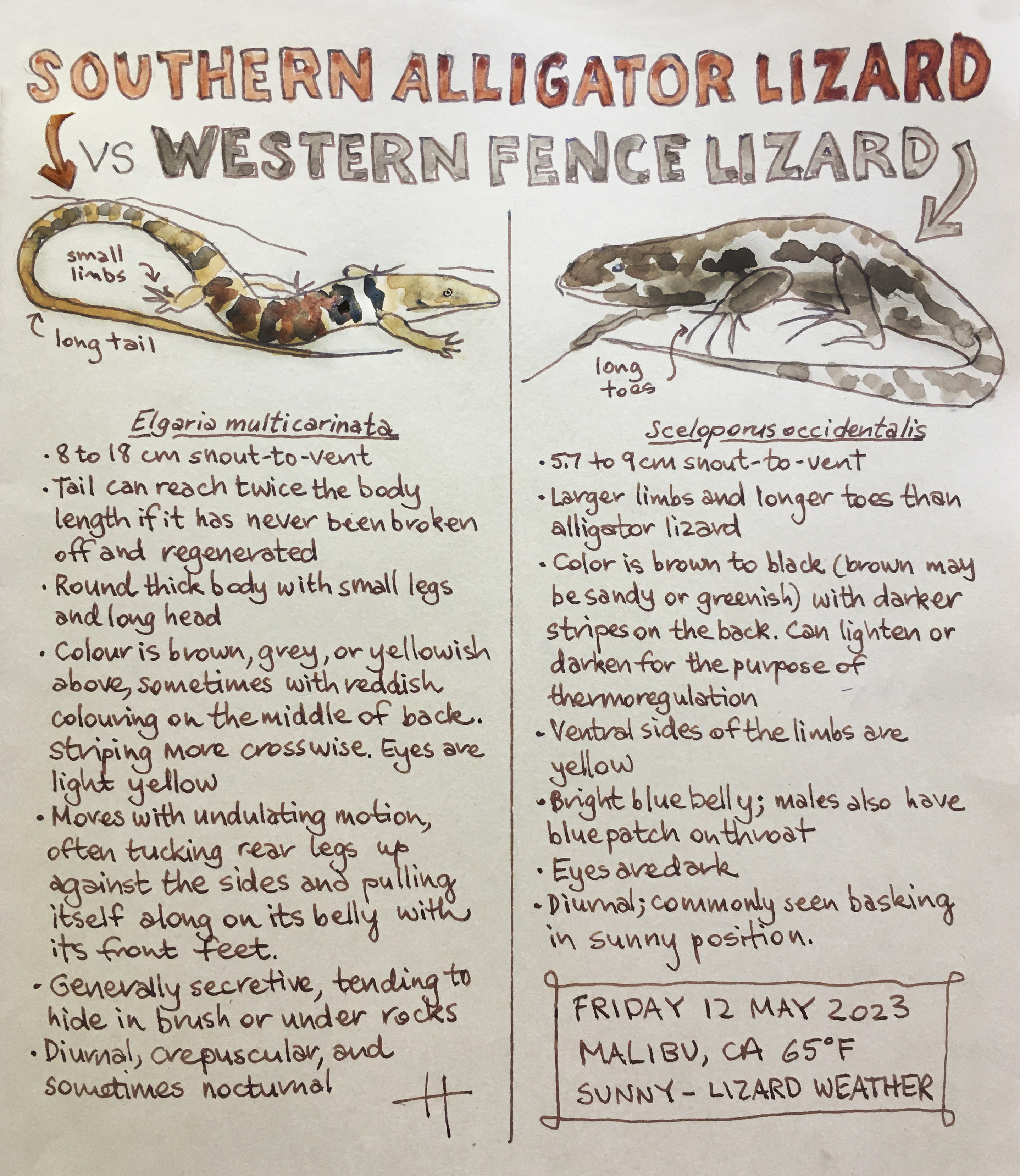
With our local lizards having such variable colouration, telling them apart is more about shape and behaviour than it is about colour or patterns. Our most commonly-seen reptile is the western fence lizard, who loves to bask in the sun, gripping with long toes or doing pushups. Alligator lizards are seen less frequently. They have long, slightly prehensile tails and a snake-like way of slithering. Now that I’ve journaled the differences, I don’t think I’ll ever get them confused.

Our friends Lola and Lynne have a Desert Tortoise (Gopherus agassizii) which they inherited from their neighbour. The species is native to the Mojave and Sonoran Deserts of the southwestern United States and northwestern Mexico. It is the official state reptile in California and Nevada.
G. agassizii lives for 50 to 80 years. Stallone is in his mid-twenties, healthy and strong. I hung out with him on their back lawn today while he munched on rose petals, his favourite snack.

I was thrilled to see my first horned lizard on this morning’s hike with Vic and Annette. Huge kudos to A. for spotting this guy in the shadows. The Blainville’s Horned Lizard is a flat-bodied lizard with a wide oval-shaped body. Adults can vary in length from 2.5-4.5 inches / 6.3-11.4 cm (snout to vent) and have enlarged pointed scales scattered on the upper body and tail, and a large crown of horns on the head. Their biggest claim to fame is that they can squirt an aimed stream of blood from the corners of the eyes for a distance up to 5 ft / 1.5 m.
We also spotted a pair of side-blotched lizard having a cuddle in the middle of the trail. Ah, spring!
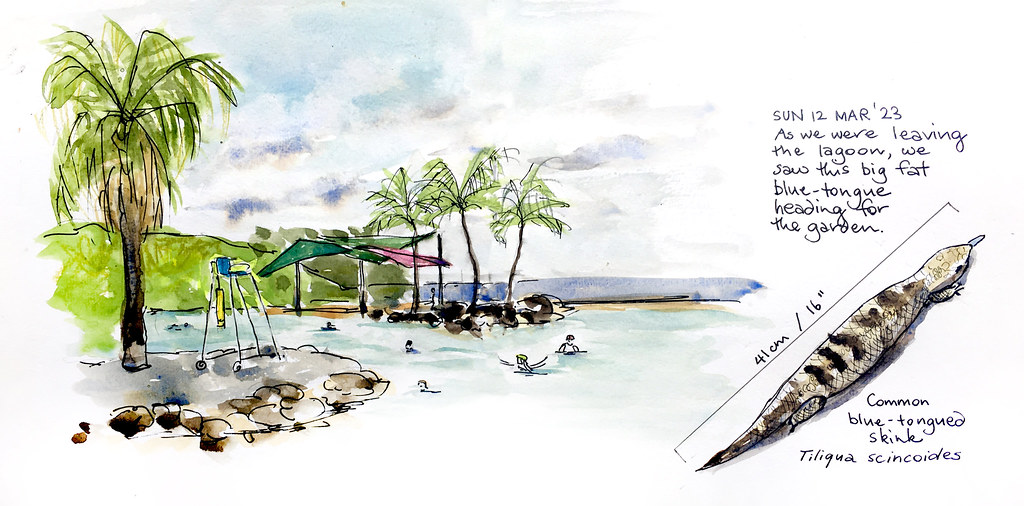
Took the kids swimming again today. I was blasé about the brushturkey and bin chickens wandering around the pool area, but was quite thrilled by the big fat bluey.
 hashiworks