

This beetle’s name literally means big mouth fire buttocks. Quite an impressive moniker for a critter that’s only 1cm long. Small but mighty, indeed.
This beetle’s name literally means big mouth fire buttocks. Quite an impressive moniker for a critter that’s only 1cm long. Small but mighty, indeed.

New-to-me beetle in the kitchen last night.

I had my first ocean swim of the year today, preceded by litter pickup and followed by bird-sketching. All in all, a lovely morning.

It’s funny, I think of orb weavers as being honking big spiders, but of course they come in all sizes. This one was only 1/8″ / 3mm long. Those are not googly eyes at the front; they are the pedipalps.
After reading that these orb weavers are called ‘trashline’ because of the debris they collect in a straight line in their webs, I went looking in the yard for them, and found a couple more. Noticing leads to learning leads to awe leads to more noticing, a delightful virtuous circle.

The native milkweed hosts lots of critters, some beneficial to it, some harmful. The most famous is the monarch butterfly (both larval and adult stages) but it’s a bit late in the year for them now.

Americans have a tendency to call all insects “bugs”. I first thought the terms were interchangeable, but I’ve learned that while all bugs are insects, not all insects are bugs.
The key difference between true bugs and other insects is their mouth parts. True bugs have rigid piercing/sucking mouthparts that look like a long beak and act like a straw. Most suck plant juices, but some feed on animals. Water bugs are venomous; they liquify then drink their prey. Yum!
Thanks to Trisha Nichols for another fun and informative lesson.

I often see this raptor at the lagoon, always solo.
The osprey (Pandion haliaetus), also called sea hawk, river hawk, and fish hawk, is a diurnal, fish-eating bird of prey. It’s large, reaching more than 60 cm (24 in) in length and 180 cm (71 in) across the wings.
The osprey is unusual in that it is a single living species that occurs nearly worldwide. Another oddity: osprey and owls are the only raptors whose outer toe is reversible, allowing them to grasp their prey with two toes in front and two behind. This is particularly helpful when they grab slippery fish.

It’s National Moth Week! I haven’t yet seen any awesome moths lately, so here’s one from last August … but I did see a tarantula hawk today, so that was pretty cool!
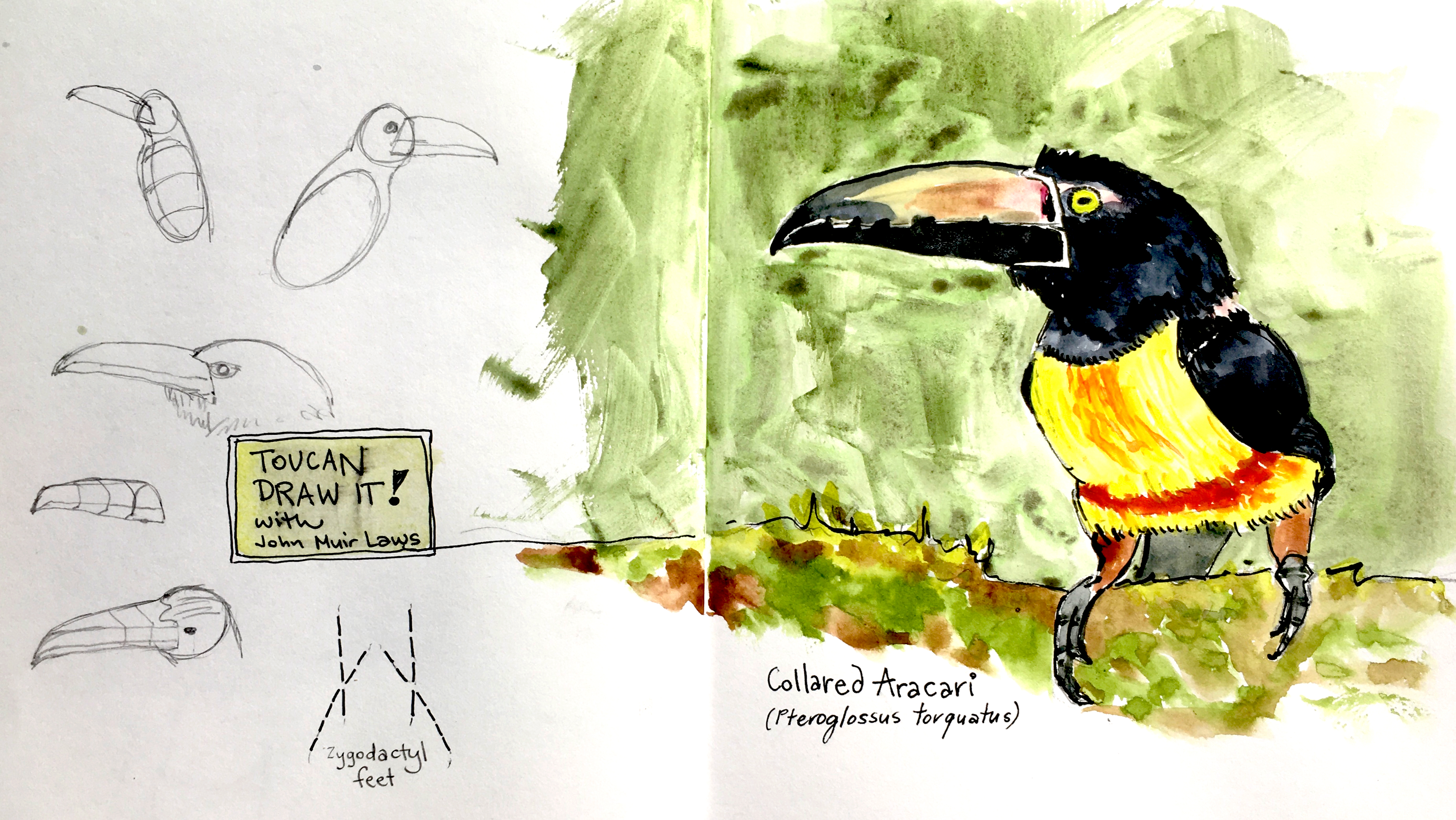

Sketching toucans with John Muir Laws. I always knew toucans had very oversized beaks, but look at that skeleton image! It’s nuts!

Tarantula hawks do it to tarantulas, mud daubers do it to other spiders. Steel-blue cricket hunters do it to crickets. Way to pack lunch for your kids.

