Charadrius vociferus

Killdeer get their name from one of their most common calls, a shrill, wailing “kill-deer”. They are shorebirds that nest away from water. Like most (all?) plovers, they lay their eggs in a shallow scrape in somewhat exposed areas, even on gravel rooftops. They will deploy a broken-wing display to lead predators away from their nests. However, this doesn’t stop horses or cows from stepping on their eggs. To deter these large hoofed animals, a killdeer will try an “ungulate display”, fluffing itself up, splaying its tail over its head, and running at the beast to attempt to make it change its path. Sadly, this tactic is often fatal for the bird.

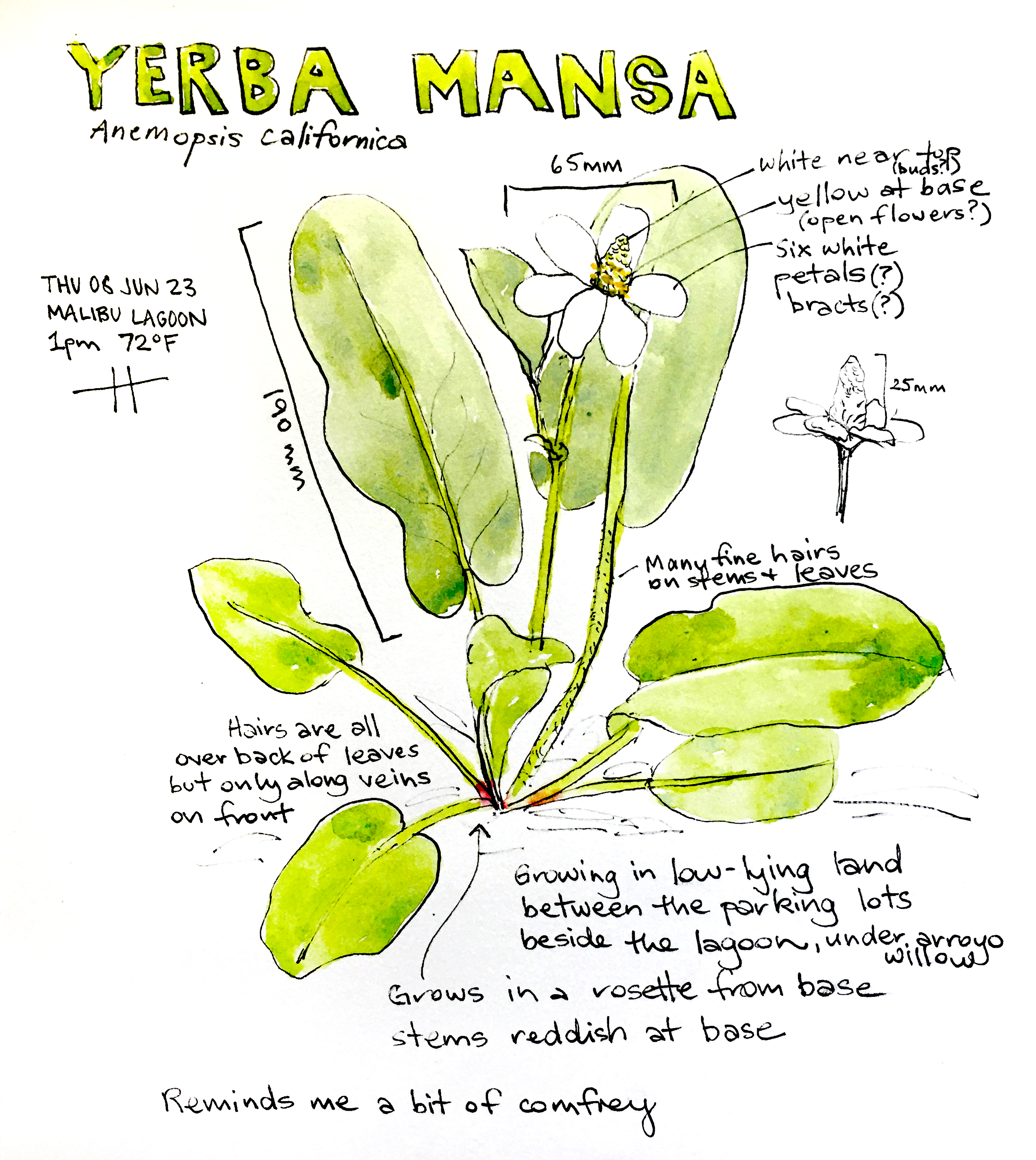
Anemopsis californica

While visiting the lagoon, I was stopped in my tracks by these pretty flowers, and had to learn more about this striking plant.

Yerba Mansa, also known as Lizard Tail, is a perennial native to southwestern US. It prefers wet locations, especially alkaline or saline marshy places below 2000 metres.

The leaves and stems are covered in soft hairs. On the upper side of the leaves, the hairs follow the veins; on the underside they cover the whole surface.

What appears to be a single bloom is actually a dense cluster of individual small flowers borne in a conical inflorescence with five to ten large white bracts beneath it. The conical structure develops into a single, tough fruit with tiny, pepper-like seeds.

The root can be consumed raw or cooked; it has a peppery flavour. Pulverized seeds can be used to make bread or added into other dishes. The root and rhizome have been used to treat the common cold, influenza, pain, wounds, burns, gastrointestinal upsets and many other conditions, but, according to WebMD, there is no good scientific evidence to support these uses. 

Larus spp.

At least eight different gull species hang out at Malibu Lagoon, and telling them apart isn’t always easy. For starters, they change their colouration every year for the first three or four years, and their summer outfits might differ from their winter ones. But setting aside the juvenile years, I’m going to try to learn how to identify the adults, even if they look very similar to a casual glance. These two, the Western and California gulls, look pretty much the same year round, so I’m starting with them. I’m honing in on the subtle differences between the two, which admittedly can only be seen close up. More pairs to come as I get around to it.

phalacrocorax

I did a bird walk at Malibu Lagoon with the Audubon Society yesterday morning, and learned so much! With friendly help, I spotted 37 different species.

My camera and binoculars are not of birding quality, but several people generously shared time on their scopes. I plan to nature journal my learnings over the coming weeks so as to help the new knowledge stick.

And I for sure want to attend their future monthly Lagoon visits. Some people travel long distances for these events; I’m so lucky to live close by this birding hotspot.

malibu lagoon

Different angle on a favourite view. Lots of people walked by as I was sketching, and many commented kindly. My favourite was a woman who said to her young son, “Look! An artist!” then to me, “He wants to be an artist when he grows up.”

“Well,” he corrected, “a kind of artist. I want to be a photographer. I have a real camera, not a phone. I can take pictures underwater!”

“Sounds like you’re already an artist,” I smiled.

pandion haliaetus

I often see this raptor at the lagoon, always solo.

The osprey (Pandion haliaetus), also called sea hawk, river hawk, and fish hawk, is a diurnal, fish-eating bird of prey. It’s large, reaching more than 60 cm (24 in) in length and 180 cm (71 in) across the wings.

The osprey is unusual in that it is a single living species that occurs nearly worldwide. Another oddity: osprey and owls are the only raptors whose outer toe is reversible, allowing them to grasp their prey with two toes in front and two behind. This is particularly helpful when they grab slippery fish.