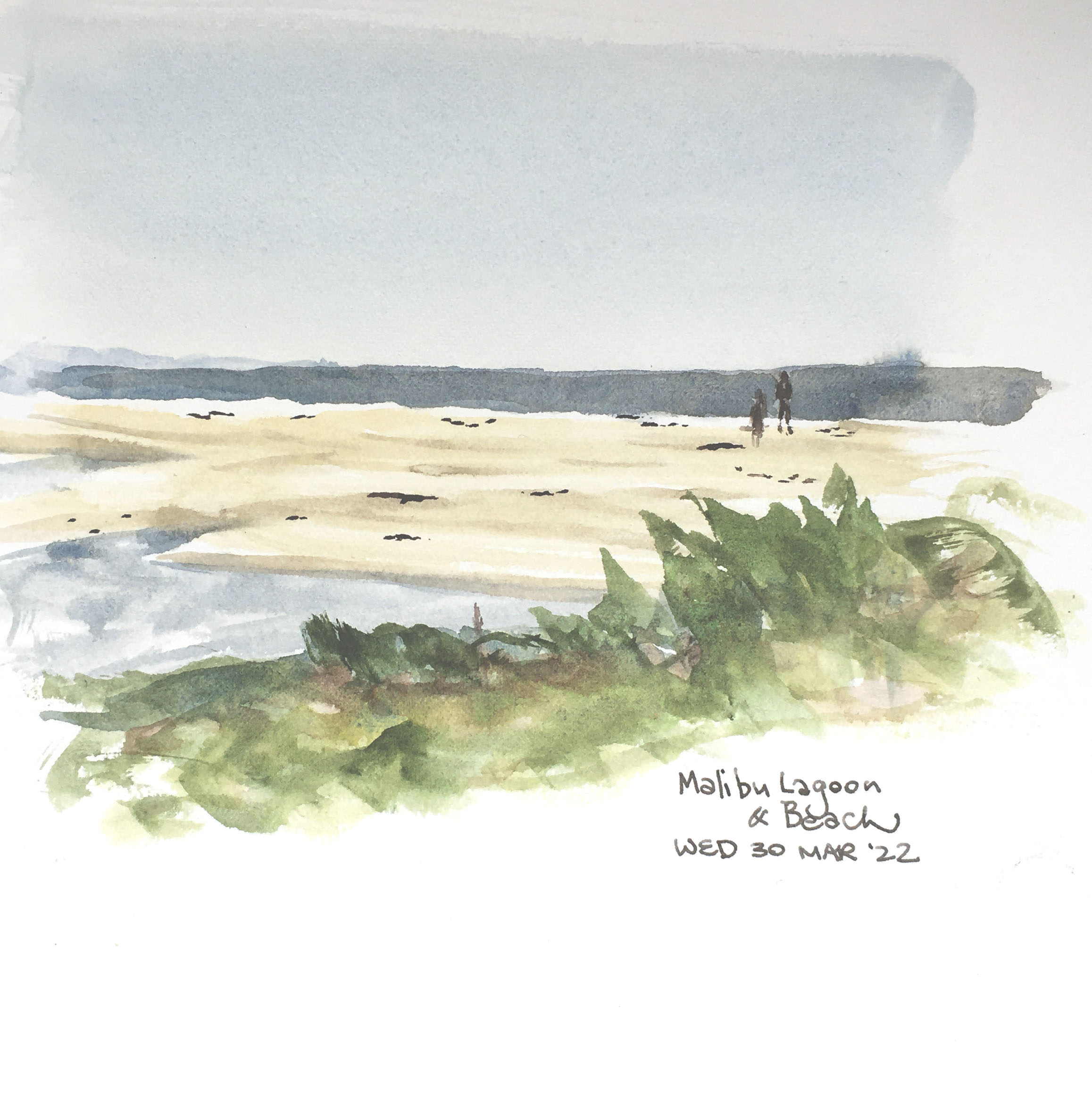
overcast

Behind me, a flock of Elegant Terns kept rising, wheeling and calling before settling down again. A Great Blue Heron swallowed an enormous fish after slapping it about for a while. We each did our thing, and I came home sated and peaceful. I never regret visiting this place.

mott adobe ruins

In 1910, Johnny Mott, a famous LA attorney, built an adobe home on the banks of Malibu Creek, in what was then Crag’s Country Club. It was reported in the Los Angeles Times that Mott’s longtime friend, President Herbert Hoover, was a frequent guest. 

When 20th Century Fox bought the property in 1946, the adobe was retained as a movie set. You can see it in “Viva Zapata!” (1952), starring Marlon Brando, but by 1970 it had fallen into ruins. 

The Mott Adobe ruins are now part of Malibu Creek State Park, and only the dramatic stone fireplace is left standing.

field guide to western wildflowers

We have a lending library for docents at MCSP, and yesterday I discovered this treasure: Field Book of Western Wild Flowers by Margaret Armstrong, published in 1915. It’s a small, thick book, filled with 500 black and white illustrations and 48 watercolour plates, and the most delightful plant descriptions. Example (Easter Bells, p 28):

“A patch of these flowers bordering the edge of a glacier, as if planted in a garden-bed, is a sight never to be forgotten. Pushing their bright leaves right through the snow they gayly swing their golden censers in the face of winter and seem the very incarnation of spring.”

Makes me want to gayly swing my golden censer 😁

You can see the text here on Gutenberg, but of course holding the hundred year old book in one’s hands is an infinitely more special experience. I’ve borrowed it, and I’m already feeling sad about the day I need to return it to the shelves.

warrior’s plume

It was another windy, chilly day at the coast so I headed over the hill to my favourite sheltered trail, the section of the Backbone between Piuma Rd and Tapia Park, also known as Piuma Ridge Trail. I love that place—it’s shady, ferny, moist, and mostly human-free. Perfect for just sitting on a mossy rock and breathing it all in with eyes closed, enjoying my daily dose of nature therapy.

I saw an interesting and new-to-me plant, so did some sketch-noting and looked it up when I got home. It’s Warrior’s Plume (Pedicularis densiflora), a perennial root parasitic herb that attaches to the roots of other plants to obtain nutrients and water. I only saw a few plants; I wonder how widespread it is. It doesn’t appear on the 1983 list of the Flora of Malibu Creek State Park, so maybe it’s a more recent arrival, or perhaps it’s too rare to have made it on the list? Regardless, it’s very pretty!

woodrats

Something I learned in MCSP Docent School this week: our native woodrats build large dens in coast live oak trees; dens can reach five feet in height and eight feet in diameter. They have separate rooms for sleeping (lined with chewed up bay leaves to keep away insects), food storage, nurseries, and protection. Woodrats live in a matriarchal social system where females choose mates, and boot out the males after mating. They are similar in appearance to the common rat species Rattus rattus and Rattus norvegicus, but with larger ears and eyes, softer coats, and furred tails (i.e., they are cuter!)

white oak farm

White Oak Farm is tucked into the northwest corner of Mulholland and Las Virgenes Roads. Once a dairy farm, it’s now part of Malibu Creek State Park, and a ranger lives in the old farmhouse. There are no ‘white oaks’ here, only valley oaks and coast live oaks. The valley oaks have lighter bark than the others, so perhaps that’s where the name came from.