
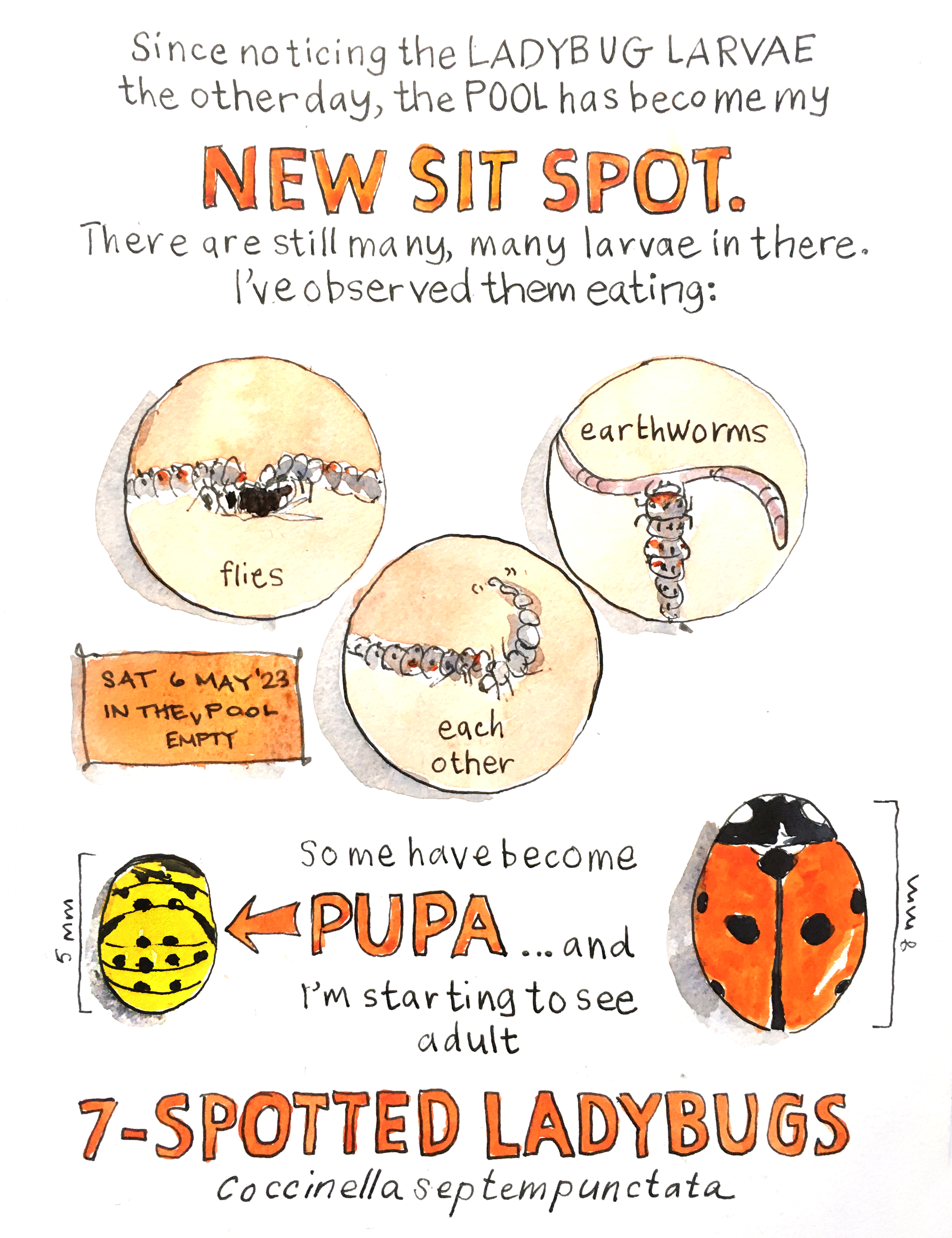
Who knew that sitting inside a huge concrete tub could be so interesting? Grateful for my extremely close focusing binoculars and my macro lens.
Who knew that sitting inside a huge concrete tub could be so interesting? Grateful for my extremely close focusing binoculars and my macro lens.

I’m pretty sure these are native, not invasive, ladybug larvae. I think the invasive Asian ones are orange all the way down their sides.

The myoporum thrips is an invasive species that’s causing a lot of damage to Myoporum laetum and M. pacificum plants in landscapes and nurseries along the California coast. We have five M. laetum trees alongside our driveway; one of them has been infested with this insect for a couple of years now.
Last year we tried introducing lacewing larvae to the tree for natural pest control, but we had storms soon afterwards and never saw evidence of adult lacewings. I’d like to try that again this year, after the winter rains are done.
The thrips can kill even well-established trees so it would be good to get them under control.

It was good to be back with Trisha on Youtube last Thursday night. I learned some new words and cicada body parts. She also told us about the Massospora cicadina fungus that turns cicadas into “flying salt shakers of death”. Amazing(ly gross).
The citrus cicada is found in the south west US (CA-AZ-UT-NV). (Trisha’s specimen was collected in Mesquite, NV.) They are not one of the 13- or 17-year cicadas; these ones have a life span of 3-4 years from egg to adult death.

Today we took the kids to the Museum of Brisbane (we all loved the PlayMoves installations), then to SparkLab at the Queensland Museum, then for a swim at South Bank. It was a long, fun day, and we’re all tired.
This has been an absolutely wonderful vacation. I fly home tomorrow ✈️.

I learned something new about insect tootsies today.

It’s fun to drink coffee beside a little native bee hive, but not so good when a bee drowns in your cup 😱

Cali spotted a highly reflective chrysalis in the garden, which brought us all running. Turns out it’s the pupa of the Common Crow Butterfly, Euploea corinna. I’m hoping I’m still here when it metamorphoses.

You’d think a bark-gnawing beetle would eat bark, but nope. It eats beetles that eat bark. Go figure.

The tarantula hawk is one of the largest parasitoid wasps, using its sting to paralyze its tarantula prey before dragging it to a brood nest as living food. A single egg is laid on the spider, hatching to a larva which eats the still-living host. They are found on all continents except Antarctica.
Tarantula hawk wasps are relatively docile and rarely sting humans without provocation. However, the sting is among the most painful of all insects’, though the intense pain only lasts about five minutes. In terms of scale, the wasp’s sting is rated near the top of the Schmidt sting pain index, second only to that of the bullet ant, and is described by Schmidt as “blinding, fierce, and shockingly electric”.
 hashiworks