

Alli and I had a lovely afternoon enjoying the best of Gaviota.
Alli and I had a lovely afternoon enjoying the best of Gaviota.

A & I returned to the Backbone Trail after more than a month’s break, and hiked the penultimate and longest section. It was so pretty, especially between Tri-Peaks and Sycamore Canyon. We had Chamberlain Trail to ourselves; it seems that only thru-hikers go there, as it isn‘t a convenient loop or out-and-back hike. I’d like to return with my birding binoculars; I *think* I saw my first Phainopeplas.

Quick sketch after a loooong hike.

Spotted this handsome striped reptile out on the trail. The California kingsnake (Lampropeltis californiae) is endemic to the western United States and northern Mexico, and is found in a variety of habitats, including woodland chaparral, grassland, deserts, marshes, and even suburban areas. It is non-venomous, and kills its prey by constriction.
Wild California kingsnakes are typically encountered at a length of 2.5-3.5 feet (76 – 107cm), though they can grow larger. This one was smaller, maybe 18 inches / 45cm long.

Another beautiful day in the Santa Monica Mountains.

Yerba santa (“holy herb”) is a hairy perennial shrub that‘s found in chaparral and coastal sage scrub, most often at higher elevations. The very aromatic leaves are lance-ovate to oval, 5 to 15 cm (2 to 6 inches) long, with a scalloped margin. Soft woolly hairs grow on both sides. In traditional medicine, it has been used to treat respiratory infections. I don’t often hike in the highest parts of the Santa Monica Mountains, so it was a treat to get up there and encounter this plant growing in profusion along the trail yesterday.

I created this page a few weeks ago for our Park docents’ newsletter. Now that it’s been published, I can post it here. A rattlesnake and a mountain lion on the same hike, that was pretty exciting!
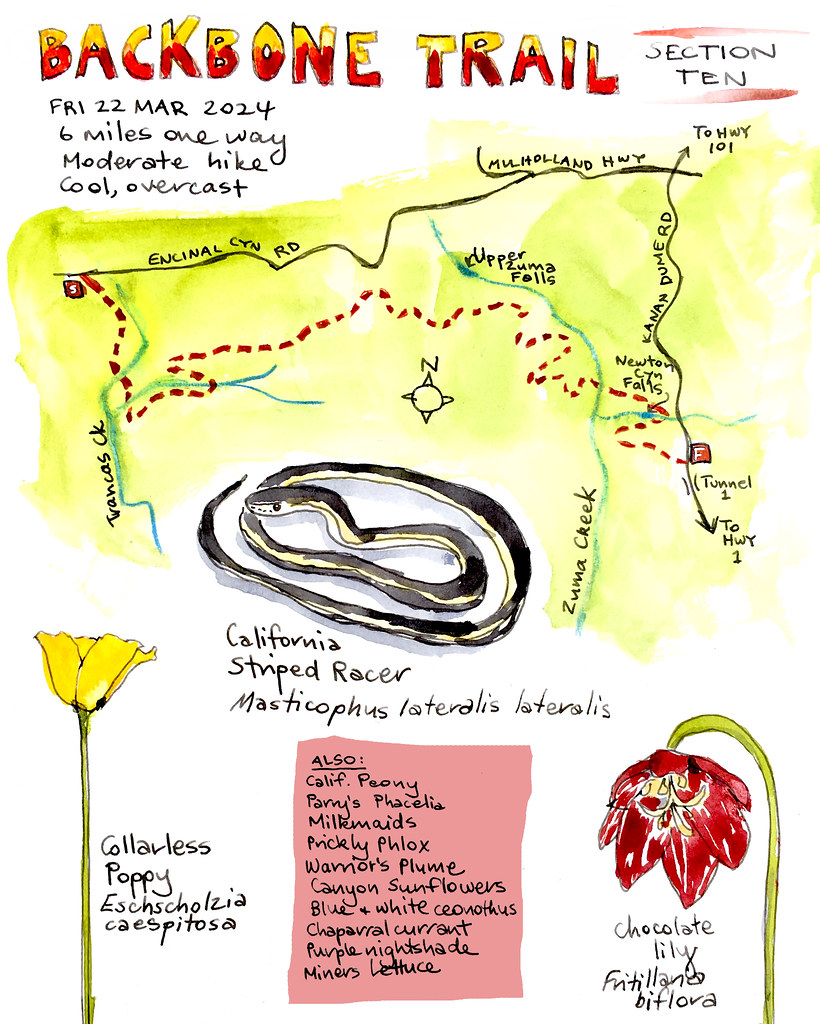
Lovely day out on the trails. Still plenty of water in the creeks and waterfalls, and the wildflowers are really starting to pop. Feeling very grateful to live in these beautiful mountains.

Vic’s sister and brother-in-law are visiting from Australia, so we took a leisurely hike to introduce them to the SM Mountains. It was lovely to meet them; I hope that we can meet up again next time I’m Downunder.

 hashiworks