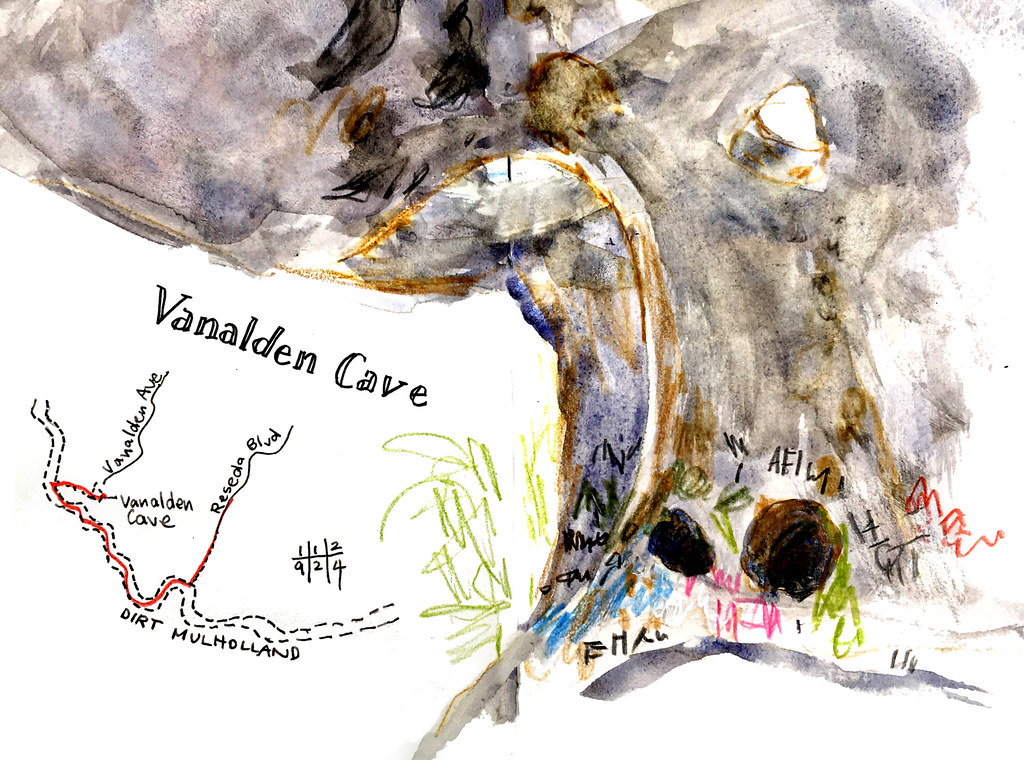
Lovely winter’s morning hike with many moments of delight. Lots of shades of buff, tan, and grey, but also some surprising new green popping up, despite the lack of rain so far.

What motivates some people to take spray paint to a site of awesome natural beauty? I will never understand how that can feel good. I thought this part of the cave looked like a sad or angry face frowning down on the graffiti.

The lower parts of Solstice Creek are well-visited, but not many people climb Sostomo Trail to enjoy the gorgeous crossing on the upper creek. The three of us settled into a bed of fallen sycamore leaves and enjoyed the quiet shade. I liked seeing the little backswimmers (Notonectidae family) — I’d also observed these aquatic insects in Australia.
Backswimmers, as the name implies, swim inverted, using their long hind legs to paddle vigorously. They prey on organisms as large as tadpoles and small fish and can deliver a painful “bite” to humans—actually a stab from their sharp proboscis. These insects inhabit still freshwater in lakes, ponds, and marshes, and can also be found in garden ponds and occasionally in swimming pools. Despite being primarily aquatic, backswimmers are effective fliers, allowing them to easily disperse to new habitats.

Secret Trail has been on my to-hike list for a while. It’s got some really pretty parts, wending as it does through chaparral, oak woodland, grassland and riparian habitats before arriving at the dramatic rock formations in the upper reaches. I’d like to go back in spring to see all the purple sage in flower.

The rock wren (Salpinctes obsoletus) is a small songbird native to western North America, Mexico and Central America. They are apparently common and widespread, but this was the first time I’d ever noticed one.
I’ve learned that rock wrens usually build their nests in crevices among boulders or beneath large rock ledges, typically on the ground or just a few inches above it, resting on a foundation of small rocks. Uniquely, they create a “paving” or “front porch” at the entrance of the nesting site, often lined with small stones, bones, and various debris. The purpose of this “paving” remains a mystery, but it is evidently significant, as rock wrens construct it before building the nest itself.
The other fun sighting on this hike was a bobcat, calmly crossing the trail quite close to humans. I’ve seen these gorgeous cats in the same area of the Park on several other occasions; they are clearly habituated to hikers.

Telstra Tower (also known as Black Mountain Tower) is one of the most visually imposing structures on the Canberra skyline, visible from many parts of Canberra and Queanbeyan. It provides important communication facilities for the area.
Prior to its closure to the public in mid-2021, it was a major tourist attraction, with visitors enjoying 360-degree views of the surrounding city and countryside. Telecommunications giant Telstra is currently considering plans to give the tower a makeover and reopen it to the public, perhaps as a site that celebrates Ngunnawal (local indigenous) culture.
Galambary (Black Mountain) holds deep cultural and spiritual importance for Aboriginal people, particularly as a sacred site for men’s business. Safeguarded by the Canberra Nature Park, it remains largely covered in native bushland—a lovely place to hike. We have happy memories of making the climb with Dad, so it was sweet to do it again.

It felt so good to go for a nice long ramble out in the Ginninderry Conservation Corridor in north-western Canberra, especially as we spotted some iconic Australian fauna. We followed it up with a delicious lunch, to make quite the perfect morning.