

Teensy little leaves being eaten by teensy little caterpillars.
Teensy little leaves being eaten by teensy little caterpillars.

Our neighbour’s garden is not alight, but the Fire Sticks succulent (Euphorbia tirucalli) sure is aptly named.

Only a few day’s worth left. It’s been a good long tomato season!

Growing veggies—planting, tending, harvesting, cooking, then eating them—brings me so much joy. And Swiss chard, with its bright crimson veins and generous ruffles, is one of the most joy-sparking of them all.
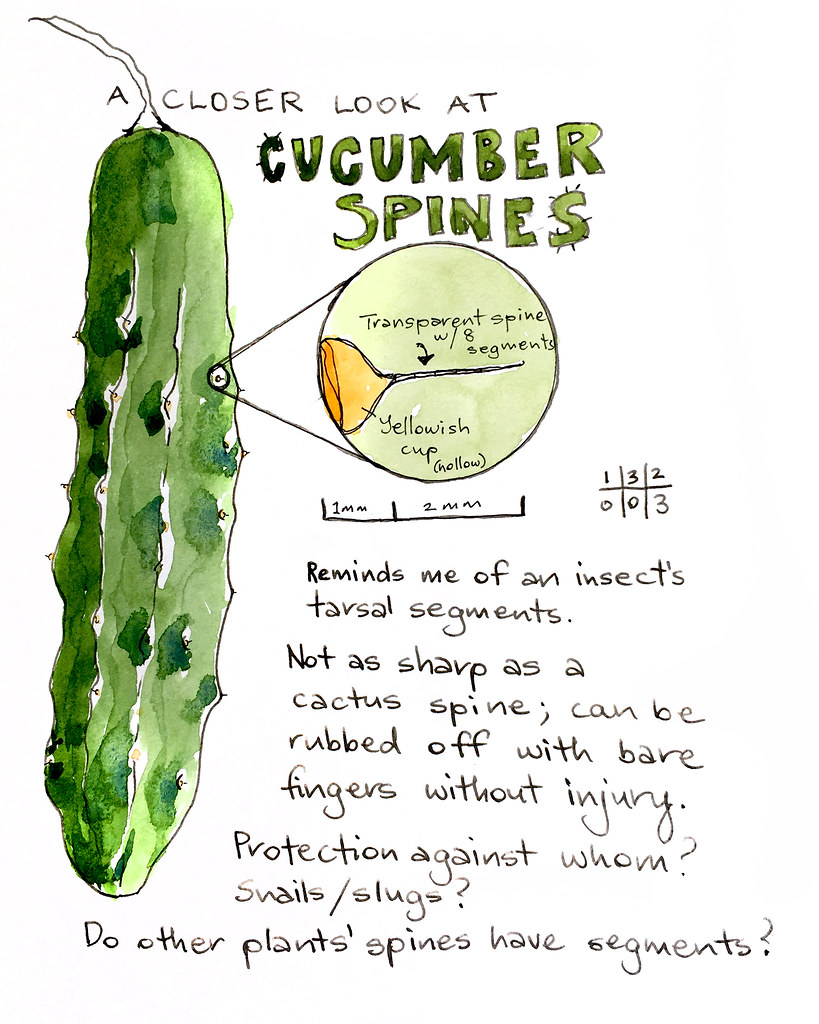
My homegrown cucumbers are very prickly. It’s not a problem; the spines are easy to scrub off. But before doing so today, I decided to examine some of them under the microscope. Now I’m curious about cactus spines!

Pretty much the last harvest of salad veg for the year; there’s still cucumbers on the vine, and lots of basil, but I pulled the last tomato plant today. This sketch shows 1/50th of the green tomatoes now filling a big colander on the counter, so we’ll still be eating them for a few weeks. Looking forward to brassicas, beets, chard, potatoes, onions ….

Large milkweed bugs are seed-feeders; their main diet is, not surprisingly, milkweed seeds. So I’m not sure what this lady was doing on the sweet potato vine.

The cabbage whites (Pieris rapae) are all over my brassicas, of course, but I’m also seeing them in the Park and on ornamentals in the neighbourhood. They seem to especially like purple lantana flowers. Do they also lay their eggs on the plant? Do their larvae eat the leaves, as they do my kale?
On the subject of lantana, it’s highly invasive where I‘m from. It covers an estimated four million hectares in eastern Australia, often to the exclusion of wildlife, people and livestock. So it’s taken me a long while to get used to seeing it as a cultivated garden plant here in Southern California.
Eat up, cabbage whites—lantana not kale!

The papalo I planted two months ago has grown to about half a metre tall, and is flowering. It’s an annual, so I’d better eat more of it before it dies!

Today’s art prompt was egg. A spore’s kinda like an egg, right?

