
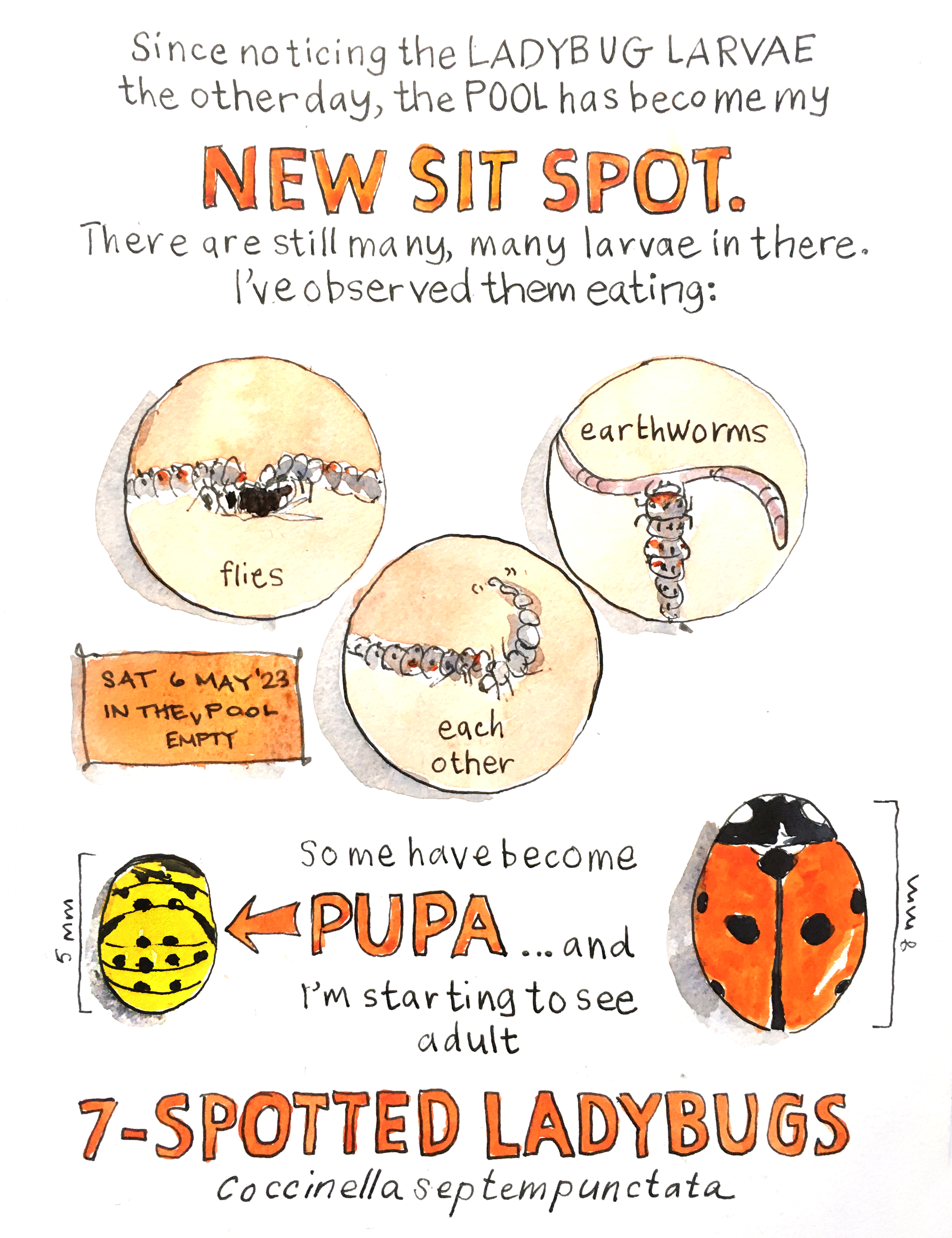
Who knew that sitting inside a huge concrete tub could be so interesting? Grateful for my extremely close focusing binoculars and my macro lens.
Who knew that sitting inside a huge concrete tub could be so interesting? Grateful for my extremely close focusing binoculars and my macro lens.

Correction on a previous blog post, and an attempt at a comic-style nature journal page (probably only entertaining to me). A reminder that sometimes we see what we want to see.

It’s always fun to poke around the tide pools with Suzanne. We saw several California brown sea hares (Aplysia californica), so-named because their rhinophores look like long ears. Like all sea hares, the California sea hare is hermaphroditic, acting as male and female simultaneously during mating. A. californica is known to form mating chains with up to 20 animals. That would be a sight to see!

There were a bunch of these tiny orb weavers inside a dead maguey leaf (Agave americana). One was green, but most were pretty well camouflaged. So cute!

Carrying ladybug larvae to an ailing plant then watching them crawl all over the leaves is a very satisfying way to spend half an hour. Just sayin’. But then I decided it would be best to plant the sage in the ground. Hopefully it will soon bounce back to good health, with or without the help of ladybugs.

I’m pretty sure these are native, not invasive, ladybug larvae. I think the invasive Asian ones are orange all the way down their sides.

I just discovered the South African visual artist Peter Clarke; I had to check him out because one of my brothers shares his name. I was inspired by his teapot linocuts to try my own rendition with fude fountain pen and watercolour.

Week 17 in the PerpJo. There’s a lovely orange/red specimen of bush monkey flower growing in Legacy Park. I first assumed it was scarlet monkey flower but that has quite different leaves, and simpler flowers. I’m confused about the Latin names of the various species. Some sites say that Mimulus changed to Diplacus. Some sites say the reverse. Regardless, the various monkey flowers are important butterfly host plants and a nectar source for hummingbirds.

Once a year, the docents from Topanga Canyon and Malibu Creek get together for a weekend of camping, learning, and socialising. And here we are, at the 37th Field Ecology Weekend, beside the meadow* in Malibu Creek State Park.
*Location of ‘the hunt’ in the original Planet of the Apes movie.

I’ve been thinking about salties since reading a disturbing news article yesterday. Then I discovered that if you search for ‘headless crocodile’ on abc.net.au, there are articles on the subject going back to 2006 … so I guess it‘s a thing that trophy hunters do, even though the species has been protected since 1970 😖.
 hashiworks