Seeing the pretty Chinese Houses on a recent hike, I got to wondering how they came by their common name. Apparently someone (Collins?) thought that the towers of inflorescences of decreasing diameter gave the plants a certain resemblance to a pagoda. Not that a pagoda is a house, but back then, I guess close enough was good enough.
This week in the PerpJo … We have a local, native thistle, the cobwebby thistle Cirsium occidentale. The plant is widespread and fairly common across most of California; unlike many introduced thistles, this native species is not a troublesome weed.
What a handsome plant! The leaves are a soft grey-green. The flower head is somewhat spherical, covered in large phyllaries with very long, spreading spines which are heavily laced in fibers resembling cobwebs. The ones were saw today had gathered dew drops on the thin threads — so pretty! The crown on top was a dense head of crimson florets.
The most common bird around here is the House Finch, a gregarious participant in the life of the yard and bird bath, with a long twittering song. The red plumage of a male House Finch comes from carotenoids in the food it eats during molt (birds can’t make bright red or yellow colours directly). Females prefer to mate with the reddest male they can find.
House Finches are native to the Western United States. They were introduced to Oahu from San Francisco sometime before 1870, and had become abundant on all the major Hawaiian Islands by 1901. In 1940, they were turned loose on Long Island, New York, and spread across almost all of the eastern United States and southern Canada within the next 50 years. They can be found in a wide variety of habitats including dry desert, coniferous forests, suburbs, and cities.
Unlike most other birds, House Finches exclusively feed their nestlings plant-based foods, including seeds. Most other vegetarian adult birds feed their babies protein-rich insects. At our place, the favourite lunch seems to be rosemary flowers.
I find describing flavours to be very difficult. What does basil taste like? Hmm, tastes like basil.
I notice that the hydroponically grown plants from the supermarket have a milder flavour than my homegrown basil. I expect the direct sunshine and intermittent watering brings out the spice.
Wild cucumber is the first annual growth to appear with the winter rains, and it’s still going strong now, five months later, with fresh vines, flowers, and maturing fruit all festooning whatever they can scramble over. I cut a fruit open to see how the seeds are going; they are still very soft. When the fruit ripens, it will explode and spray the large, hard seeds out in all directions.
Marah macrocarpa has an unusual germination method. The initial shoot emerges from the seed and grows downward into the earth. This shoot then splits, one part swelling to form a tuber, while the second part grows back to the surface and becomes the vine. The large, hard tuberous root can reach several meters in length and weigh in excess of 100 kilograms, leading to one of the plant’s common names, manroot.
I thought I’d learn a bit more about our most common spider, the ubiquitous daddy long-legs, also known as the cellar spider. As a synanthrope (an organism that lives near and benefits from humans and their environmental modifications), these spiders can be found on every continent in the world. They prefer the warmth inside human dwellings; daddy long-legs living outdoors can be found in the dimly-lit, calm environment of caves and in between rock crevices.
It takes about one year for these spiders to mature after they are born, and their life span can be two years or more post-maturity.
There is a common misconception that this spider’s venom is extremely dangerous but that their fangs are too short to pierce human skin. Neither statement is true. The fangs are longer (0.25mm) than the epidermis is thick (0.1mm); the venom has a negligible effect on mammals, including humans. So let’s put that urban legend to bed.
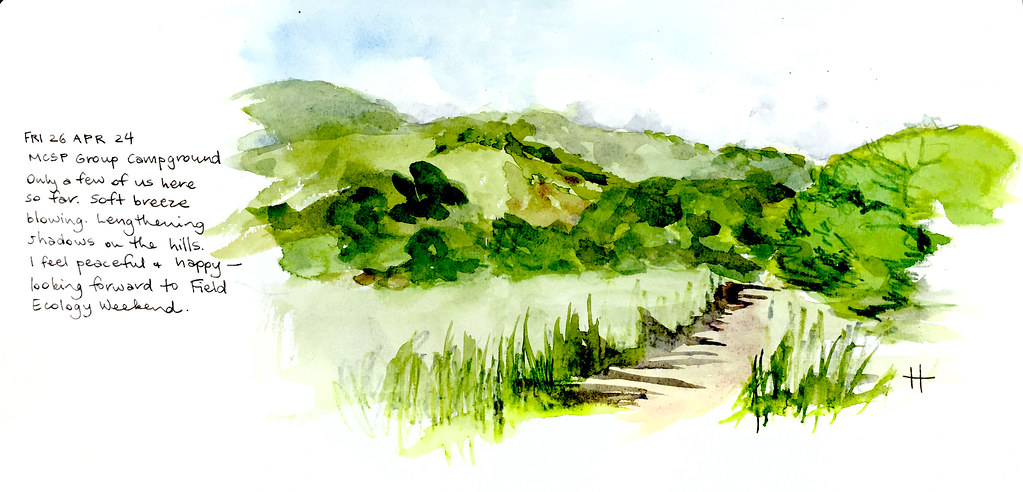
Every year, the Malibu Creek and Topanga Canyon Docents gather for a weekend of camping, outdoor education, and camaraderie, known as Field Ecology Weekend. I’m just home from the 38th Annual FEW. Speaking as one of the organisers, it was everything we hoped it would be.
I blogged about the castor oil plant in our neighbourhood a few months ago; it’s all now flowering and setting seed, preparing for even further invasion.



 hashiworks