

I just read Fox and I, An Uncommon Friendship by Catherine Raven, and found it unusual, fascinating and beautiful. Recommend.
I just read Fox and I, An Uncommon Friendship by Catherine Raven, and found it unusual, fascinating and beautiful. Recommend.

Our white (sacred) sage plant was being crowded by a bush sunflower. In pruning back the sunflower, I inadvertently broke two of the sage’s growing tips. I hope I can strike the cuttings—I‘ve had good success with basil; fingers crossed on the sage.
Salvia apiana is an evergreen perennial shrub that is native to these parts, though it wasn’t growing on our block until I planted it. It is widely used by Native American peoples on the Pacific coast of the United States, medicinally and ceremonially. Illegal poaching of wild white sage populations for the commercial sale of ’smudge sticks’ is a concern held by many; if you purchase such a product, you are contributing to the world-wide demand that fuels the poaching. Instead, consider growing your own sacred sage.

A stormy afternoon is the perfect time for an online art class.

I’ve come home to a very happy healthy veggie garden.

One of my goals this spring is to positively identify the different lupines growing around here. Not sure if Lupinus argenteus is one of them.

Very tired. Very happy.

Today we took the kids to the Museum of Brisbane (we all loved the PlayMoves installations), then to SparkLab at the Queensland Museum, then for a swim at South Bank. It was a long, fun day, and we’re all tired.
This has been an absolutely wonderful vacation. I fly home tomorrow ✈️.

I’m going to miss this place.
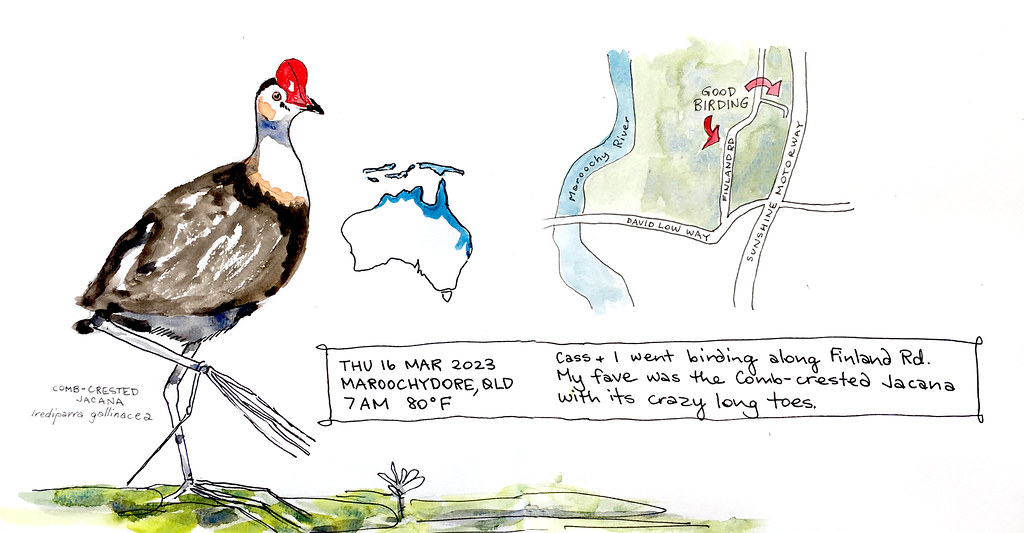
This morning, Cass took me to one of her favourite nearby birding spots, where I was delighted by the Comb-crested Jacanas, Irediparra gallinacea. Look at those feet, evolved for walking on water plants!
By late morning I was at Samford Conservation Park, meeting up with artist and environmental educator Bethan Burton. She’s a treasure! Our few hours together weren’t nearly enough. We observed an interesting butterfly whose forewings seemed to be transparent; she later texted me an ID: Cressida cressida, the Clearwing Swallowtail or Big Greasy — funny name! Gorgeous butterfly! Lovely woman!
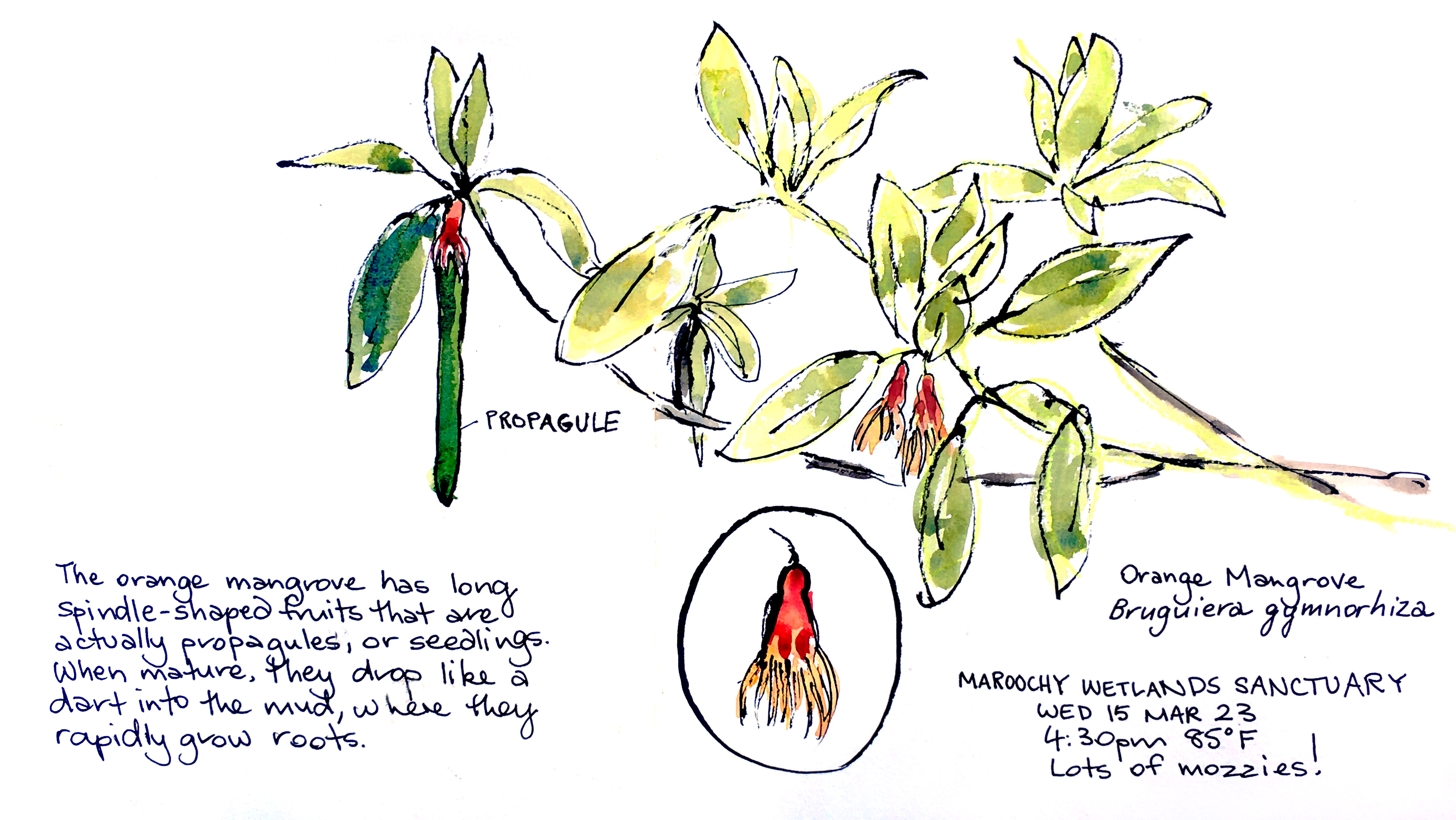
Another day, another wetland, this time in the company of my rad SIL, Cass. The Maroochydore Wetlands Sanctuary at Bli Bli is, according to one of their interpretive signs, “home to 180 species of birds, 30 species of crabs, five species of mangroves, and untold species of reptiles, amphibians, insects, crustaceans, molluscs, plants and fungi.” And millions of mosquitoes. I even wore Aerogard, an exercise in futility.
I was particularly taken with the Orange Mangrove, Bruguiera gymnorhiza. It has the largest leaves of all the mangroves in the Sanctuary, bright red-orange flowers, and an interesting method of reproduction. We found a propagule that had dropped onto the boardwalk, and helpfully shot it into the mud below. According to Wikipedia, the propagules are eaten by many indigenous groups in northern Australia and southeastern Papua New Guinea, and there is also evidence of them being eaten in India, Bangladesh, and other parts of Southeast Asia.
 hashiworks