

Some mornings, I decide that I’ll take Bodie for a walk in the afternoon instead. Then the afternoon comes and we both feel like this.
Some mornings, I decide that I’ll take Bodie for a walk in the afternoon instead. Then the afternoon comes and we both feel like this.

Look what I just found! I don’t know if it’s an Anna’s or an Allen’s hummingbird. The nice thing about this nest location is we can see it through in the window. Incubation period for an Anna’s is 16 days, for an Allen’s 17-22 days. Stay tuned!
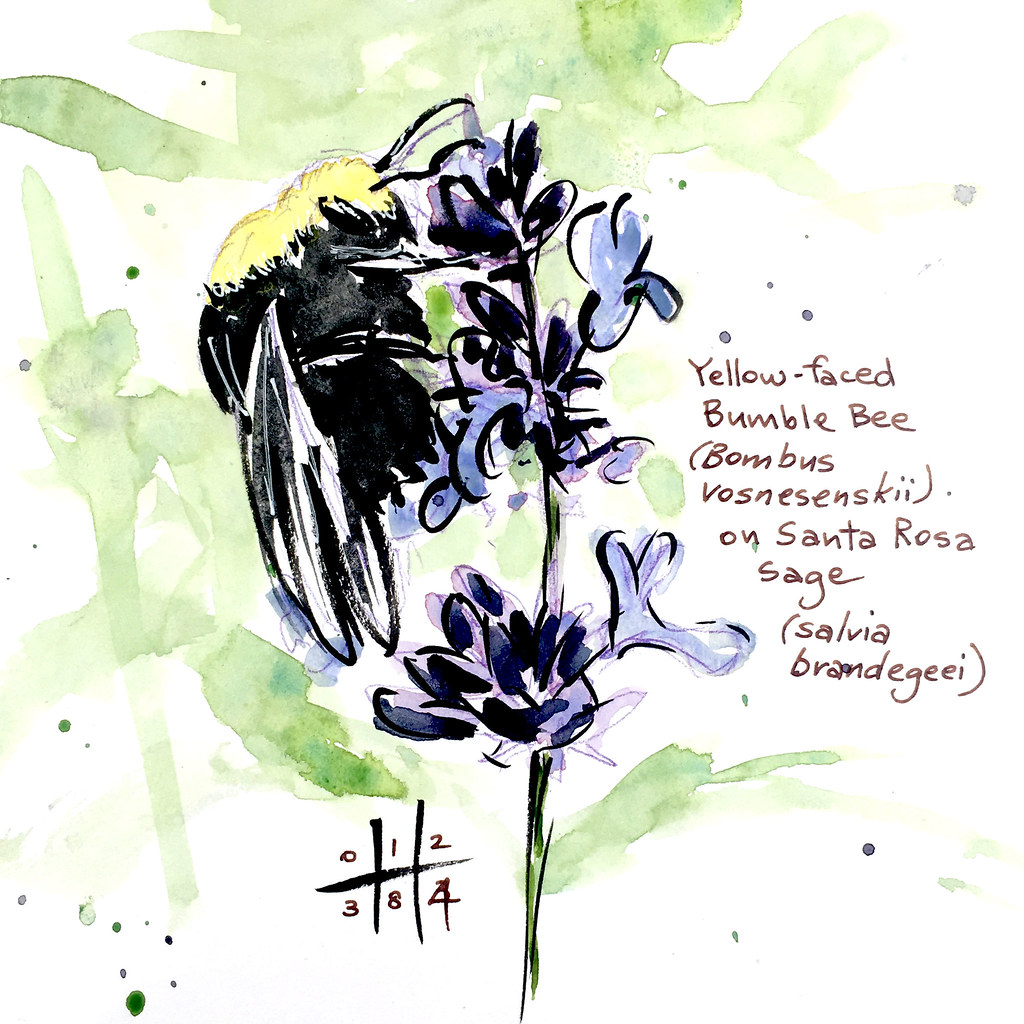
According to iNaturalist, there are 24 species of bumblebees in California. The one that is busily pollinating our sage is the Yellow-faced Bumblebee. Bombus vosnesenskii is among the most common bee species on the West Coast of the United States, and the most common bumblebee from Oregon northward. The bee nests underground, usually in colonies of 200-300 workers.

I was actually surprised when I looked up the planting date on this shrub; it’s only been in the ground for 2.5 years — it seems longer. Looking at pictures of mature specimens, I’m excited for the future. But now I’m wondering why we went with a cultivar, not a local Ceanothus. Perhaps it’s all that was available at the nursery?

While camping, I read and enjoyed this short book by Tristan Gooley. My main takeaway is this (far from simple) exercise: Wherever/whenever you are outdoors, ask yourself “In what direction am I looking?” and “What time is it?“ (Learn to) use nature to find the answers. I’d like to get better at this.


We left Stovepipe Wells in the late morning, and headed south. The plan was to find the Geologist’s Cabin and perhaps spend the night there. 25 mi / 40 km of rough dirt road took us about two and a half hours to traverse. The location is spectacular, on a rise at the western end of Butte Valley, in full view of majestic Striped Butte rising from the valley floor. But others had arrived ahead of us. Though they graciously offered to share the space, they also told us about another cabin further down the track.
Thus we discovered Stella’s Cabin, a rough structure of stone, mud and corrugated iron, once home to prospectors Clint and Stella Anderson. Stella stayed on alone for five years after Clint’s death in 1973. Having lived in similarly primitive conditions in my younger years, I felt right at home. The wood stove worked fine, and we spent a cozy night on the floor. In the morning we contributed some doggerel to the visitors’ log, before starting the long trek home.
Stella’s Cabin was for sure the cherry on top of a fabulous Death Valley visit. We just hope we didn’t contract hantavirus from all the rodent droppings🤞🏻.

Death Valley is the largest national park in the contiguous United States, as well as the hottest, driest and lowest of all the national parks in the United States. More than 93% of the park is a designated wilderness area, which means—among other things—that your dog cannot go to those parts. As we took Bodie on this trip, we didn’t get to do much hiking. But there is still plenty to see close to vehicle access, especially when you have a four wheel drive.
Recent heavy rain made kayaking possible in Badwater Basin (Lake Manley). This is kinda impressive, but 120,000 years ago, Lake Manley was 600 ft—not knee—deep. The “high tide” lines are visible, high above the valley floor.
Everywhere you look in Death Valley, you witness geological time. But the cool thing about Ubehebe Crater is that it formed so very recently; conceivably, another one could blow tomorrow.
Best part of the day? Dinner cooked and eaten on an isolated knoll on the road to Skidoo ghost town, with views of the Valley and mountains and crescent moon. Magic.

We got on the road fairly late on Saturday (our neighbour was bitten by a rattlesnake, delaying our departure a little). We made it as far as Big Pine CA, where the friendly folks at the Starlight Motel made us welcome. The next day—Sunday—we headed into Death Valley, exploring the northerly part of the Park. The higher altitudes (and latitudes) make this section a lot less “deathy” than the more southern regions. Abundant wildflowers line the roads, temps are milder, and we were happy to find a campsite at almost-full Mesquite Springs, one of our favourite DV campgrounds. The day’s highlight? The layer-caked Last Chance Range near Eureka Dunes. Stunning. For desert quirkiness, Crankshaft Crossing, where plenty of folks have donated defunct crankshafts, took the prize.

While gingerly investigating the nettle, I managed to get stung under my chin. The perils of nature journaling!

There are over 9000 species of click beetles worldwide, and over 900 species in North America alone.
This family is characterized by the unusual click mechanism on the beetle’s underside. A spine on the prosternum can be snapped into a corresponding notch on the mesosternum, producing a violent “click” that can bounce the beetle into the air. Clicking is mainly used to avoid predation, although it is also useful when the beetle is on its back and needs to right itself. See some close-ups and slow motion video here.
 hashiworks