

Now my hands smell all nasturtiumy.
Now my hands smell all nasturtiumy.

The Matilija Poppies are putting on a lovely show in the Park. Romneya coulteri is native to California and northern Mexico. The plant grows from 2 to 3 metres (6 to 9 feet) tall, with very large flowers that somewhat resemble a fried egg.
The flower is the largest of any California native species. It was nominated as state flower in 1890, but the California poppy won the title in a landslide.

They say virtue is its own reward, but I got a bonus 😊.
Stream orchids are widespread in North America, and ranked secure in conservation status, but they are rare and vulnerable in our mountains.
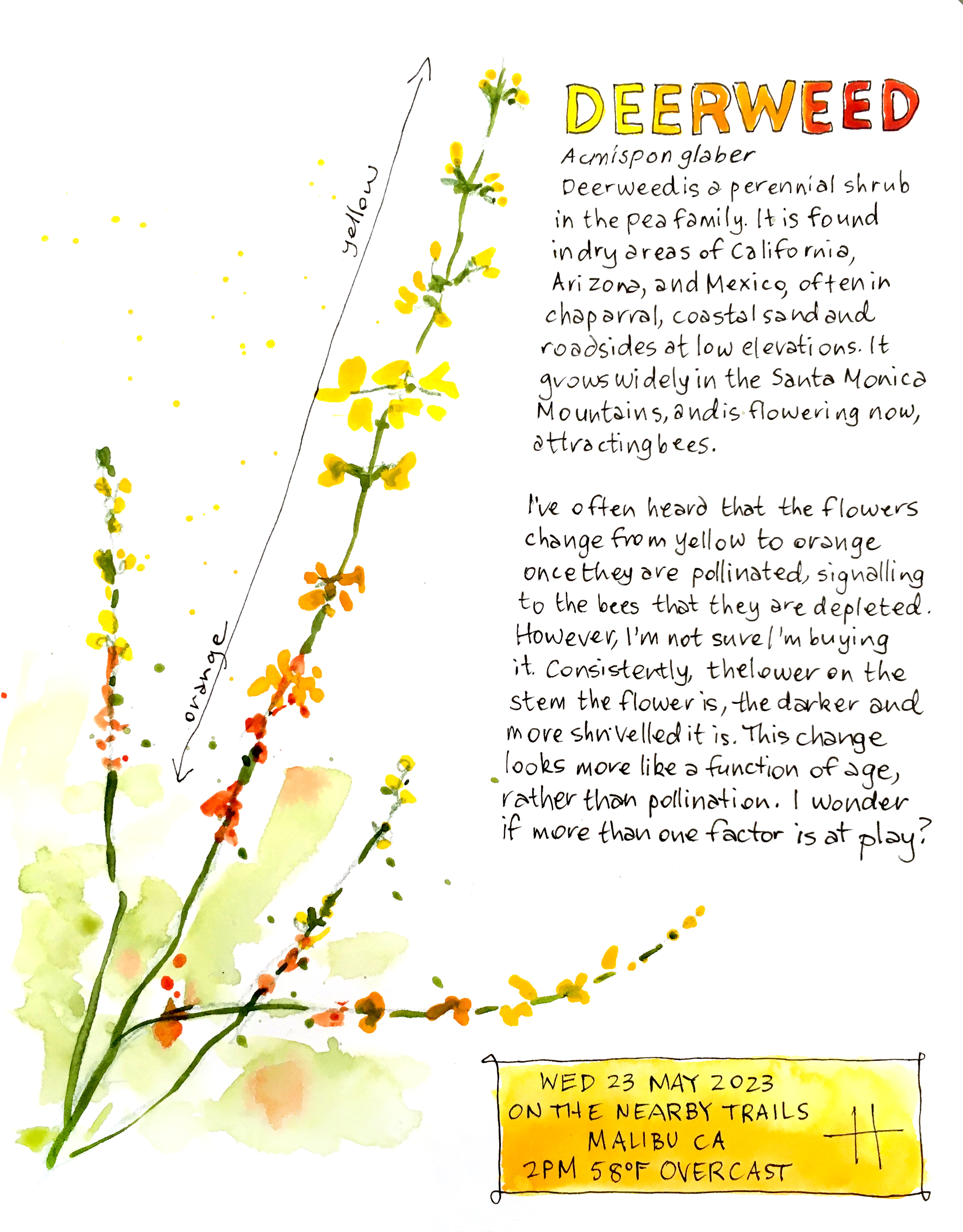
I’ve been looking at a lot of deerweed flowers, and I’m not convinced by the prevailing wisdom about their varying colours. If an individual flower turns orange after pollination, as I’ve often heard, then I would expect to see a more random distribution of orange flowers. But it’s very consistent — the further down the stem, the darker (and more shrivelled) the flower. There are no yellow flowers down low — am I to assume that every single blossom was pollinated? And there are no orange flowers up high — why not? I see bees up high.
It really seems to me that every flower gets darker as it gets older; that it’s age, not pollination, that makes the colour change.

Clarkia unguiculata is commonly known as elegant clarkia. It is endemic to California, where it’s found in many woodland habitats, including the understory of oak woodlands here in the Santa Monica Mountains. It’s one of my favourite wildflowers, and not just because my last name is Clark 😊.
The showy flowers have hairy, fused sepals forming a cup beneath the corolla, and four petals up to 2.5 centimeters long. The paddle-like petals are pink to reddish to purple and have a slender “stalk” and diamond-shaped or triangular “tongue” (sorry, are there more correct names for parts of a petal?). There are eight long stamens, the outer four of which have large red anthers. The white stigma protrudes from the flower and can be quite large.
The above paragraph does nothing to convey how pretty this plant is! It really is very elegant.

Week 17 in the PerpJo. There’s a lovely orange/red specimen of bush monkey flower growing in Legacy Park. I first assumed it was scarlet monkey flower but that has quite different leaves, and simpler flowers. I’m confused about the Latin names of the various species. Some sites say that Mimulus changed to Diplacus. Some sites say the reverse. Regardless, the various monkey flowers are important butterfly host plants and a nectar source for hummingbirds.

Viola pedunculata, the Johnny jump-up, California golden violet, or yellow pansy, is a perennial yellow wildflower of the coast and coastal ranges in California and northwestern Baja California. The plant grows on open, grassy slopes, in chaparral habitats, and in oak woodlands. We see its cheerful yellow flowers in the Santa Monica Mountains from early to late spring.

Pretty blue-eyed grass is actually an iris, not a grass. It’s putting on a good show around here right now. No Chumash uses were recorded for this plant, but the Ohlone used an infusion of the roots and leaves as a cure for indigestion and stomach pain.

Our local wild chia (Salvia columbariae) is closely related to commercial chia (Salvia hispanica). It was a favoured food of the Chumash and other Native American peoples, being high in both protein and fat. The seeds were gathered in large quantities, stored and traded, then roasted and ground into flour. The seeds were also used medicinally and ceremonially. It is an annual herb, and is flowering now in the Santa Monica Mountains.

This week in the PerpJo: prickly popcorn flower. I often see this little cutie while out hiking—it flowers from March to June—but I’ve never noticed it beside our driveway before. But perhaps I’m just becoming more observant.
 hashiworks