The wetlands in Legacy Park are alive with red-winged blackbirds, great-tailed grackles, mallards, coots and egrets. I like to sit by the tules and watch the interactions. Today there were a lot more drakes (9) than ducks (2); the females were getting persistently pursued and didn’t seem too happy about it.
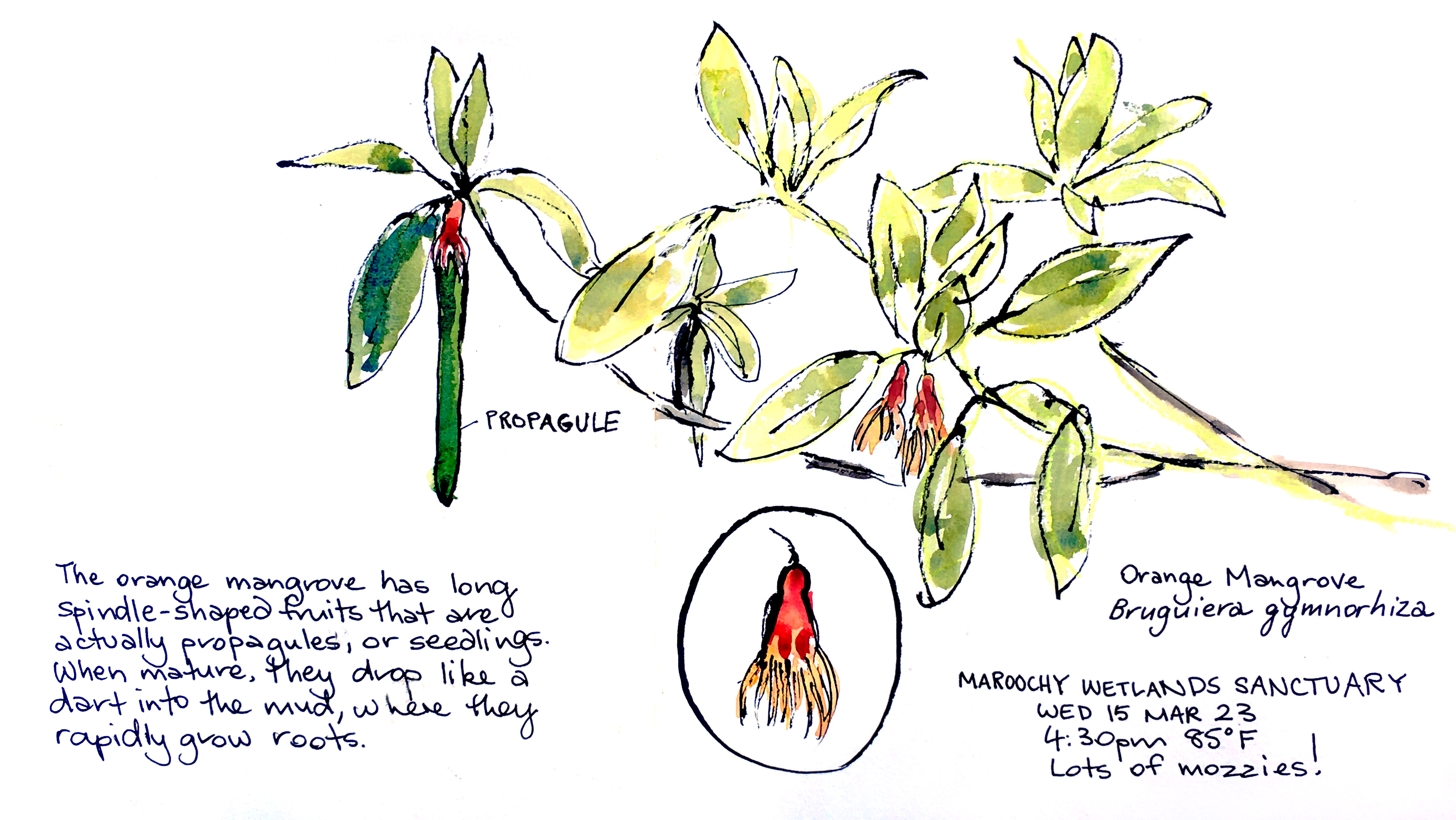
Another day, another wetland, this time in the company of my rad SIL, Cass. The Maroochydore Wetlands Sanctuary at Bli Bli is, according to one of their interpretive signs, “home to 180 species of birds, 30 species of crabs, five species of mangroves, and untold species of reptiles, amphibians, insects, crustaceans, molluscs, plants and fungi.” And millions of mosquitoes. I even wore Aerogard, an exercise in futility.
I was particularly taken with the Orange Mangrove, Bruguiera gymnorhiza. It has the largest leaves of all the mangroves in the Sanctuary, bright red-orange flowers, and an interesting method of reproduction. We found a propagule that had dropped onto the boardwalk, and helpfully shot it into the mud below. According to Wikipedia, the propagules are eaten by many indigenous groups in northern Australia and southeastern Papua New Guinea, and there is also evidence of them being eaten in India, Bangladesh, and other parts of Southeast Asia.
I’ve been wanting to stop at Boondall Wetlands for the longest time, and today I finally did. The reserve supports various plant communities including eucalyptus and melaleuca woodlands, remnant rainforests, ironbark forests, casuarina forests, grasslands, tidal mudflats, mangroves, swamplands, hypersaline flats and salt marshes.
It’s a great birdwatching site—apparently over 190 species of birds use the various habitats throughout the year—but I visited in the middle of a hot day so didn’t see much bird action. Definitely worth a return visit at other times and seasons.



 hashiworks