

Experimenting with stencils and mark-making, à la Esté MacLeod.
Experimenting with stencils and mark-making, à la Esté MacLeod.

The myoporum thrips is an invasive species that’s causing a lot of damage to Myoporum laetum and M. pacificum plants in landscapes and nurseries along the California coast. We have five M. laetum trees alongside our driveway; one of them has been infested with this insect for a couple of years now.
Last year we tried introducing lacewing larvae to the tree for natural pest control, but we had storms soon afterwards and never saw evidence of adult lacewings. I’d like to try that again this year, after the winter rains are done.
The thrips can kill even well-established trees so it would be good to get them under control.

They say the best time to plant a tree is ten years ago. The second-best time, in our case, is five years ago. We’re happy to see flowers on the macadamia for the first time; here’s hoping that they pollinate successfully. We do have a lot of bees in the yard, so there’s reason to be optimistic.
The macadamia is native to rainforests in south east Queensland and northern New South Wales, Australia. (It is not native to Hawaii, as many people think.) Our variety (Cate) was developed here in Malibu, and suits a more Mediterranean climate.
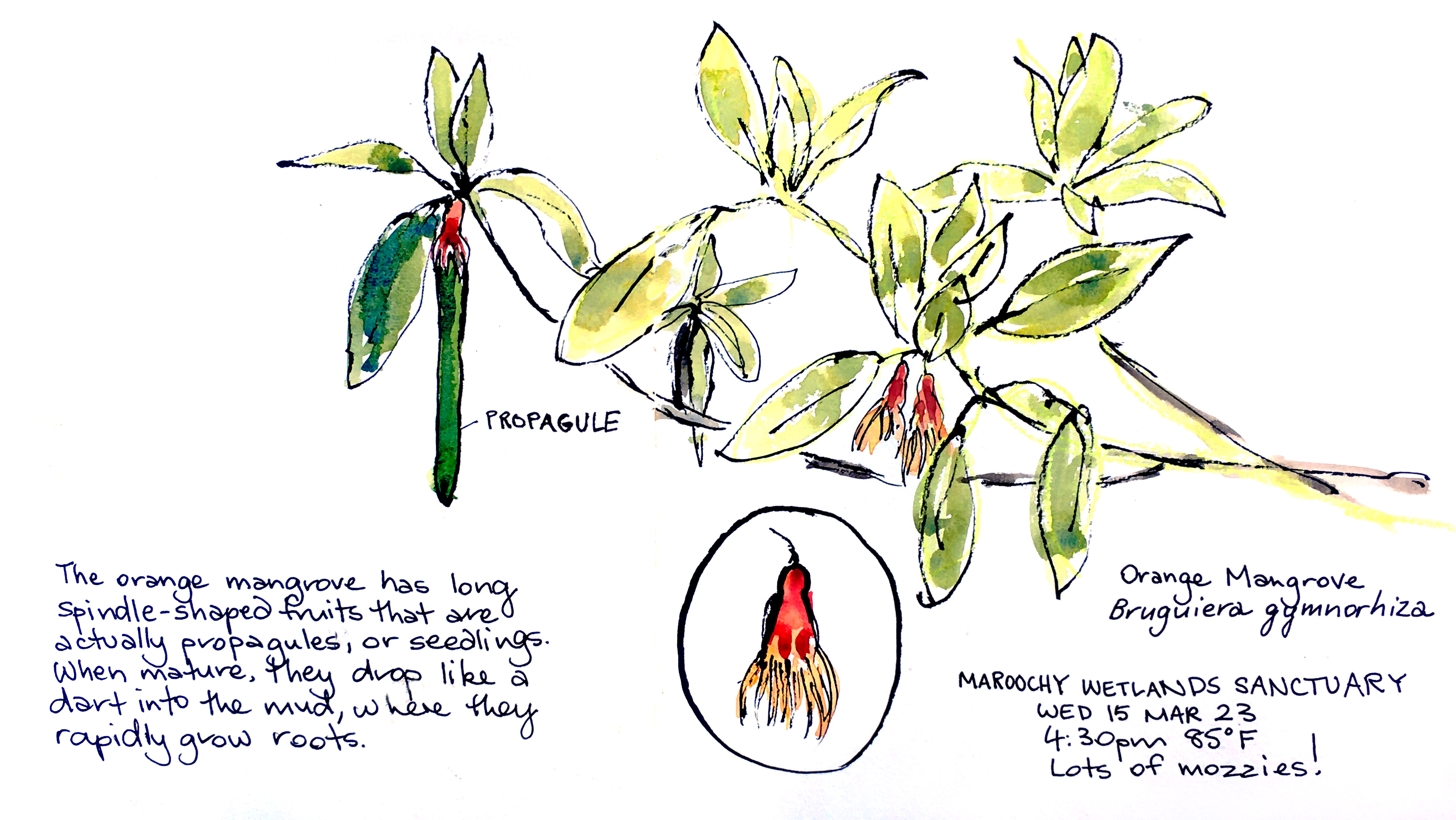
Another day, another wetland, this time in the company of my rad SIL, Cass. The Maroochydore Wetlands Sanctuary at Bli Bli is, according to one of their interpretive signs, “home to 180 species of birds, 30 species of crabs, five species of mangroves, and untold species of reptiles, amphibians, insects, crustaceans, molluscs, plants and fungi.” And millions of mosquitoes. I even wore Aerogard, an exercise in futility.
I was particularly taken with the Orange Mangrove, Bruguiera gymnorhiza. It has the largest leaves of all the mangroves in the Sanctuary, bright red-orange flowers, and an interesting method of reproduction. We found a propagule that had dropped onto the boardwalk, and helpfully shot it into the mud below. According to Wikipedia, the propagules are eaten by many indigenous groups in northern Australia and southeastern Papua New Guinea, and there is also evidence of them being eaten in India, Bangladesh, and other parts of Southeast Asia.

Around here, you can’t swing a quoll (not that you would) without hitting a park or green space. Mature trees, creeks, and playgrounds abound, which provide huge quality-of-life enhancements to residents, whether they realise it or not.
Brisbane has, on average, 54 per cent green cover, though, as in most cities, affluent areas have more mature trees than poorer suburbs. (In comparison, Melbourne had just 23 per cent total tree cover in 2020, and Sydney had 34 per cent. All three cities lost green cover between 2013 and 2020.)
Needless to say, I’ve been spending time every day in the nearby green spaces, mostly just sitting and breathing it all in. Today, there was also a little sketching in a pink cafe with a fancy chandelier. It’s good to mix it up.
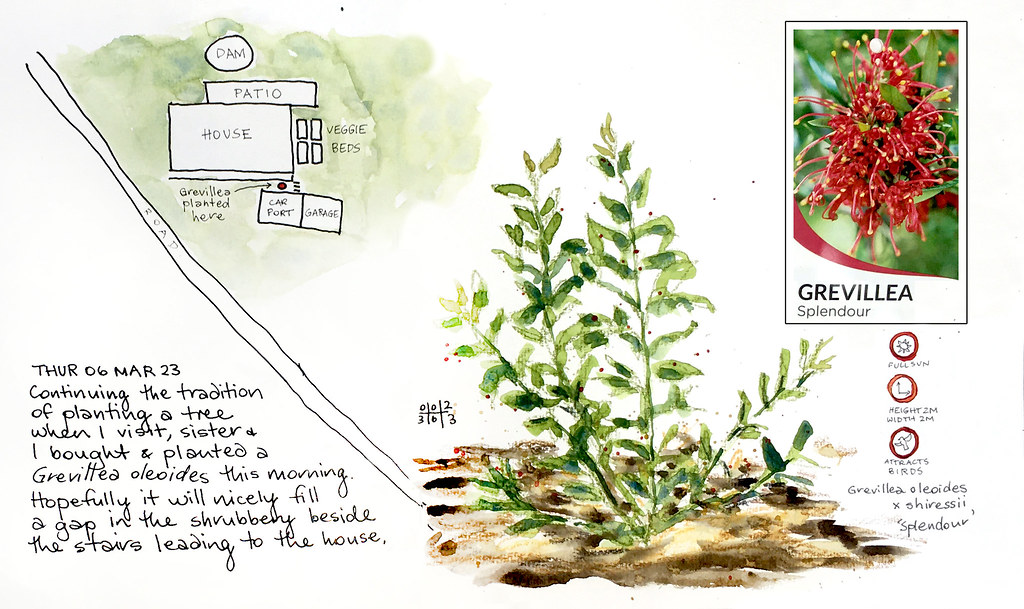
My sister lives on a bush block, and there is absolutely no shortage of trees here (mostly eucalypts and acacias). But I still like to add to the assortment when I visit. It started when Mum died and we planted creeping boobialla, Myoporum parvifolium, in her honour (she had breast cancer — get it?) When Dad passed he got a Grevillea ‘Ned Kelly’, to celebrate his love of Australia folk legends. We don’t need the excuse of someone dying to plant a tree; now we do it each time I come.

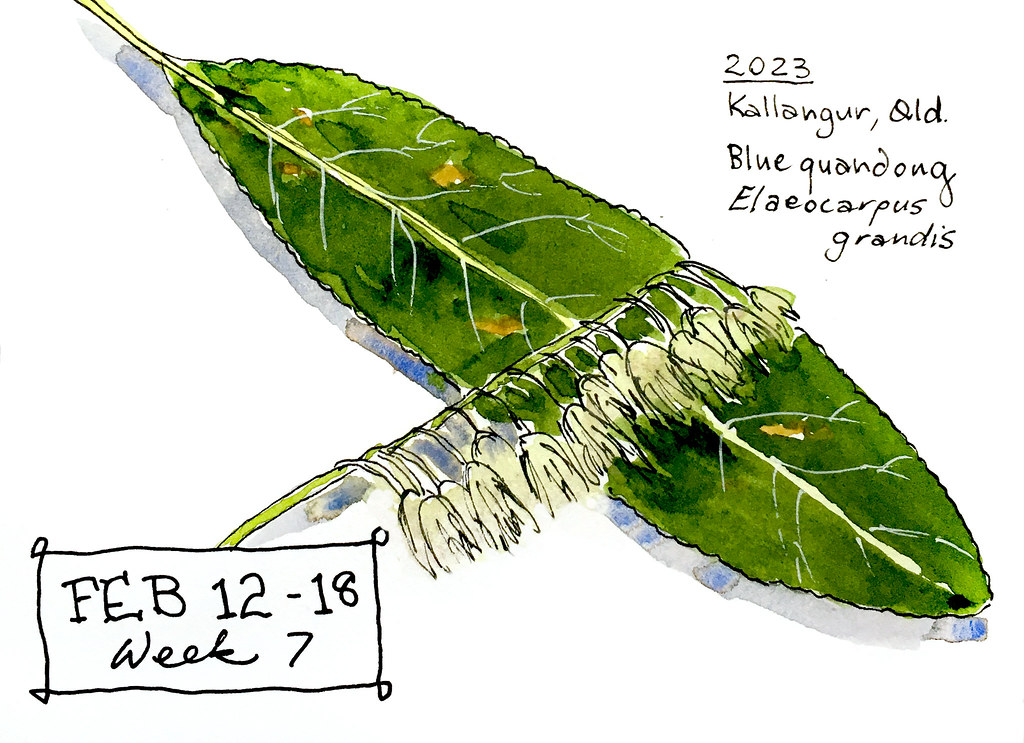
There’s a huge Elaeocarpus grandis tree in full flower in the park near my daughter’s house.
This rainforest tree commonly known as white quandong, blue quandong, silver quandong, blue fig or blueberry ash, is endemic to eastern Australia. It is a large tree with buttress roots at the base of the trunk, oblong to elliptic leaves with small teeth on the edges, racemes of greenish-white flowers and more or less spherical blue fruit, which are edible but bitter.
Indigenous Australians ate the fruit raw or buried the unripe fruit in sand for four days to make it sweeter and more palatable. Early settlers used the fruit for jams, pies and pickles. The fruit of E. grandis is eaten by birds, including the wompoo fruit-dove, southern cassowary and Australian brushturkey.
I have a vintage (1940s) Chinese Checkers set that belonged to my mother; the “marbles” are painted quandong seeds. It looks like this one. I am not sure if they are E. grandis seeds as there are at least a couple of dozen trees called quandong.

The lemon tree continues to cause me some head-scratching. I’m hoping that rock dust will help normalise its growth. Gardening is an experiment and an adventure!

Several of the coast live oaks along High Road in Malibu Creek State Park broke and toppled in the recent storms. I hung out with one of them for a while this afternoon, enjoying its glowing heart.
 hashiworks