Tag: topanga state park
Salpinctes obsoletus

The rock wren (Salpinctes obsoletus) is a small songbird native to western North America, Mexico and Central America. They are apparently common and widespread, but this was the first time I’d ever noticed one.
I’ve learned that rock wrens usually build their nests in crevices among boulders or beneath large rock ledges, typically on the ground or just a few inches above it, resting on a foundation of small rocks. Uniquely, they create a “paving” or “front porch” at the entrance of the nesting site, often lined with small stones, bones, and various debris. The purpose of this “paving” remains a mystery, but it is evidently significant, as rock wrens construct it before building the nest itself.
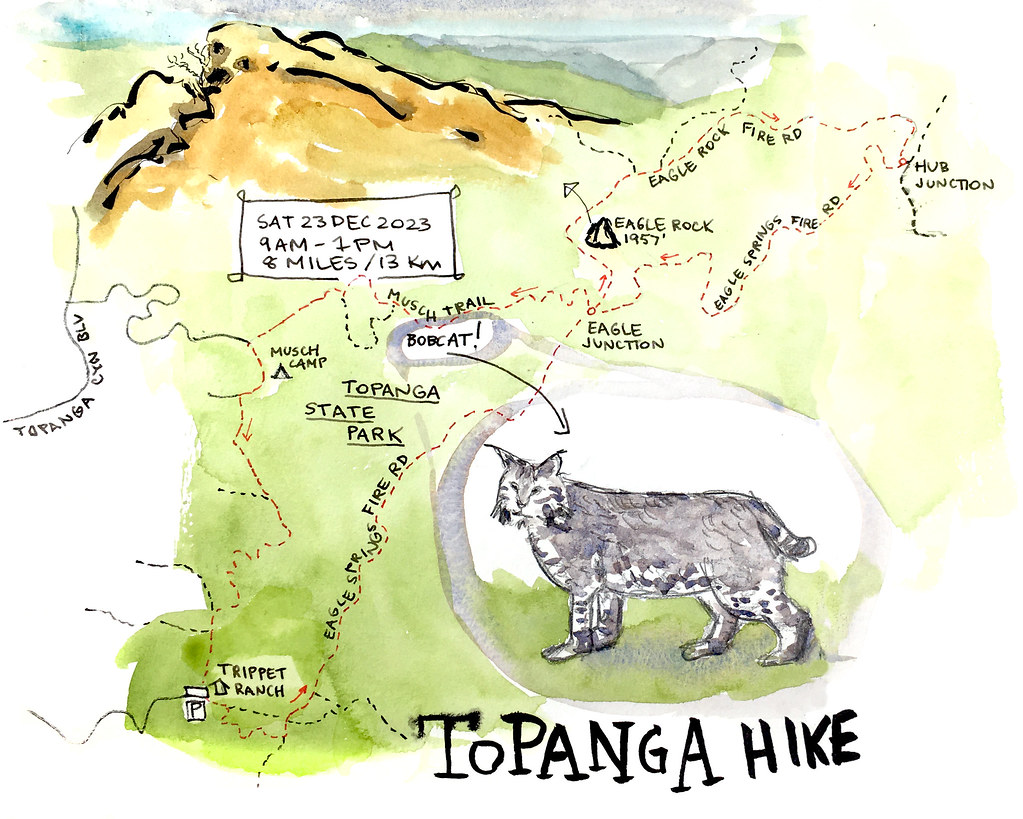
The other fun sighting on this hike was a bobcat, calmly crossing the trail quite close to humans. I’ve seen these gorgeous cats in the same area of the Park on several other occasions; they are clearly habituated to hikers.
crawling

Horned lizards’ first line of defence is to stay very still; this, along with their excellent camouflage, makes them difficult to spot on the trail. But I know where they hang out along the Musch Trail, so if we look very carefully, and if they crawl just a little bit, we may be rewarded with a sighting.
leaves

‘Twas a grand day to hike Hondo. I spotted a new caterpillar, and learned more about it when I got home. The genista broom moth, Uresiphita reversalis, is light to medium brown with a dark spot on each top wing. The hindwings are yellow or orange with some brownish-gray shading toward the edges. Genista caterpillars feed on acacias, brooms (Genista spp., thus the common name) and lupines, among other species. They ingest and store alkaloids from their host plants, which make the worms bitter or even toxic to mammals, birds and some insect predators. So don’t try eating them!
Asclepias eriocarpa

Asclepias eriocarpa is native to California and adjacent parts of Nevada and Baja California. It grows in many habitat types such as rocky hillsides, woods, deserts, and especially dry areas. Along with other milkweeds, woollypod is vital to the survival of the monarch butterfly, as well as being a great nectar source for a range of beneficial insects.
Milkweeds contain cardiac glycosides, naturally occurring drugs that increase the force of heart contraction and have been used to treat heart conditions. The cardiac glycosides are potentially poisonous to humans, and are definitely toxic to dogs, cats, and grazing animals. So maybe don’t plant it in your horse paddock.
Phrynosoma blainvillii
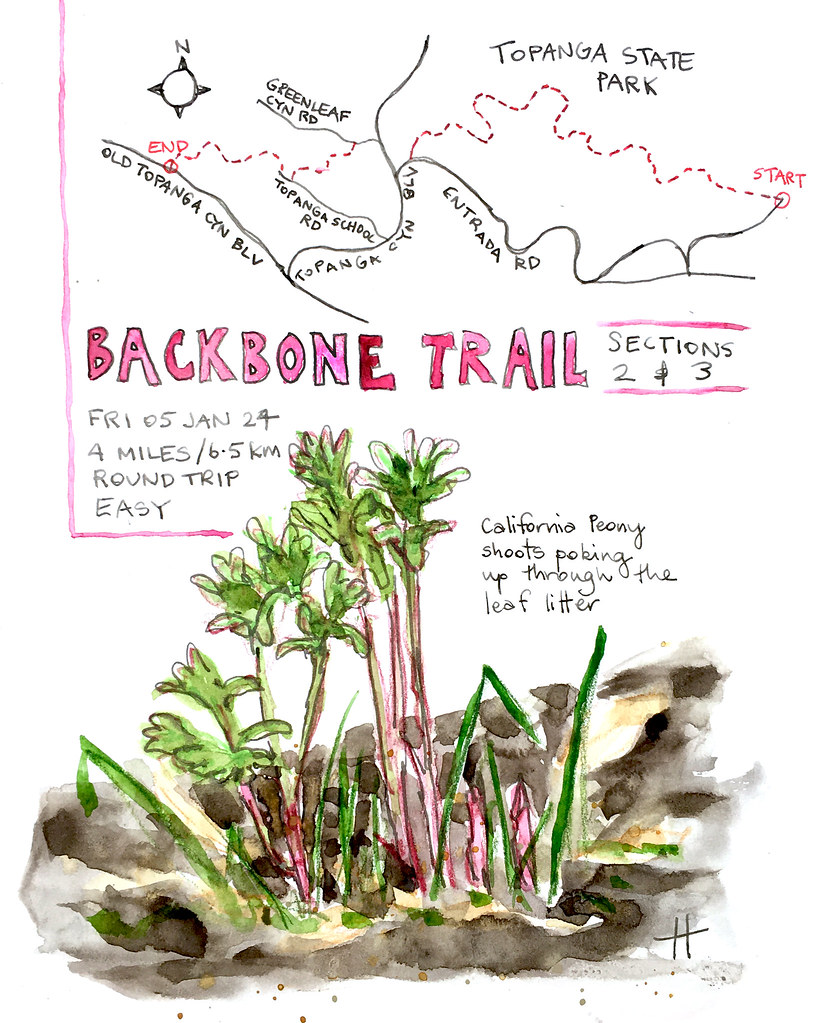
Paeonia californica

Easy part of the Backbone Trail. Glad to see the native peonies emerging!
Paeonia californica, a perennial herbaceous plant reaching a height of 35–70 cm, undergoes subterranean retreat during the summer and reemerges with the onset of winter rains. Its flowering period primarily spans from January to March, followed by the development of two to five fruits per flower.
Indigenous to southwestern California and northern Baja California, California peonies thrive in dry hillsides within the coastal sage scrub and chaparral communities. Frequently found as understory plants, they grow up to an elevation of 1500 m.
Lynx rufus

Thank you, nature, for the best gift — a bobcat sighting!
Delairea odorata

I hiked up to Parker Mesa Overlook from Los Liones yesterday. I‘ve only been to the overlook once before, on Nov 9, 1997 (according to my hiking book). My friend David and I did a sunset/night hike that evening, and we saw a rocket launch from Vandenberg Air Force (now “Space Force”) base. We actually didn’t know wtf we were seeing, but we read about it next day in the news. It looked like a massive translucent zeppelin. Amazing sight!
Delairea odorata is a perennial vine (family Asteraceae) native to South Africa. It is problematic in some of our coastal riparian areas, moist forests, and oak woodlands. The vines form dense mats of vegetation over trees and shrubs, killing plants underneath. It is toxic to animals and fish can be killed when plant materials are soaking in waterways. Unfortunately, it’s completely taken over Los Liones Canyon within Topanga State Park.
under the toyon

I spent a quiet half hour with the hummingbird sage under a toyon tree, enjoying the colours, the coolness, and the calls of oak titmouse, red-shouldered hawk, white-breasted nuthatch, and acorn woodpecker. Time under trees is an essential component of my mental and physical health—is it for you?