Eriogonum cinereum

Ashyleaf buckwheat is one of my favourite chaparral plants, and I love that it grows natively here on our block. Also known as coastal buckwheat, it is endemic to the coastline of Southern California, primarily within Los Angeles County and Ventura County.

Eriogonum cinereum can reach from 0.6–1.25 m in height and width. Its foliage is a lovely pale turquoise/silvery grey colour. The leaves are wavy-edged and one to three centimeters long. The inflorescences stick out from the plant, each with several flower cluster heads of tiny tightly-packed frilly flowers which are usually pale pink in colour. It is the food plant for Euphilotes bernardino, the Bernardino dotted blue butterfly.

Malosma laurina

Catching up in the PerpJo. Not much is flowering now, but the sumac is!

Malosma laurina is a large, rounded evergreen shrub or small tree growing 3 to 5 meters tall. The fragrant leaves and stems, being full of volatile compounds, contribute to the characteristic fragrance of chaparral. The flowers give off a “woodsy-herbal” smell, reminiscent of green apples and turpentine.

The fruit is a whitish drupe 3 mm in diameter with a smooth, flattish stone inside. The Chumash crushed and ate the dried fruits of Malosma laurina and also used the root bark to make a tea for treating dysentery.

Laurel sumac grows natively along the Southern California coastline in frost-free areas. It’s a very tough plant, hard to eradicate — if a fire burns its above ground parts, a large burl underground will re-sprout. It grows new leaves and stems all year long, even during hot dry summers, when most native plants stop growing.

everything all at once

One of my favourite sit spots is under the silky oak tree, on the edge of the driveway. There’s a big Tagetes lemmonii bush (a fan favourite around here) right next to it. The species is named for John Gill Lemmon, husband of American botanist, artist and intellectual Sara Plummer Lemmon (1836 – 1923).

Sara was responsible for the California poppy being designated as our state flower. She established Santa Barbara’s first lending library, where she also sold art and music supplies and hosted cultural gatherings. She sounds like a really interesting woman — I’d like to know more about her.

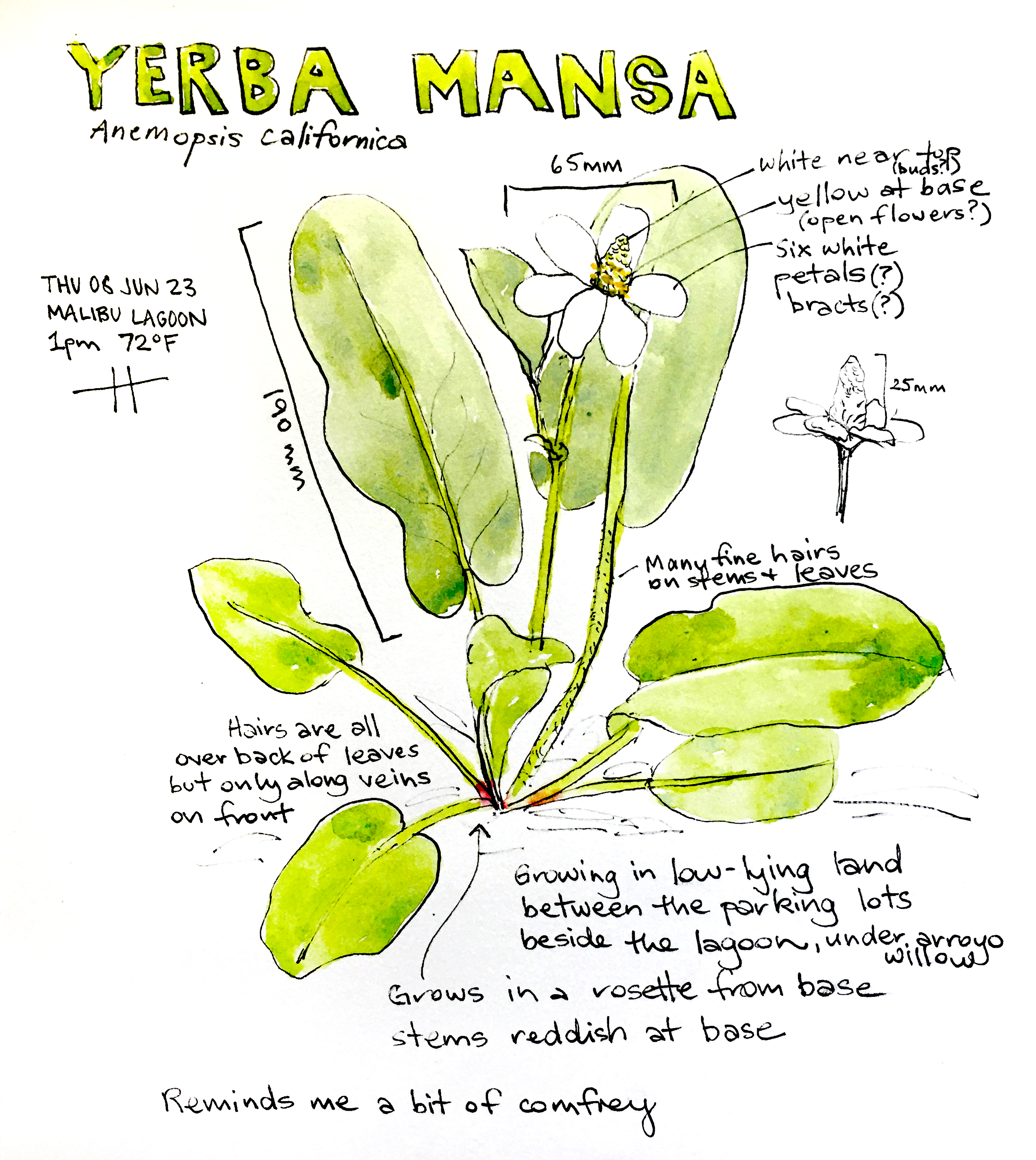
Anemopsis californica

While visiting the lagoon, I was stopped in my tracks by these pretty flowers, and had to learn more about this striking plant.

Yerba Mansa, also known as Lizard Tail, is a perennial native to southwestern US. It prefers wet locations, especially alkaline or saline marshy places below 2000 metres.

The leaves and stems are covered in soft hairs. On the upper side of the leaves, the hairs follow the veins; on the underside they cover the whole surface.

What appears to be a single bloom is actually a dense cluster of individual small flowers borne in a conical inflorescence with five to ten large white bracts beneath it. The conical structure develops into a single, tough fruit with tiny, pepper-like seeds.

The root can be consumed raw or cooked; it has a peppery flavour. Pulverized seeds can be used to make bread or added into other dishes. The root and rhizome have been used to treat the common cold, influenza, pain, wounds, burns, gastrointestinal upsets and many other conditions, but, according to WebMD, there is no good scientific evidence to support these uses. 

Peritoma arborea

I should try to get bladderpod established on our block. It’s apparently easy to grow from seed (and readily self-seeds). It‘s drought-tolerant and fire-retardant, and it attracts native bees, butterflies and hummingbirds. And deer don’t eat it.

The only downside is that it hosts the harlequin beetle which can be a serious pest on brassicas, which I do like to grow in the veggie garden. I wonder how far apart that two kinds of plants would have to be, for this to not be a problem? Hmm, this warrants some further research.

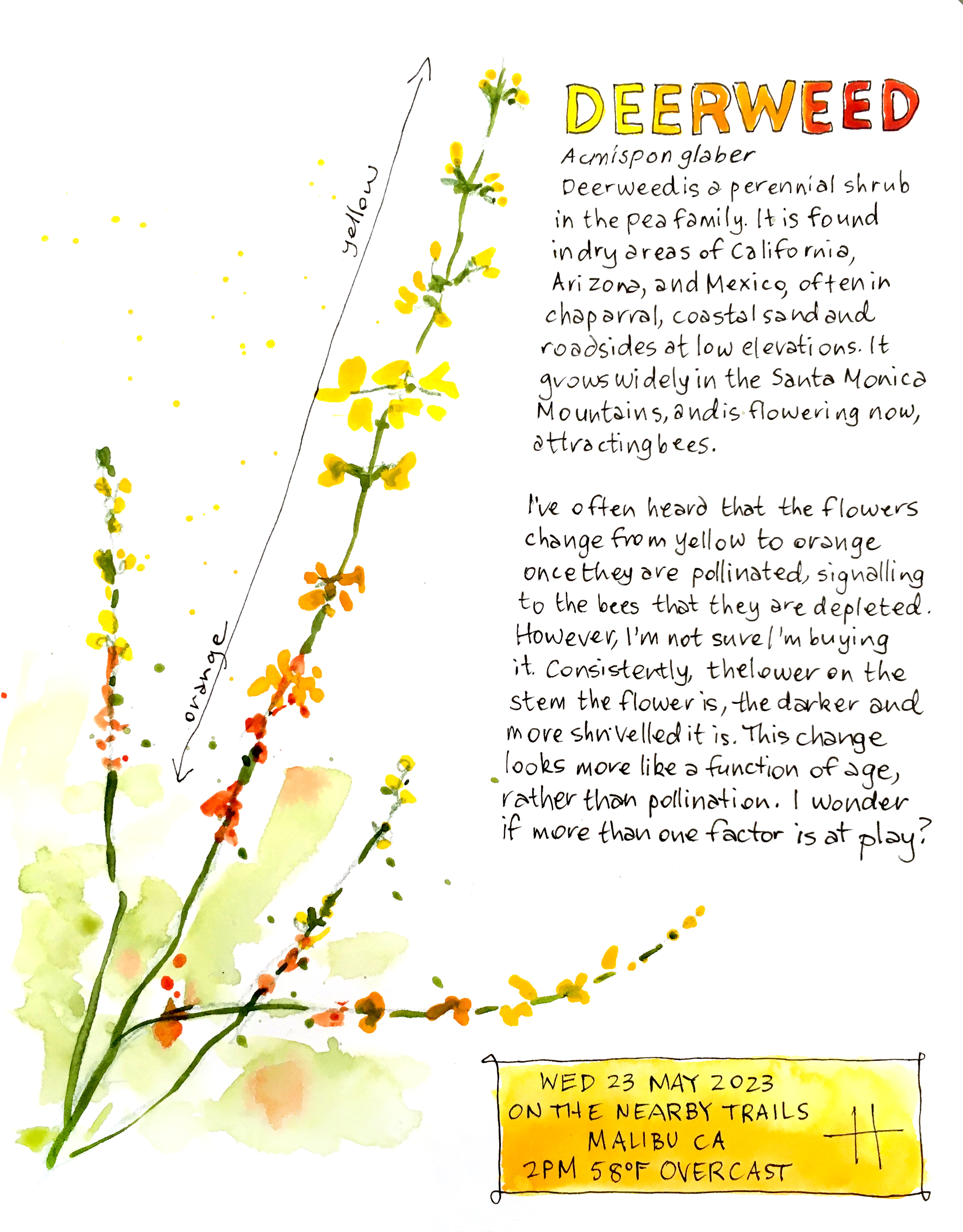
Acmispon glaber

I’ve been looking at a lot of deerweed flowers, and I’m not convinced by the prevailing wisdom about their varying colours. If an individual flower turns orange after pollination, as I’ve often heard, then I would expect to see a more random distribution of orange flowers. But it’s very consistent — the further down the stem, the darker (and more shrivelled) the flower. There are no yellow flowers down low — am I to assume that every single blossom was pollinated? And there are no orange flowers up high — why not? I see bees up high.

It really seems to me that every flower gets darker as it gets older; that it’s age, not pollination, that makes the colour change.

Schoenoplectus acutus

The wetlands in Legacy Park are alive with red-winged blackbirds, great-tailed grackles, mallards, coots and egrets. I like to sit by the tules and watch the interactions. Today there were a lot more drakes (9) than ducks (2); the females were getting persistently pursued and didn’t seem too happy about it.

Salvia apiana

Carrying ladybug larvae to an ailing plant then watching them crawl all over the leaves is a very satisfying way to spend half an hour. Just sayin’. But then I decided it would be best to plant the sage in the ground. Hopefully it will soon bounce back to good health, with or without the help of ladybugs.

fostering plant love

We kicked off the 2023 Junior Ranger program at Malibu Creek State Park today, with my session on plants. We had 23 kids in our target age group (7 to 12 yrs old) plus another 40-odd parents + older/younger kids. Many questions were asked. Many leaves were fondled. I think we all enjoyed ourselves—I know I did!

One enthusiastic young miss informed me that she wants to be a veterinarian. And because she loves animals, she also loves plants, because animals need plants. And we humans need both animals and plants. We are all connected. Yes, wise one, we are.

Viola pedunculata

Viola pedunculata, the Johnny jump-up, California golden violet, or yellow pansy, is a perennial yellow wildflower of the coast and coastal ranges in California and northwestern Baja California. The plant grows on open, grassy slopes, in chaparral habitats, and in oak woodlands. We see its cheerful yellow flowers in the Santa Monica Mountains from early to late spring.