

I know nature journaling isn’t about making pretty pictures, but sometimes it’s nice to do both on the same page.

I know nature journaling isn’t about making pretty pictures, but sometimes it’s nice to do both on the same page.


After completing this sketch, I was hiking back down the trail, and met a group of young adults on their way up. One guy asked me if there was asparagus growing nearby, because he’d just picked and eaten some. Uh … no. There is no asparagus growing here. After reminding him that all plants in the Park are protected, and that some are poisonous, we parted ways. A little further down the track I found the broken plant. I knew it was some kind of lily about to flower, but it wasn’t till I got home I learned that it was Toxicoscordion fremontii (Frémont’s deathcamas or common star lily). As the name suggests, it’s highly toxic to livestock and humans.
I hope he’s OK, but … what a foolish human being! People, don’t go eating plants in the wild unless you know for sure what they are!

I somehow managed to make the silver dollar jade look like a bunch of lollies bursting out of their paper bag. PARTY!!!

The native bush sunflowers (Encelia californica) are just about done for the year. The invasive fountain grass (Pennisetum setaceum) is still going strong 😩

The native yucca (short u, yuh-ka) is starting to flower. This beautiful and useful plant is often confused with the similarly-named yuca (long u, yoo-ka). It’s not helped by our local supermarkets mis-labelling the yuca roots in the produce department.

If you’re looking to eat the roots, you’ll want yuca (also known as cassava). If you want to make soap from the roots, you’ll need the completely unrelated yucca.
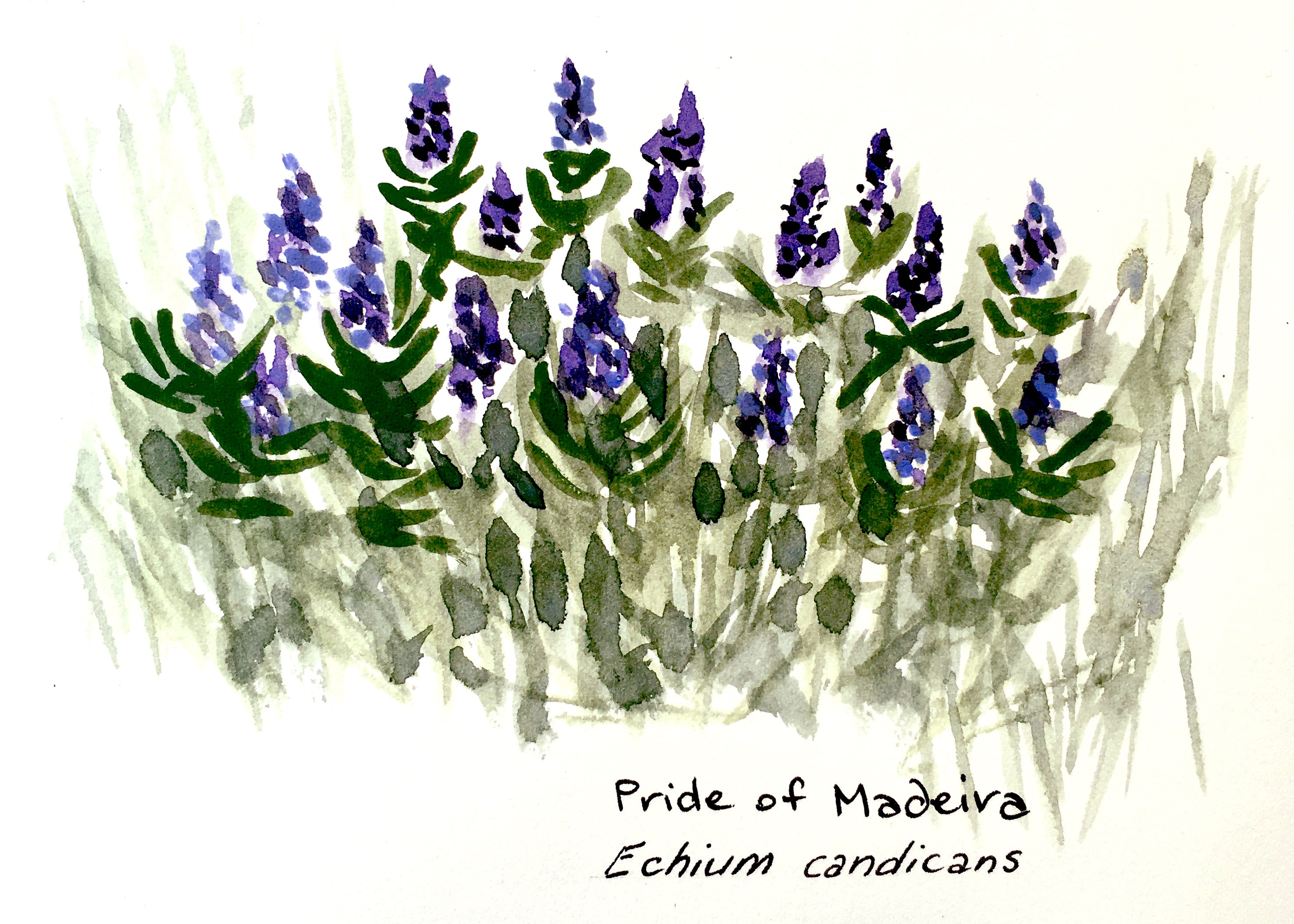
In amongst the native sagebrush and laurel sumac in the Malibu Bluffs Open Space is a big healthy patch of non-native Pride of Madeira. Even though it doesn’t ‘belong’ there, the bees, hummingbirds, orange-tips and tiny native pollinators are loving it.

Agave americana (maguey) is a huge, sharp, blue-green succulent that blooms once, then dies. The flower spike ranges from 12-25 feet (3.5-7.5m) in height — this one by our driveway is just getting started. The bloom trigger mechanism is not well understood, but it generally flowers at about 10 years of age. The fruit are edible — I’ll be collecting and sautéing them when the time comes.

Apparently Callistemons are now Melaleucas. I’ll just keep calling them Bottlebrushes.


The bush sunflowers are busting out all over our sea-cliffs, making “very effective masses of color, in fine contrast to the blue of the sea below and the sky above”, as Margaret Armstrong rightly observed over a hundred years ago. The bees are happy, and later when the seeds have set, the birds will be too.


So many wildflowers on today’s hike! I counted 32 different species, including several that were new to me. This one’s figwort or bee plant. The flowers are small, but look like cute little faces.
(Oops, just saw a typo on my sketch. It’s Scrophularia. Sounds like a disease, doesn’t it?)
 hashiworks