
Who knew that sitting inside a huge concrete tub could be so interesting? Grateful for my extremely close focusing binoculars and my macro lens.
Who knew that sitting inside a huge concrete tub could be so interesting? Grateful for my extremely close focusing binoculars and my macro lens.

There were a bunch of these tiny orb weavers inside a dead maguey leaf (Agave americana). One was green, but most were pretty well camouflaged. So cute!

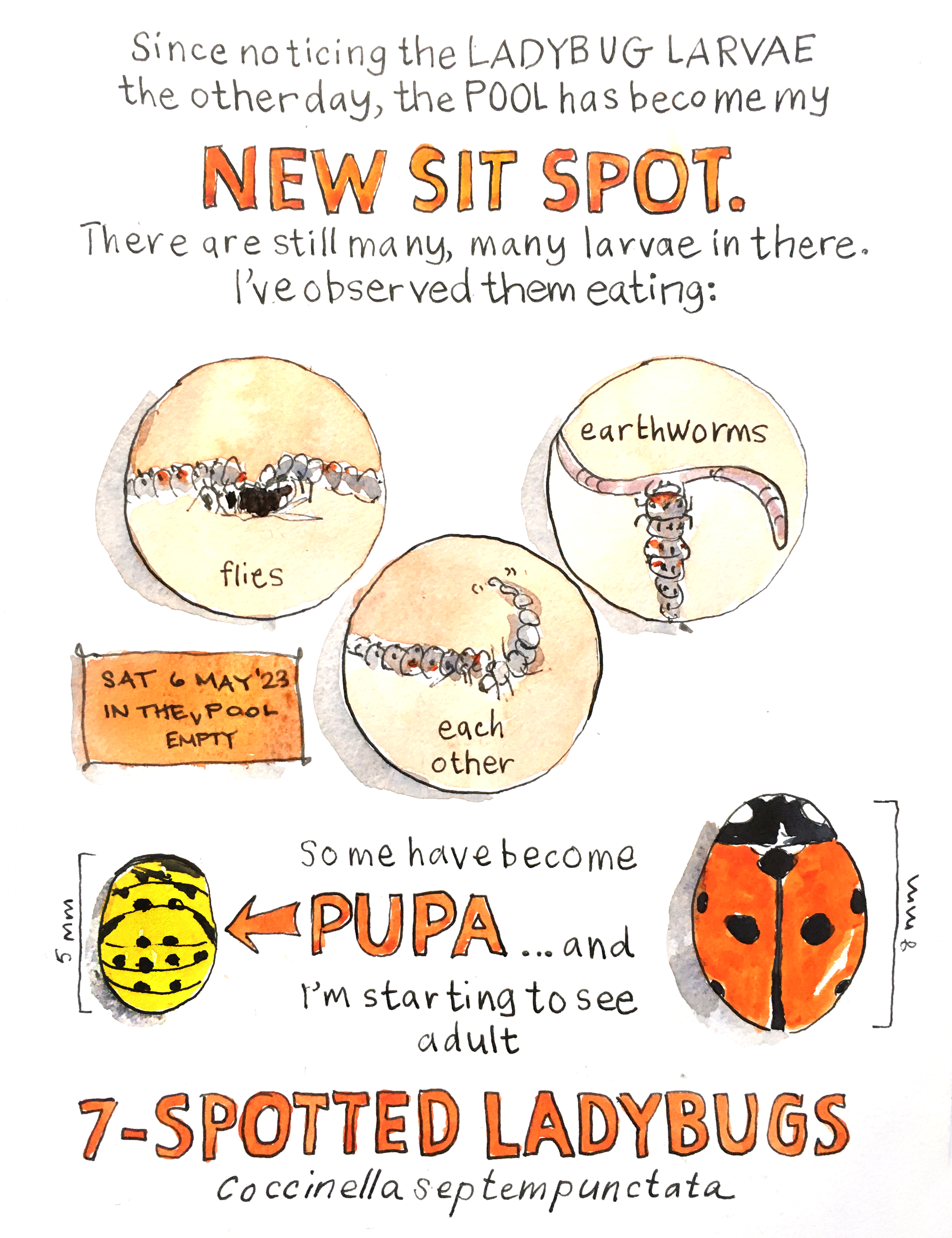
Carrying ladybug larvae to an ailing plant then watching them crawl all over the leaves is a very satisfying way to spend half an hour. Just sayin’. But then I decided it would be best to plant the sage in the ground. Hopefully it will soon bounce back to good health, with or without the help of ladybugs.

I’m pretty sure these are native, not invasive, ladybug larvae. I think the invasive Asian ones are orange all the way down their sides.

I was thrilled to see my first horned lizard on this morning’s hike with Vic and Annette. Huge kudos to A. for spotting this guy in the shadows. The Blainville’s Horned Lizard is a flat-bodied lizard with a wide oval-shaped body. Adults can vary in length from 2.5-4.5 inches / 6.3-11.4 cm (snout to vent) and have enlarged pointed scales scattered on the upper body and tail, and a large crown of horns on the head. Their biggest claim to fame is that they can squirt an aimed stream of blood from the corners of the eyes for a distance up to 5 ft / 1.5 m.
We also spotted a pair of side-blotched lizard having a cuddle in the middle of the trail. Ah, spring!

Great-tailed grackles do indeed have great tails—they can fold them in half to make a vertical presentation. These birds are larger than starlings but smaller than crows. Males are iridescent black which sometimes has them simply called “blackbirds”. Females are brown with darker wings and tail.
It’s breeding season, and there’s a lot of grackle activity (and song!) going on at Legacy Park, where they are sharing space with red-winged blackbirds, another beautiful and melodious black bird.
Photo reference: Vivek Khanzodé

UPDATE 5.6.23: I incorrectly showed the position of the female flowers. See this post.
It promises to be a great year for acorns around here! Most of the coast live oaks are currently sprouting thousands of yellow fingers, male flowers on their long catkins. Their female counterparts are hard to see, but if you look closely you can find them wedged in the angle between leaf and branch.
California’s oak woodlands sustain higher levels of biodiversity than virtually any other terrestrial ecosystem in the state. More than 300 species of birds, reptiles, amphibians and mammals depend on oak woodlands for food and shelter, and that doesn’t count the many hundred species of insects, spiders, mosses, lichens and fungi.
Like so many other habitats, oak woodlands are under severe threat from development and climate change. But for this year, at least, we can look forward to a healthy acorn crop. Yay!

Pretty blue-eyed grass is actually an iris, not a grass. It’s putting on a good show around here right now. No Chumash uses were recorded for this plant, but the Ohlone used an infusion of the roots and leaves as a cure for indigestion and stomach pain.

It was good to be back with Trisha on Youtube last Thursday night. I learned some new words and cicada body parts. She also told us about the Massospora cicadina fungus that turns cicadas into “flying salt shakers of death”. Amazing(ly gross).
The citrus cicada is found in the south west US (CA-AZ-UT-NV). (Trisha’s specimen was collected in Mesquite, NV.) They are not one of the 13- or 17-year cicadas; these ones have a life span of 3-4 years from egg to adult death.

I learned something new about insect tootsies today.
 hashiworks