

In honour of International Day for Biological Diversity, here are the birds I’ve seen at home over the past couple of days. I made an attempt at relative sizing, but I think the oriole ended up a bit small.
In honour of International Day for Biological Diversity, here are the birds I’ve seen at home over the past couple of days. I made an attempt at relative sizing, but I think the oriole ended up a bit small.

Click to enbiggen.
We have a LOT of snails at the moment; they especially love the citrus. As I picked them off the trees this morning, I checked the whorl orientation, and yep, they were all dextral. It would be fun to see a sinistral snail! The idea makes the daily removal somewhat more interesting.

Digger bees, although solitary, nest in large aggregations. Each female digs her own tunnel, which can be up to a foot deep and have several branches. Each branch terminates in a chamber where the female lays a single egg, providing it with pollen and nectar collected from flowers. The larvae hatch and consume the stored food, then grow into pupae and then into adult bees, all while underground.
Next spring or early summer the adults will emerge, mate, and do it all over again … Right now we‘re at the mating stage, by the looks of things! I don’t know if they will re-use the existing tunnels or dig new ones. I‘ll keep checking on them.
There are also a few bee flies (possibly tribe Villini) hovering about at ground level. The larval stages of bee flies are predators or parasitoids of the eggs and larvae of other insects. The adult females usually deposit eggs in the vicinity of possible hosts, quite often in the burrows of beetles or wasps/solitary bees. So I’m pretty sure that’s what they’re looking to do! It’s a fly-eat-bee world.

Click to enbiggen.

I have lived within an hour’s drive of Conejo Valley Botanic Garden for decades. How is it that I never visited until the other day? What a lovely place! What other nearby natural joys am I missing out on?
It was a delight to come upon an unfamiliar, yet local, oak tree, Quercus tomentella. This species is a relict. Though it is now limited to the offshore islands, it was once widespread in mainland California, as evidenced by the many late Tertiary fossils of the species found here. The tree in the gardens is young (planted 1995). All going well, it should grow two and a half times this high. Live long and prosper, Island Oak!

Fun morning sighting. I only ever see one thrasher at a time, usually dashing across the driveway, so I don’t know if there are multiples here. But I’m always happy to spot this mockingbird relative.
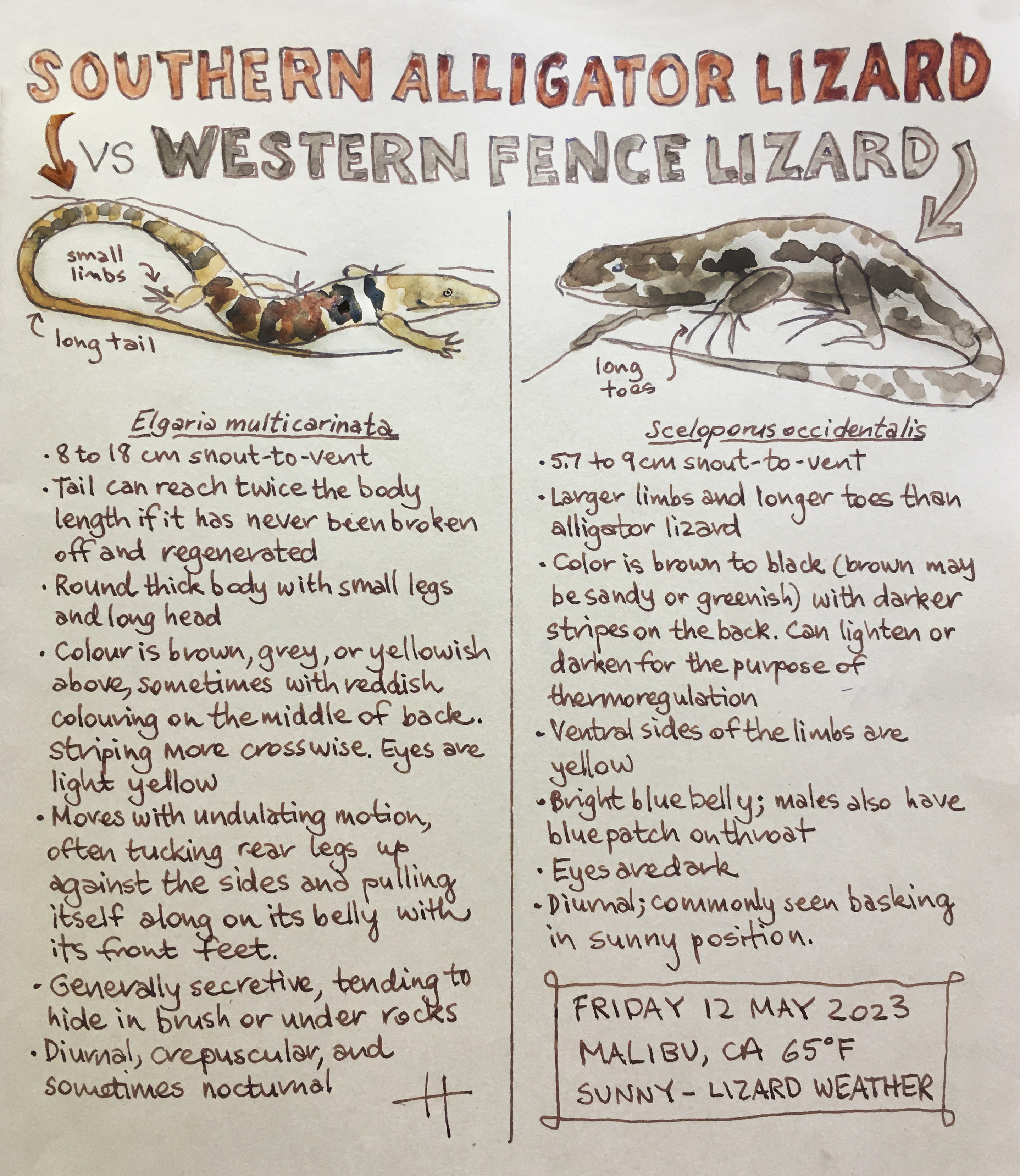
With our local lizards having such variable colouration, telling them apart is more about shape and behaviour than it is about colour or patterns. Our most commonly-seen reptile is the western fence lizard, who loves to bask in the sun, gripping with long toes or doing pushups. Alligator lizards are seen less frequently. They have long, slightly prehensile tails and a snake-like way of slithering. Now that I’ve journaled the differences, I don’t think I’ll ever get them confused.

Spiny lobsters can produce a loud rasping sound by rubbing an extension of their antennae against a rigid part of their body below their eyes. This noise may be used to communicate with other lobsters or to ward off predators.
This was the most intact lobster shell I’ve ever seen at the beach. Sure, it was broken in half and was missing a few legs, but it was mostly there.

The wetlands in Legacy Park are alive with red-winged blackbirds, great-tailed grackles, mallards, coots and egrets. I like to sit by the tules and watch the interactions. Today there were a lot more drakes (9) than ducks (2); the females were getting persistently pursued and didn’t seem too happy about it.

I am admiring the vase of pretty purple chive flowers here on my table, and feeling inspired by the botanical illustrations of Swedish botanist Carl Lindman (1856-1928). There is so much to learn from artists like him.
Chives are widespread in nature across much of Europe, Asia, and North America. A. schoenoprasum is the only species of Allium native to both the New and the Old Worlds. As well as producing edible flowers, leaves and bulbs, chives have pest-repelling properties that make them a great companion plant for most other vegetables and herbs. The plant also provides a great deal of nectar for pollinators. Gotta love ’em!
 hashiworks