

I always love a Jean Mackay class. Here in SoCal we don’t have many deciduous trees, so it’s not likely I’ll get to see a lot of abandoned nests in bare branches in the coming months. But I’ll be keeping my eyes open, just in case.
I always love a Jean Mackay class. Here in SoCal we don’t have many deciduous trees, so it’s not likely I’ll get to see a lot of abandoned nests in bare branches in the coming months. But I’ll be keeping my eyes open, just in case.

So many questions!


I had the best time at the first meetup of the Santa Monica Mountains Nature Journal Club. Thirteen of us (including some NJ newbies) got together at gorgeous King Gillette Ranch for nature journalling, food, art supply tryouts, and brainstorming. Can’t wait to do it again next month!
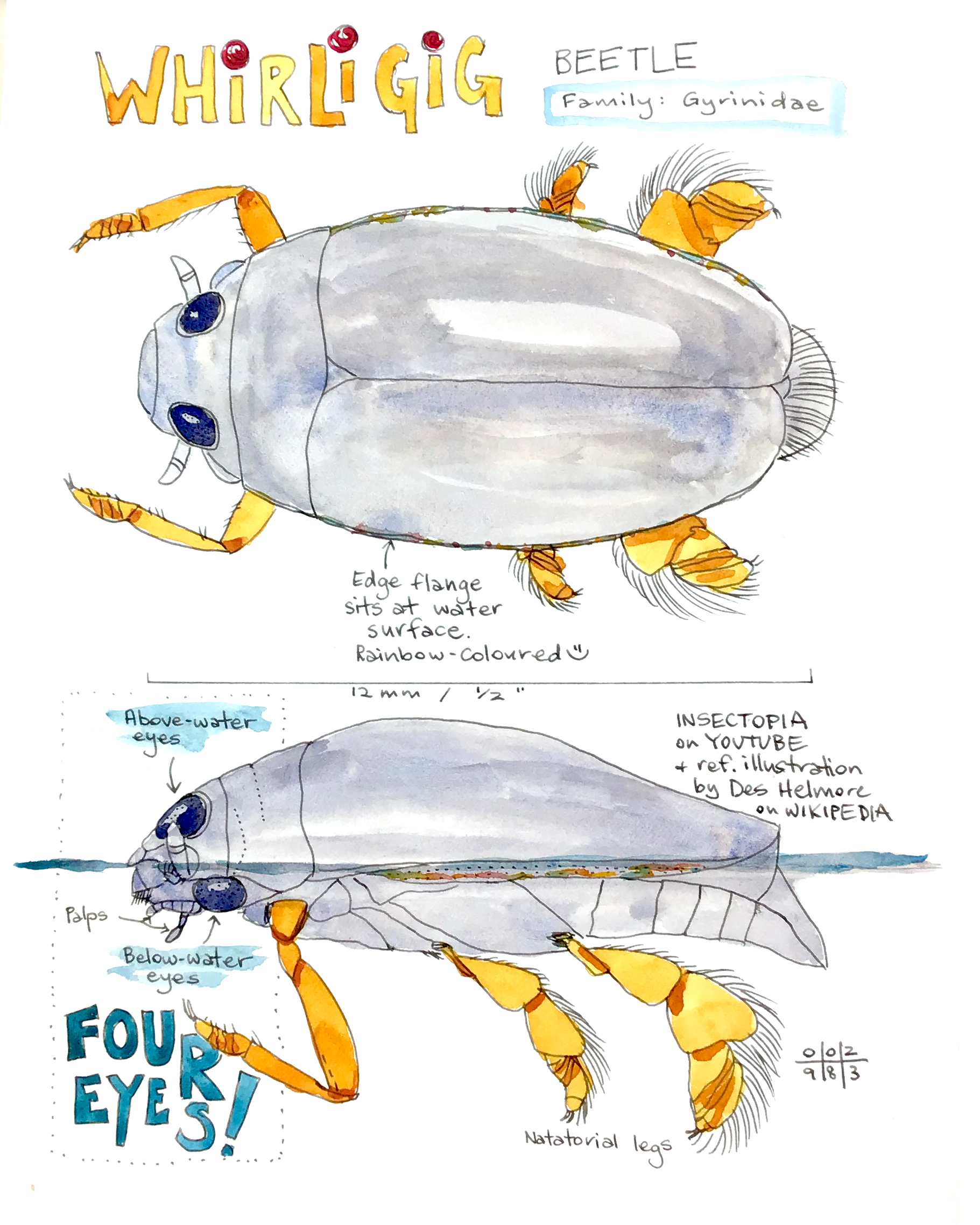
Here’s something strange: the compound eyes of a whirligig beetle are divided into a higher part that is above water level when the beetle is floating passively, and a lower part that sits below water level. Gyrinidae are the only type of beetle with this feature.
The antennae are also unusual among beetles, being short and plump, and placed about at water level.
Whirligigs get their common name from their habit of swimming rapidly in circles when alarmed. Adults carry an air bubble under the elytra at the tip of their abdomen, allowing them to breathe underwater. They are very social creatures, often found in large numbers swimming around on the water’s surface. There are about 700 species worldwide.

Before driving home from my shift at the state park visitor center, I sat under a tree in the parking lot to record thoughts and sounds. I really love my (volunteer) job. The people who come in — they want what we’re selling. I don’t mean drinks and branded swag, but hiking trails, wildlife, history, geology, a respite from the city. It’s such a pleasure to answer their questions (and provoke more), show them something they‘ve never seen, give them a new experience, or provide a comfort.
And when your colleague sends you home with a bunch of art supplies? Bonus! (thanks Dave!)

Some people find taking hallucinogens fun, but I’m not one of them. However, I did enjoy a trip down memory lane, back to that day when we ditched high school and went down to the river to skinny dip, and there was lots of datura growing on the sandy banks …

For a long time I thought we only had one thrasher in our yard, but now it’s clear we have a pair. They are busy all day long bringing food to their nest in the bougainvillea. Fingers crossed for a successful fledge!

I had fun watching a couple of flame skimmer dragonflies cavorting over the pool while I ate my lunch.
 hashiworks