Nature journaling very tiny things, with the help of a microscope. I was interrupted by the grosbeak strike, so got no further with this page.

Nature journaling very tiny things, with the help of a microscope. I was interrupted by the grosbeak strike, so got no further with this page.

White-breasted nuthatches (Sitta carolinensis) eat insects and large, meaty seeds. They get their common name from their habit of jamming nuts and acorns into tree bark, then whacking them with their sharp bill to “hatch” out the seed from the inside. They nest in holes in trees (either created naturally or excavated by woodpeckers) and are most commonly found in deciduous woodland. I was very happy to meet this one today.

It’s been a long while since we had a bird collision. The shelf outside the kitchen window, complete with tall plants, was doing the trick. But yesterday a black-headed grosbeak flew into a gap in the foliage and crashed. The saddest part was that we had only just seen her at the bird bath a day or two before — grosbeaks are not common visitors here. So freaking sad.

It’s fun to come across living organisms in unexpected places.

I looked up this beetle when I got home from our nature journal meetup. Turns out, this is one of the most widely distributed eucalyptus leaf beetles in Australia, but it was only discovered in the US (here in Los Angeles) a year ago.
Paropsis atomaria is considered a pest in eucalyptus plantations in Australia and is reported to cause defoliation, decreased growth and wood quality, and sometimes tree death. Both larvae and adults feed on the foliage. Development from egg to adult takes approximately one month and there are up to four generations per year
So this cute little beetle is quite the eucalyptus scourge. I bet there are many California native plant supporters who are not unhappy that it has reached our shores — eucalyptus species themselves being invasive around here.

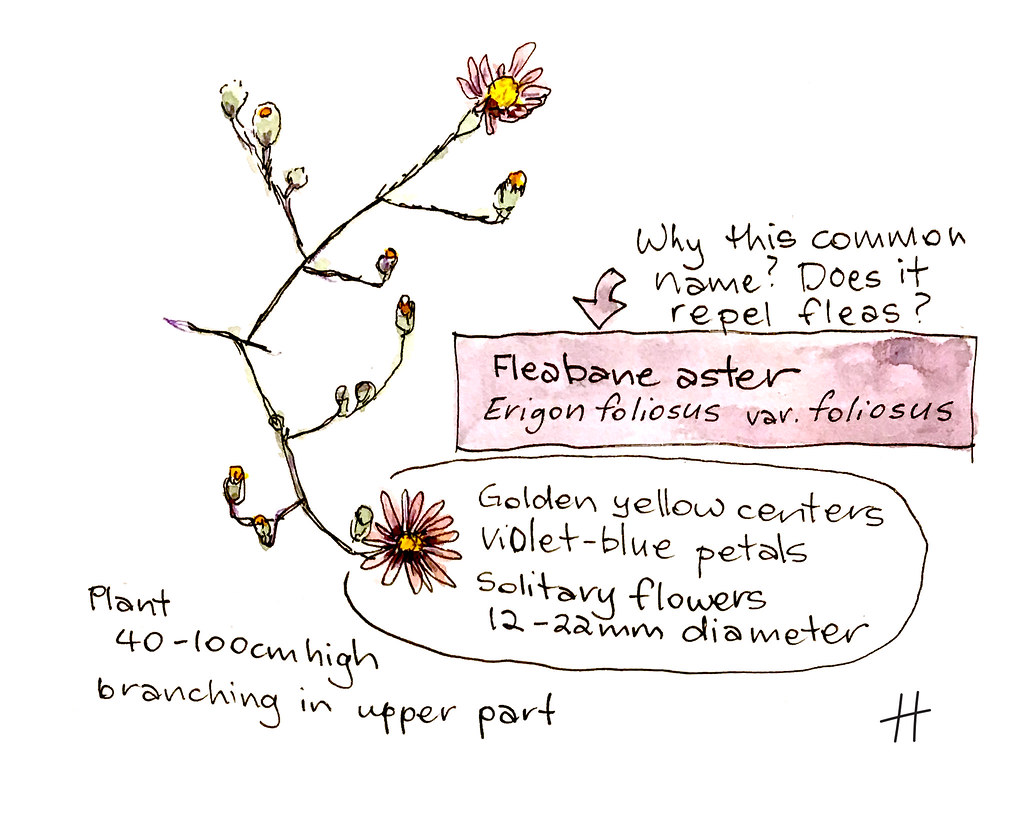
There are quite a few plants in the Asteraceae family with the common name ‘fleabane’. It was once thought that these daisies would rid your house of fleas; this belief apparently now lives in the realm of ‘superstition.’
There aren’t many wildflowers around here at this time of year, so it’s even more enjoyable to see these delicate beauties. Erigeron foliosus is native to western North America from Oregon, through California, into Baja California. It can be found in many habitats, including chaparral, oak woodlands, and rocky talus.
The Western Snowy Plover nests on open sand, so it’s extremely vulnerable to human impacts, both direct and indirect. For example, the kelp that is washed ashore is browsed upon by many insects and crustaceans. These invertebrates are a primary food source for plovers and other shore birds, so “cleaning up” the wrack removes a key element in the food chain. A more indirect impact: the population explosion of crows and ravens — caused by the abundant food sources offered by humans — has greatly multiplied a major plover predator.
At current counts, there are less than 2500 Western Snowy Plovers throughout their coastal range (a population of 3000 is the minimum goal) and their habitat continues to shrink. So if you see a cable fence on your local beach, be sure to stay out of the nesting zone to give these vulnerable (and adorable) birds a chance to breed and thrive.
Thanks to Kriss Neuman of Point Blue Conservation Science for a fascinating lesson. Thanks to John Muir Laws for his drawing tips.

I always love a Jean Mackay class. Here in SoCal we don’t have many deciduous trees, so it’s not likely I’ll get to see a lot of abandoned nests in bare branches in the coming months. But I’ll be keeping my eyes open, just in case.