

Teensy little leaves being eaten by teensy little caterpillars.
Teensy little leaves being eaten by teensy little caterpillars.

This week in the PerpJo. Rhus ovata, commonly known as sugar bush or sugar sumac, is a shrub or small tree found growing in the canyons and slopes of the chaparral and related ecosystems in Southern California, Arizona, Baja California and Baja California Sur. It is a long lived-plant, up to 100 years, and has dense evergreen foliage. It is closely related to and hybridizes with lemonadeberry, which grows at our place. It’s in the cashew family!


We had our third SMMNJC meetup today, and I’m still a-glow, hours later. Fourteen of us met at low tide at Malibu Lagoon State Beach to share a picnic, then marvel at sea hares, anemones, limpets, shrimp, crabs, octopuses, patterns in the sand, seabirds, and so much more. Near the end of our time together, I quoted the immortal words of Kurt Vonnegut, “Well if this isn’t nice, I don’t know what is.” My heart is full.

We recently saw the return of Yellow-rumped warblers to our yard. They breed in the northern parts of the continent and come south in the non-breeding season.
Males have conspicuous yellow patches on the crown, flank, and rump (the latter giving rise to the nickname “butter butt” among birdwatchers). Their Latin name means “crowned moth-eater”, though they eat plenty of other insect species, as well as spiders.
Happy to see them back!
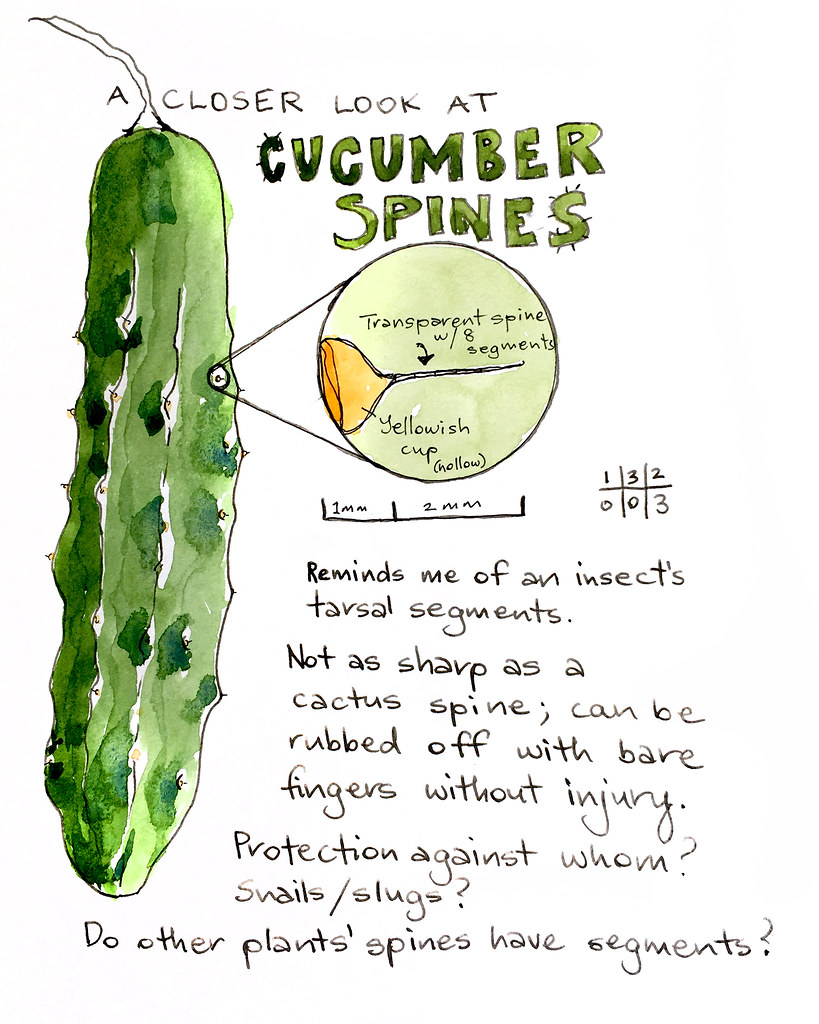
My homegrown cucumbers are very prickly. It’s not a problem; the spines are easy to scrub off. But before doing so today, I decided to examine some of them under the microscope. Now I’m curious about cactus spines!

On Sulphur Mountain I saw a curious phenomenon—clusters of baby acorns on one of the coast live oaks. This makes no sense to me, for multiple reasons:
I know we’ve had a weird weather year, but I only observed this phenomenon in a single tree out of many hundreds I passed. Why would only one tree be affected, if weather was the cause? What’s going on here?

Our nature journaling trip to Santa Cruz Island was cancelled by the transportation company due to strong winds. Instead, we climbed the Sulphur Mountain Road Trail and journaled frogs, jumping spiders, mutant acorns, wood rat nests, and more. I saw my first northern harrier! What a lovely day with kindred spirits.

Found this chewed fungus in the middle of a track at the Park; left by whom, I wonder? I think it’s an earth ball, Scleroderma verrucosum, but I am no mycologist.

Large milkweed bugs are seed-feeders; their main diet is, not surprisingly, milkweed seeds. So I’m not sure what this lady was doing on the sweet potato vine.

 hashiworks