

Easy section this time, in one of my favourite parts of Malibu Creek State Park. It was fun to see thousands of acorns sprouting on the forest floor, even knowing that only the slimmest fraction of them will grow into trees.
Easy section this time, in one of my favourite parts of Malibu Creek State Park. It was fun to see thousands of acorns sprouting on the forest floor, even knowing that only the slimmest fraction of them will grow into trees.

The Backbone adventure proceeds apace. Five sections down, eight to go. This section is particularly enjoyable, with spectacular rock formations and awesome views. And, at this time of year, lots of fungi!

The bird bath camera continues to bring us surprises. While it’s a little tedious scrolling through the many, many house finch captures, it’s worth it when we see a new arrival. The red-breasted nuthatch is another winter visitor to our region. Like other nuthatches, these move quickly over trunks and branches probing for food in crevices and under flakes of bark. They creep up, down, and sideways without regard for which way is up. Such fun to see this one at the bath.

Seen on the wildlife camera, a new-to-us visitor enjoying a drink and a splash. We are in the winter range of the Hermit Thrush, and very happy to welcome this one to our garden, as they rarely visit backyards. I haven’t heard its lovely, melancholy song, but I’m keeping my ears open.

What a beauty! In fact, the scientific name translates as “Beautiful foliage, beautiful leaf”. There are 80+ extant species in the Phylliidae family, ranging from as far east as the Seychelles in the Indian Ocean, throughout the Australasian region, to as far west as Fiji in the Southern Pacific. They are some of the most remarkably camouflaged mimics in the animal kingdom. A leaf insect doesn’t just look like its habitat; when it walks, it rocks back and forth, mimicking a real leaf being blown by the wind. And its eggs look like seeds. Amazing.

It was fun to nature journal this plant at Charmlee Wilderness Park; it was alone beside the trail, with no siblings in sight. I didn’t know what it was called till I saw Suzanne later and she identified it from my sketch.
California Goldenrod (Solidago velutina ssp. californica) has a basal rosette of leaves that are still present at flowering time. The leaves get progressively smaller higher up on the stem. Each leaf has three prominent veins running from the base to near the tip. One plant can produce as many as 500 small yellow flower heads in a large, branching array at the top of the plant. The flowers remind me of goldenbush, and in fact both plants are in the Asteraceae family.

Underwing moths (Catocala spp.) are known for having dull, camouflaging forewings, and brightly colored hindwings which they suddenly flash open if disturbed. It is believed that the patterning of the hindwings resembles the eyes of a predatory animal, such as a cat. A bird or other small predator that is not used to this display is likely to be frightened, allowing the moth to escape.
Of the more than 250 known species, slightly less than half are found in North America—mostly in the United States—while the rest occur in Eurasia.

We discovered a Jerusalem cricket exoskeleton. Given the opportunity to sketch it from any angle, I decided to draw its ventral (under) side. Thanks to Trisha from Insectopia, I can name a few insect parts!
Jerusalem crickets have hypognathus heads, which means their mouthparts point down. That pointy bit at the bottom of the head is the mouth. The palps are little ‘mouth fingers’ that help push food into their maw.
We’ve been seeing these big guys a LOT of late, in the house, in the yard, and out on the trails. They are not venomous, but they have strong mandibles and can inflict a painful bite. They also emit a foul odour if distressed. For these reasons, I don’t usually handle live ones, so it was a treat to have this molt to examine closely.
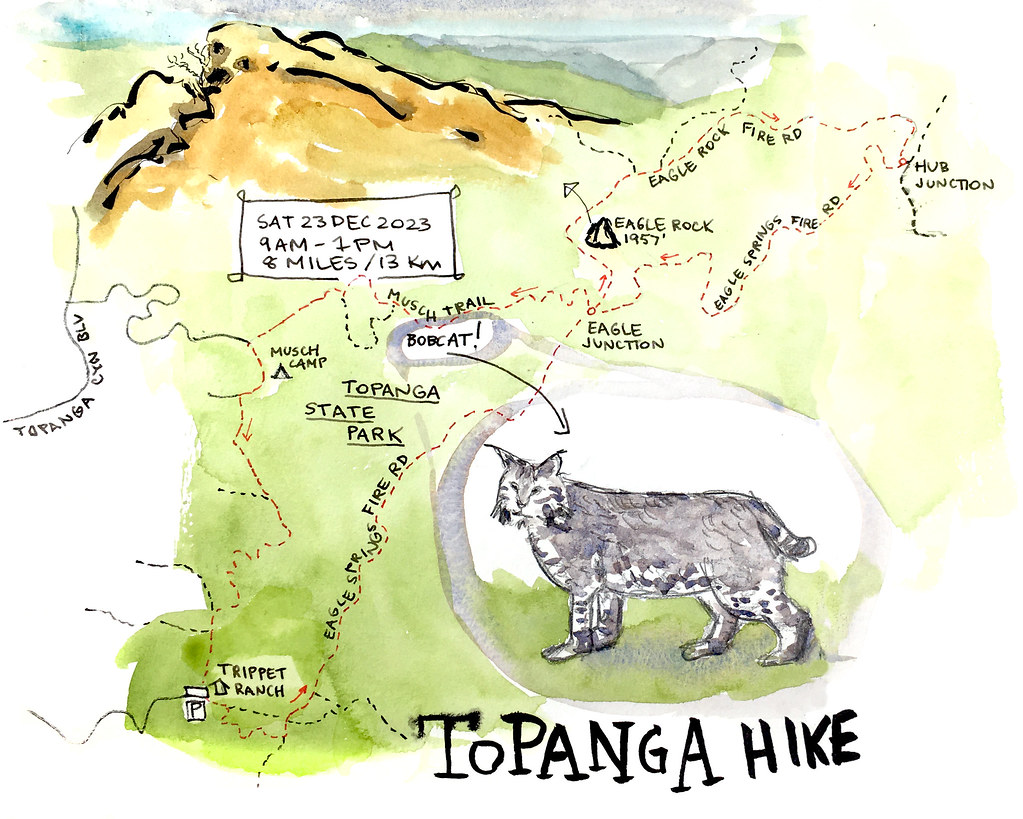
Thank you, nature, for the best gift — a bobcat sighting!

During the rains we had a surprise visitor, a blind snake! It’s our first time seeing this earthworm-looking reptile. Rena humilis is found in the southwestern United States and northern Mexico. It lives underground, sometimes as deep as 20 metres (66 ft). Having no need for vision, its eyes are vestigial, just two light-detecting black spots. The skull is thick to permit burrowing.
Its diet is made up mostly of insects and their larvae and eggs. It is found in deserts and scrub where the soil is loose enough to work, so I’m not sure what it was doing in our living room! I moved it outside, and noticed that my hands smelled like mushrooms afterwards. Very earthy.
 hashiworks