

It’s been a while since I drew an insect with Trisha from Insectopia. I learned a new term: SULCUS (singular) / SULCI (plural) for folds in an insect’s exoskeleton. It also refers to the depressions or grooves in the brain.
It’s been a while since I drew an insect with Trisha from Insectopia. I learned a new term: SULCUS (singular) / SULCI (plural) for folds in an insect’s exoskeleton. It also refers to the depressions or grooves in the brain.

There are over 9000 species of click beetles worldwide, and over 900 species in North America alone.
This family is characterized by the unusual click mechanism on the beetle’s underside. A spine on the prosternum can be snapped into a corresponding notch on the mesosternum, producing a violent “click” that can bounce the beetle into the air. Clicking is mainly used to avoid predation, although it is also useful when the beetle is on its back and needs to right itself. See some close-ups and slow motion video here.

We had fun drawing a ground beetle with Trisha this past week, especially as the specimen had mysterious additional mouthparts that our entomologist had never seen before. I didn’t do a great job depicting the metallic red/green head and pronotum. I’d like to get myself some metallic watercolours for times like these.

We didn’t identify this fly down to the species, but we figured out the family. Some tachinid flies parasitize pest species, which has allowed them to be used as biological control agents by farmers. For instance, Istocheta aldrichi only attacks the Japanese beetle. But some are generalists; Compsilura concinnata uses at least 200 different hosts, and so is not safe to be used as biological control.
Adult tachinids feed on flowers and nectar from aphids and scale insects. As many species typically feed on pollen, they can be important pollinators of some plants, especially at higher elevations in mountains where bees are relatively few. So don’t be hating on them, just because they’re flies!

What a beauty! In fact, the scientific name translates as “Beautiful foliage, beautiful leaf”. There are 80+ extant species in the Phylliidae family, ranging from as far east as the Seychelles in the Indian Ocean, throughout the Australasian region, to as far west as Fiji in the Southern Pacific. They are some of the most remarkably camouflaged mimics in the animal kingdom. A leaf insect doesn’t just look like its habitat; when it walks, it rocks back and forth, mimicking a real leaf being blown by the wind. And its eggs look like seeds. Amazing.

Underwing moths (Catocala spp.) are known for having dull, camouflaging forewings, and brightly colored hindwings which they suddenly flash open if disturbed. It is believed that the patterning of the hindwings resembles the eyes of a predatory animal, such as a cat. A bird or other small predator that is not used to this display is likely to be frightened, allowing the moth to escape.
Of the more than 250 known species, slightly less than half are found in North America—mostly in the United States—while the rest occur in Eurasia.

This honking big moth is found in eastern North America, from Florida to Maine in the U.S., and from Saskatchewan eastward through central Quebec to Nova Scotia in Canada. It is also found across Mexico; it is considered threatened there, due to habitat loss.
The moth has lime-green wings and a white body. Its typical wingspan is roughly 114 mm (4.5″), but wingspans can exceed 178 mm (7″), ranking the species as one of the larger moths in North America. I’d love to see one in the wild!
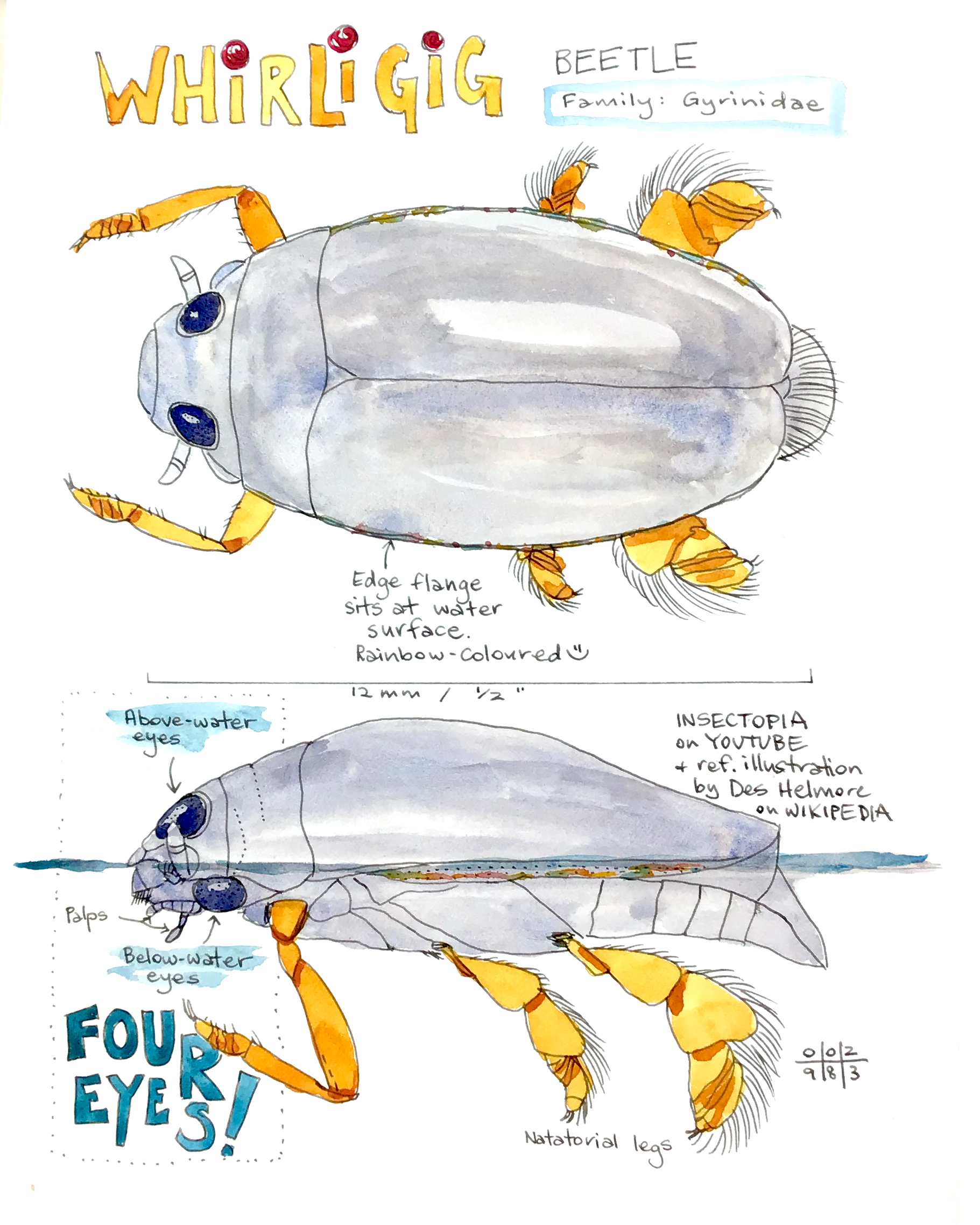
Here’s something strange: the compound eyes of a whirligig beetle are divided into a higher part that is above water level when the beetle is floating passively, and a lower part that sits below water level. Gyrinidae are the only type of beetle with this feature.
The antennae are also unusual among beetles, being short and plump, and placed about at water level.
Whirligigs get their common name from their habit of swimming rapidly in circles when alarmed. Adults carry an air bubble under the elytra at the tip of their abdomen, allowing them to breathe underwater. They are very social creatures, often found in large numbers swimming around on the water’s surface. There are about 700 species worldwide.

Mutillidae is a family of more than 7,000 species of wasps whose wingless females resemble large, hairy ants. Velvet ants can be found worldwide. Over 400 species occur in the North American Southwest, where this male specimen was collected.
Males fly in search of females; after mating, the female enters a host insect nest, typically a ground-nesting bee or wasp burrow, and deposits one egg near each larva or pupa. The mutillid larvae then develop as idiobiont ectoparasitoids, eventually killing their immobile larval/pupal hosts within a week or two.
The exoskeleton of the velvet ant is remarkably strong. It requires 11 times more force to crush than that of the honeybee.

Augochlora pura is a solitary sweat bee found primarily in the Eastern United States. Its Latin name means “pure golden green“, a lovely description of its metallic green hue. It nests in rotting logs, and can produce up to three generations per year. Both males and females have been observed licking sweat from human skin, most likely seeking salt.
If you are being “foraged” by sweat bees, be careful to brush them from your elbow and knee joints before bending your limbs, or you may be inadvertently stung.
 hashiworks