

Saxicola rubicola

Charcoal and graphite. From a class with Maggie Hurley.

From the kitchen window, I can see the huge creeping rosemary bush on the hill above the house. While I sip my morning tea, I watch flocks of finches swoop in to eat the flowers for breakfast.

As I was falling asleep last night, I could hear adult and young Great Horned Owls out in the darkness. The babies were screaming for food; I imagine the parents were hooting “Patience little ones! We’re coming!“


The most common bird around here is the House Finch, a gregarious participant in the life of the yard and bird bath, with a long twittering song. The red plumage of a male House Finch comes from carotenoids in the food it eats during molt (birds can’t make bright red or yellow colours directly). Females prefer to mate with the reddest male they can find.
House Finches are native to the Western United States. They were introduced to Oahu from San Francisco sometime before 1870, and had become abundant on all the major Hawaiian Islands by 1901. In 1940, they were turned loose on Long Island, New York, and spread across almost all of the eastern United States and southern Canada within the next 50 years. They can be found in a wide variety of habitats including dry desert, coniferous forests, suburbs, and cities.
Unlike most other birds, House Finches exclusively feed their nestlings plant-based foods, including seeds. Most other vegetarian adult birds feed their babies protein-rich insects. At our place, the favourite lunch seems to be rosemary flowers.

Green Herons are short and stocky (for a heron) with a thick neck that is often drawn down into the body. It’s only when they strike at food that you can see the length of the neck.
Although Green Herons are fairly common across the U.S., their population has suffered a decline of approximately 1.3% per year between 1966 to 2019, resulting in a cumulative decline of about 51%, according to the North American Breeding Bird Survey. In the past, people hunted Green Herons for food and controlled their numbers near fish hatcheries. Today they, like so many creatures, are negatively impacted by habitat loss from the destruction of wetlands.
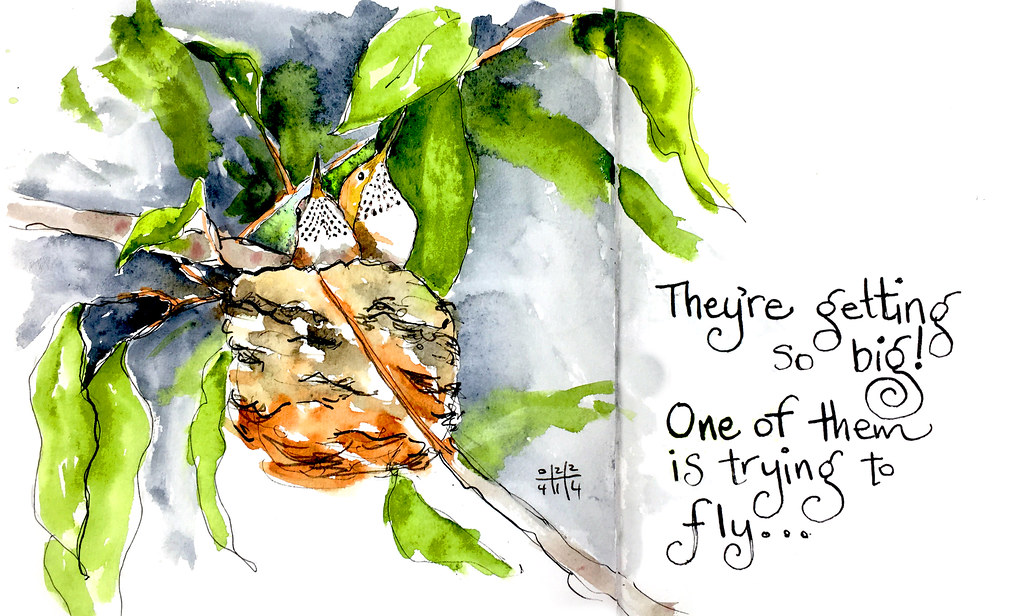
Ah! They grow up so fast! The baby hummers continue to provide daily drama and entertainment, but soon they’ll be out in the big wide world.
I love the feather pattern on their chins. Reminds me of Hallgrímskirkja.

Sometimes it’s excellent to be wrong. I thought these babies were dead, but they are very much alive. We (and the camera) still haven’t seen the mama feeding them, but she must be doing so. Yay!

For the third year in a row, a hummingbird has nested in our yard then failed to raise a brood. We’ve had the wildlife camera on this nest for several days, but the mama has not been back. Two little unfed puffballs rest in peace.
 hashiworks