
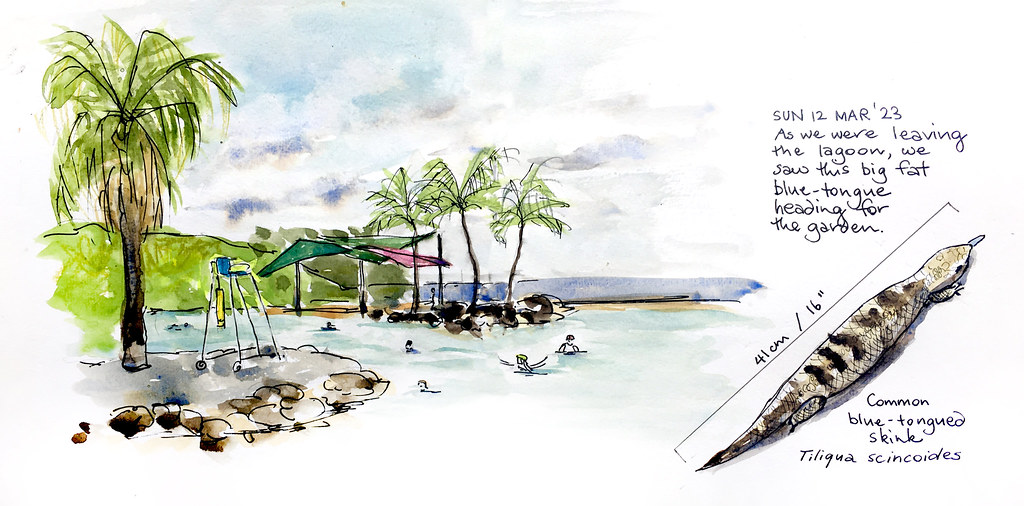
Took the kids swimming again today. I was blasé about the brushturkey and bin chickens wandering around the pool area, but was quite thrilled by the big fat bluey.
Took the kids swimming again today. I was blasé about the brushturkey and bin chickens wandering around the pool area, but was quite thrilled by the big fat bluey.
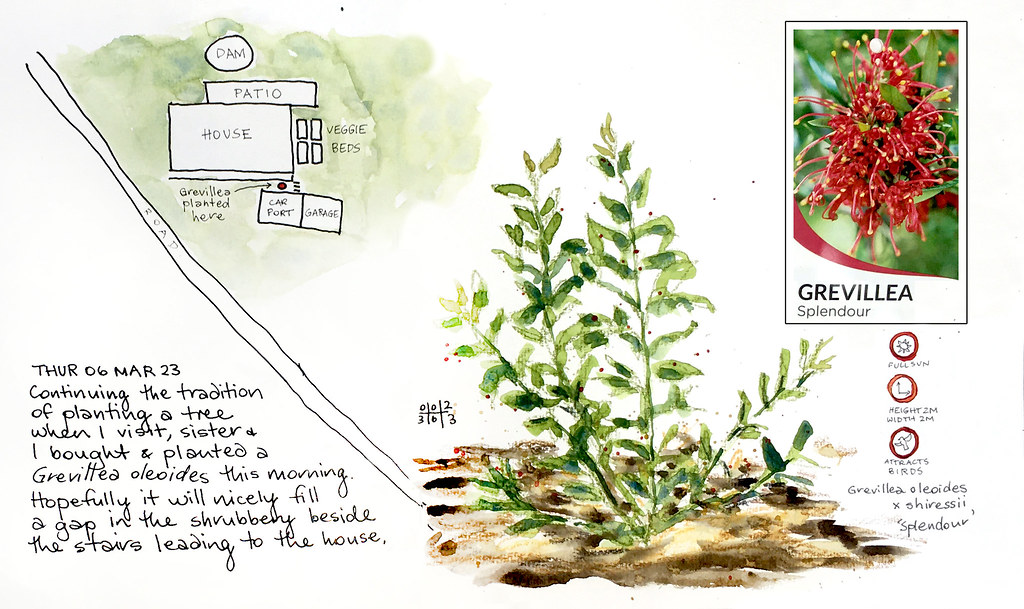
My sister lives on a bush block, and there is absolutely no shortage of trees here (mostly eucalypts and acacias). But I still like to add to the assortment when I visit. It started when Mum died and we planted creeping boobialla, Myoporum parvifolium, in her honour (she had breast cancer — get it?) When Dad passed he got a Grevillea ‘Ned Kelly’, to celebrate his love of Australia folk legends. We don’t need the excuse of someone dying to plant a tree; now we do it each time I come.

Last night we went on a guided night hike at Mulligans Flat, a 1285ha (3175 acre) predator-fenced woodland sanctuary near Canberra. Several native species have been successfully reintroduced here, including the Eastern Quoll, a marsupial about the size of a house cat, and the Eastern Bettong, a little macropod, both of which we spotted. We also heard Stone Bush-curlews and saw Superb Parrots, Eastern Rosellas, Sulphur-crested Cockatoos, Eastern Grey Kangaroos, Red-necked Wallabies, Swamp Wallabies, many Common Brushtail Possums and orb weaver spiders, and one teeny frog. It was awesome!

Crested pigeons and noisy miners are both abundant in Queensland. This miner apparently thought that the flock of pigeons should move on, and let them know it in no uncertain terms.
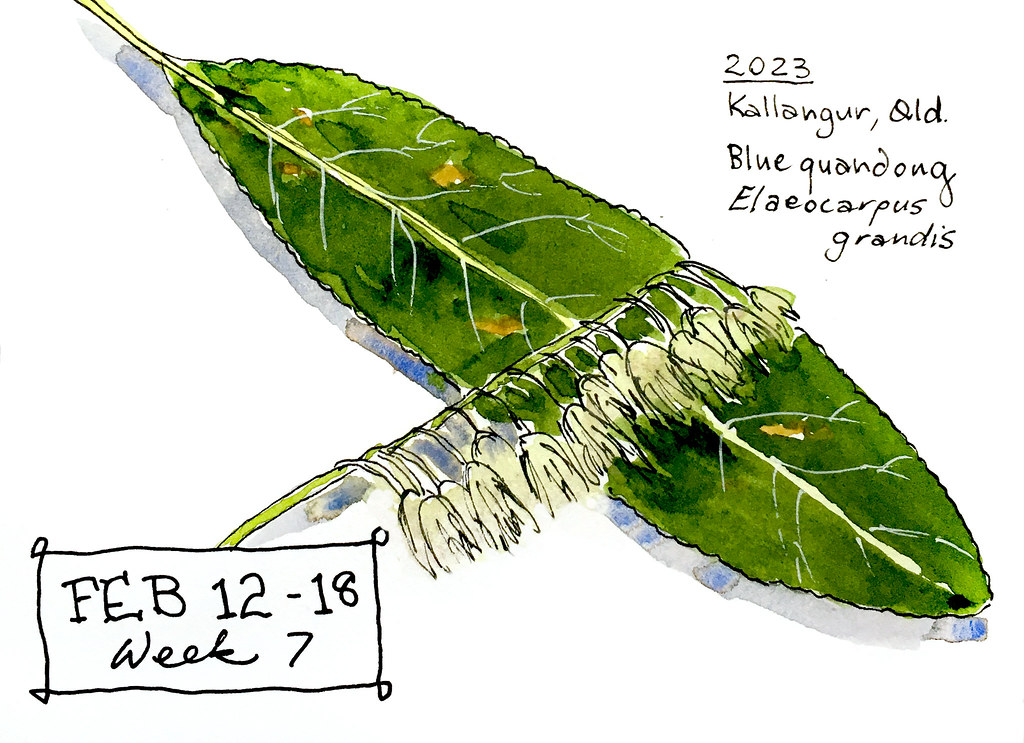
There’s a huge Elaeocarpus grandis tree in full flower in the park near my daughter’s house.
This rainforest tree commonly known as white quandong, blue quandong, silver quandong, blue fig or blueberry ash, is endemic to eastern Australia. It is a large tree with buttress roots at the base of the trunk, oblong to elliptic leaves with small teeth on the edges, racemes of greenish-white flowers and more or less spherical blue fruit, which are edible but bitter.
Indigenous Australians ate the fruit raw or buried the unripe fruit in sand for four days to make it sweeter and more palatable. Early settlers used the fruit for jams, pies and pickles. The fruit of E. grandis is eaten by birds, including the wompoo fruit-dove, southern cassowary and Australian brushturkey.
I have a vintage (1940s) Chinese Checkers set that belonged to my mother; the “marbles” are painted quandong seeds. It looks like this one. I am not sure if they are E. grandis seeds as there are at least a couple of dozen trees called quandong.

Exploring with the grandkids, we spotted a koala (Phascolarctos cinereus) and her joey high in the branches of an ironbark tree near their home. A lovely sighting for our last day in Australia. Today we fly home.

Enjoying the rainbow lorikeets (Trichoglossus moluccanus) in the palm trees at dawn.

This guy was on the kitchen floor this morning, barely alive. I thought it was a leaf and picked it up, then noticed a leg waving weakly. I put it outside and it must have recovered somewhat because when I came back with my sketchbook, it was gone.
Only a few more days in Aus, so it may be my last honking big spider for a while.

Common brushtail possums are the Australian marsupials most often seen by city dwellers, as they can thrive in a wide range of natural and human-modified environments. They are inventive and determined foragers with a liking for kitchen raids, fruit trees, and vegetable gardens, as our Wollongong friends well know!
This baby was in the temporary care of our wildlife rescuer friend when we stayed with her the other night. Pretty darn cute.

A pair of curious superb fairywrens kept me company at Bingi Bingi Point.
The superb fairywren was named ‘Australian Bird of the Year’ for 2021, after a survey conducted by Birdlife Australia saw the species narrowly defeat the tawny frogmouth.

Australia is famed for its colourful birds, but the little monochrome ones can be just as fascinating. Grey Fantails live across most of Australia. Hyperactive, agile and graceful, they perform rapid aerial acrobatics, constantly splaying out their tail feathers into a fan. They feed on flying insects which they chase out from the edge of shrubs and bushes and snap up mid-air. Cute!
 hashiworks