

“What is the name of that honeyeater with a blue face?” I wondered. Oh right, of course …
“What is the name of that honeyeater with a blue face?” I wondered. Oh right, of course …

My sister Cass and I spent a lovely morning at the Maroochy Regional Bushland Botanic Gardens, birding and nature journaling, while Uncy Dan took the kids off on their own adventure.


There’s an active brush turkey nest in my friends’ front yard, right below the verandah. It’s a huge mound of mulch and leaf litter, several metres wide, which the male tends daily with much scratching and shifting of the plant material as the eggs incubate deep inside.
Brush turkeys are not exactly beloved in suburban gardens, as they steal every bit of mulch they can find. Once one starts building a mound, it’s pretty much impossible to get it to stop.
If the chosen location is really inconvenient, you can try to redirect the bird’s attention to a different part of your garden by creating a compost mound. The brush turkey might be drawn to this spot and eventually adopt the compost mound as its nesting site. Good luck!

I spotted a new-to-me Australian native in the grounds of my local university. Showy Honey-Myrtle is endemic to an area near Albany in Western Australia. The Noongar indigenous name is mindiyet.
Melaleuca nesophila is cultivated as an ornamental plant. It grows in full sun to part shade, in sandy or clay loam soils. Once established, it will tolerate extended dry periods as well as coastal conditions. This species is naturalised in some parts of Victoria where it is considered a serious environmental weed, as it replaces the local native plants.

Fun gum tree at the El Capitán State Beach campground. The ranger tried to tell me it was a Myoporum but he was nuts.
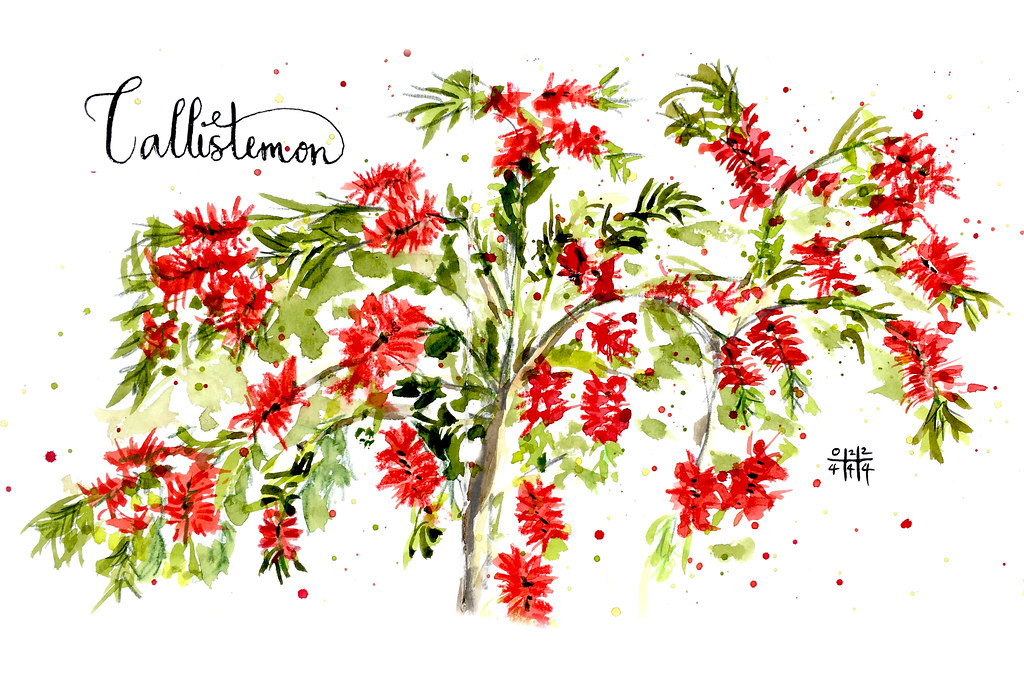
We bought this Callistemon 10 years ago. It spent a few years in a pot before going in the ground, and now it’s well-established and close to its maximum size of 1.8m high x 1.5m wide. It feeds hooded orioles, house finches, lesser goldfinches, and maybe other birds too during the long flowering season, and brings us much pleasure.
I’m more of a purist about planting CA natives now, but I’m not sad about the select Australian trees and shrubs we’ve established here (no acacias or eucalypts, they are way too invasive).

The Kurrajong bottle tree — native to the foothills and plains of eastern Australia — is adapted to semi-arid climates, warm temperatures and seasonal drought. It’s been introduced to South Africa, the United States and Mediterranean countries, where it is well suited for use as a street and park tree.
The kurrajong was used by many Australian Aboriginal clans and tribes. The seeds were removed, cleaned of the fine hairs within the seed pod, and roasted. Water could be obtained from the tree roots by boring a hole in the trunk and squeezing the wood. There are also records of the seed pods being turned into a children’s rattle or toy. The soft spongy wood was used for making shields, and the bark as a fibre. The leaves are also used as emergency fodder for drought-affected animal stock. There are records of European settlers using the seeds as a coffee substitute.
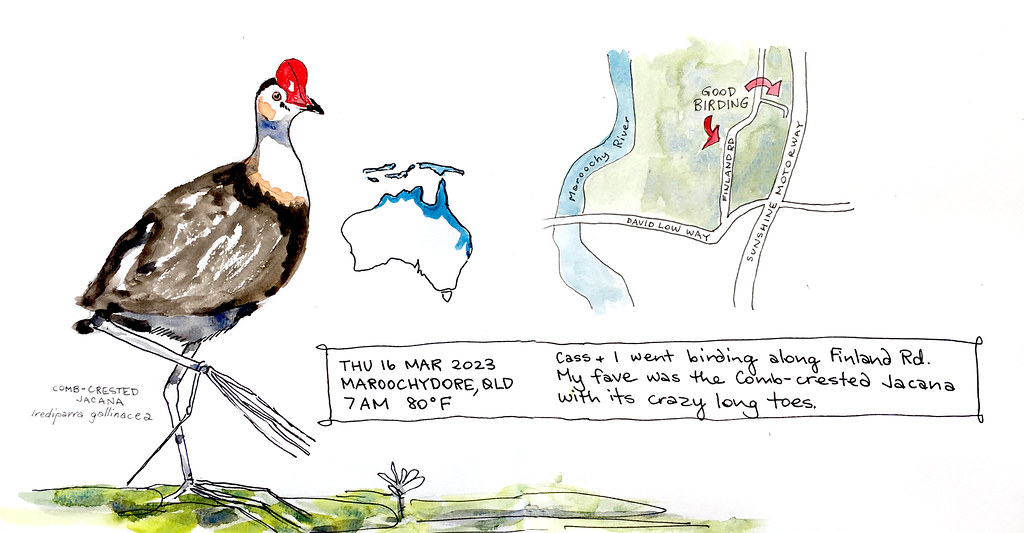
This morning, Cass took me to one of her favourite nearby birding spots, where I was delighted by the Comb-crested Jacanas, Irediparra gallinacea. Look at those feet, evolved for walking on water plants!
By late morning I was at Samford Conservation Park, meeting up with artist and environmental educator Bethan Burton. She’s a treasure! Our few hours together weren’t nearly enough. We observed an interesting butterfly whose forewings seemed to be transparent; she later texted me an ID: Cressida cressida, the Clearwing Swallowtail or Big Greasy — funny name! Gorgeous butterfly! Lovely woman!
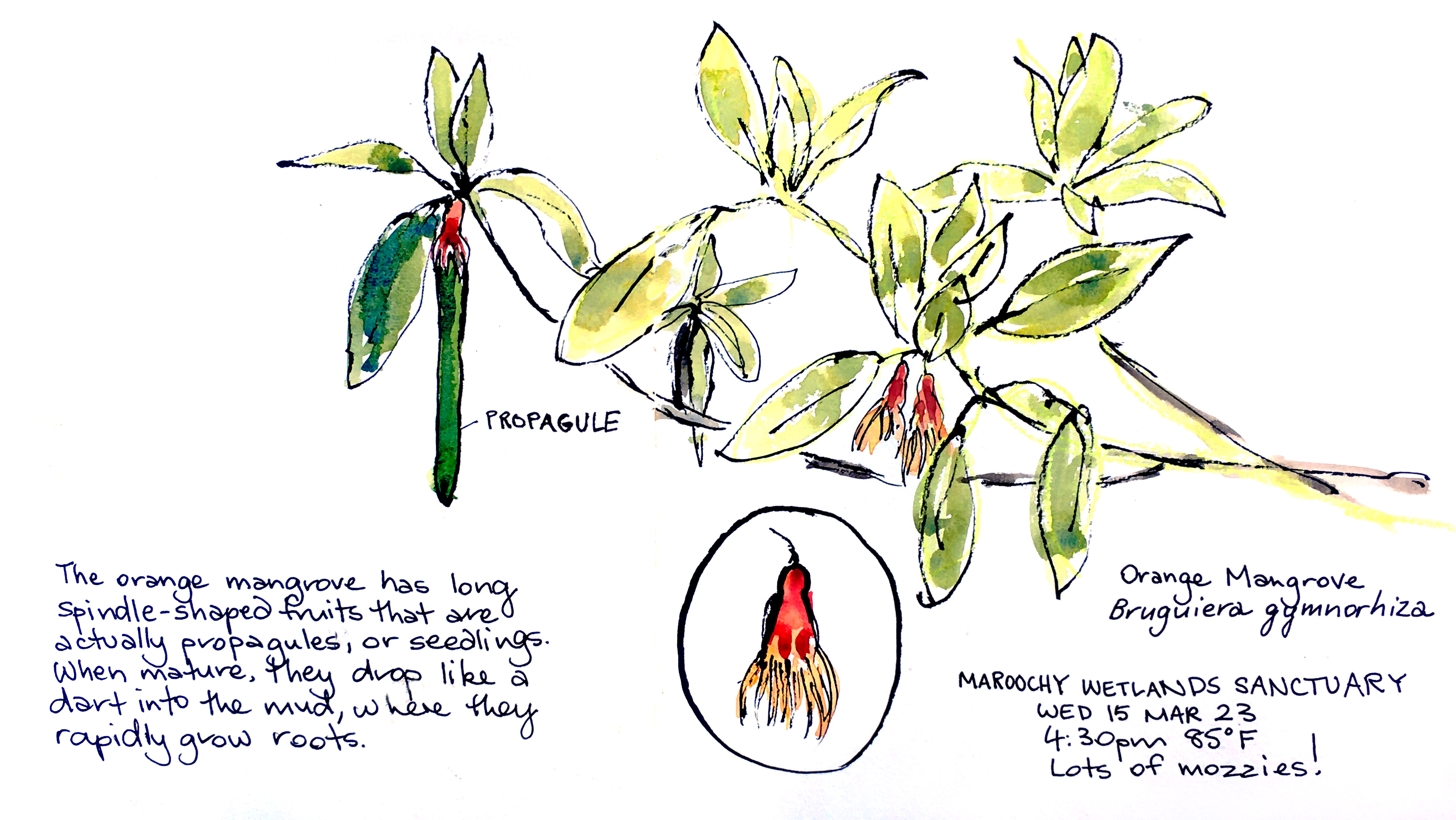
Another day, another wetland, this time in the company of my rad SIL, Cass. The Maroochydore Wetlands Sanctuary at Bli Bli is, according to one of their interpretive signs, “home to 180 species of birds, 30 species of crabs, five species of mangroves, and untold species of reptiles, amphibians, insects, crustaceans, molluscs, plants and fungi.” And millions of mosquitoes. I even wore Aerogard, an exercise in futility.
I was particularly taken with the Orange Mangrove, Bruguiera gymnorhiza. It has the largest leaves of all the mangroves in the Sanctuary, bright red-orange flowers, and an interesting method of reproduction. We found a propagule that had dropped onto the boardwalk, and helpfully shot it into the mud below. According to Wikipedia, the propagules are eaten by many indigenous groups in northern Australia and southeastern Papua New Guinea, and there is also evidence of them being eaten in India, Bangladesh, and other parts of Southeast Asia.

I’ve been wanting to stop at Boondall Wetlands for the longest time, and today I finally did. The reserve supports various plant communities including eucalyptus and melaleuca woodlands, remnant rainforests, ironbark forests, casuarina forests, grasslands, tidal mudflats, mangroves, swamplands, hypersaline flats and salt marshes.
It’s a great birdwatching site—apparently over 190 species of birds use the various habitats throughout the year—but I visited in the middle of a hot day so didn’t see much bird action. Definitely worth a return visit at other times and seasons.
 hashiworks