Trichonephila edulis

There are sooooo many golden orb weavers (Trichonephila edulis) here in the Australian sub-tropics at this time of year; every garden sports half a dozen or more, it seems. Their tangled webs are large, strong and sticky, so one needs to be careful when walking outside in the dark. The spider’s bite is not venomous, though it can cause pain and swelling. Perhaps you’d like to try biting back: edulis means edible. The spider has apparently been considered a delicacy in Papua New Guinea and New Caledonia, plucked by the legs from its web and lightly roasted over an open fire.

The koala (Phascolarctos cinereus) on the other hand, is much harder to spot. So I was pretty happy when all my neck-craning paid off this afternoon, down by the creek.

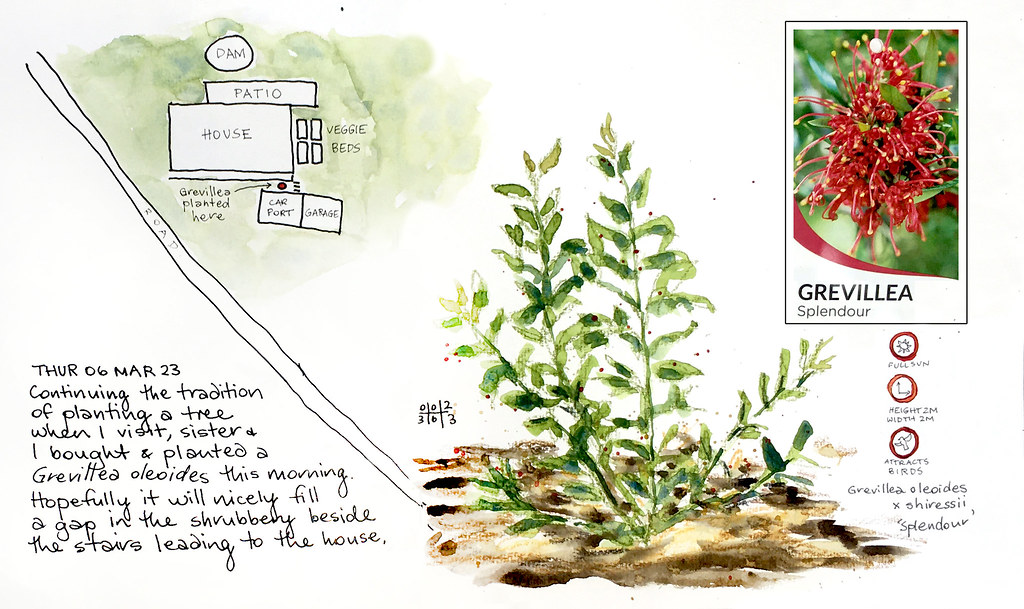
Grevillea oleoides

My sister lives on a bush block, and there is absolutely no shortage of trees here (mostly eucalypts and acacias). But I still like to add to the assortment when I visit. It started when Mum died and we planted creeping boobialla, Myoporum parvifolium, in her honour (she had breast cancer — get it?) When Dad passed he got a Grevillea ‘Ned Kelly’, to celebrate his love of Australia folk legends. We don’t need the excuse of someone dying to plant a tree; now we do it each time I come.

Mulligans Flat

Last night we went on a guided night hike at Mulligans Flat, a 1285ha (3175 acre) predator-fenced woodland sanctuary near Canberra. Several native species have been successfully reintroduced here, including the Eastern Quoll, a marsupial about the size of a house cat, and the Eastern Bettong, a little macropod, both of which we spotted. We also heard Stone Bush-curlews and saw Superb Parrots, Eastern Rosellas, Sulphur-crested Cockatoos, Eastern Grey Kangaroos, Red-necked Wallabies, Swamp Wallabies, many Common Brushtail Possums and orb weaver spiders, and one teeny frog. It was awesome!

Rusten House

Rusten House began life in 1862 as Queanbeyan’s second hospital. It accommodated 16 patients, with care provided by Matron Rusten and her husband. When a larger hospital opened nearby in the 1930s, Rusten House was converted into nurses’ quarters.

Heritage-listed, beautifully-conserved Rusten House is now a contemporary art and cultural facility. Today we attended the opening of a small but impactful exhibition of feminist posters dating from the 70s and 80s, some of which I remember from my activist youth. Lunch was served in the garden and we enjoyed the company of a friend and her daughter. I snuck away to sketch and missed the speeches.

Wallabia bicolor

Namadgi National Park is a protected area in the south-west of the Australian Capital Territory (ACT). It occupies 106,095 hectares (262,166 acres), approximately 46 percent of the ACT’s land area.

Declared a national park in 1984, Namadgi National Park has helped protect the biodiversity of the ACT. Eighty percent of the area burned in the Orroral Valley bushfire in early 2020; recovery is ongoing. I’m not sure if the Square Rock trail was in the burn area, but to my eyes today, the place was looking pretty good!

Limnodynastes peronii

Frog photo reference: Reptiles and Frogs of the Australian Capital Territory by Ross Bennett

After identifying the frog calls from the dam — my sister is a bit of an expert — we went out and had a lovely morning walk around the Australian National University, enjoying the historic buildings, public art, and green spaces. I recognised very little from my misspent teenage years when I would illegally drink in the Union Bar.

Then we spent some time at the National Museum of Australia, always worth a visit. The café lunch was delicious and the Great Southern Land gallery impressed us both.