

I spotted this beauty in the house; after catching it for some closer observations and ID, I released it into the veggie garden. Maybe it will hunt cabbage white butterflies—one can hope!
I spotted this beauty in the house; after catching it for some closer observations and ID, I released it into the veggie garden. Maybe it will hunt cabbage white butterflies—one can hope!

This iridescent little beetle (about 8mm long) was on a milkweed plant at the Park yesterday. So bright and metallic!
Both adult and larvae C. cobaltinus life stages eat dogbane and milkweed species. These plants contain toxic molecules known as cardenolides, which the beetle is resistant to. In fact, it stores the cardenolides in its glands, and uses them against predators.
Cobalt Mikweed Beetles are similar to click beetles in being able to launch themselves a couple of times the length of their body. Little but mighty!

Mosquito hawk. Skeeter-eater. Gallinipper. Gollywhopper. Jenny longlegs. Daddy longlegs. Crane flies are found all over the world and go by many different names. There are several common misconceptions about these insects:
Crane fly larvae can be important in the soil ecosystem, because they process organic material and increase microbial activity. Larvae and adults are also valuable prey items for many animals, including insects, spiders, fish, amphibians, birds, and mammals. However, the larvae of some crane fly species are agricultural pests, as they feed on the roots, root hairs, crown, and sometimes the leaves of crops. But mostly, these giant, delicate creatures are completely harmless.

The deerweed on the hills at Leo Carrillo is being absolutely denuded by Western Tussock Moth larvae. Shrub after shrub along the trail has been stripped to bare stems, while others show a thick population of caterpillars munching away with abandon.
Orgyia vetusta is native to western North America, and is considered a pest by many because of the speed at which the caterpillars can defoliate a tree. They‘ve been reported on virtually all California oak species as well as various fruit and nut trees, ceanothus, hawthorn, manzanita, toyon, walnut, and willow. And deerweed!
The defoliation wrought by these caterpillars can trigger a chain reaction in ecosystems. Trees and plants serve as vital resources for numerous organisms, and their decline can throw food chains into disarray and diminish biodiversity. Tussock moth caterpillars have several natural predators, including birds, parasitic wasps and predatory beetles. Here’s hoping that the population reaches a healthy stasis at Leo Carrillo.


Our most common centipede around here is Scolopendra polymorpha. Their bodies generally reach 4–7 in (10–18 cm) in length, so this one was not a particularly large specimen. They can vary a lot in colour; I loved this guy’s turquoise legs!
Centipedes, including this one, can inflict an intensely painful pinch. They puncture the skin with a powerful pair of modified, hollow, clawed legs called forcipules located on the first body segment, immediately behind the head. Venom glands run through a tube, from inside the head to the tip of each forcipule. The venom may cause an allergic reaction in some people, so best not to pick one up with your bare hands.
Centipedes are carnivorous and nocturnal. They eat silverfish, cockroaches, spiders, crickets, bed bugs and moths, so maybe don’t be too sad if you find one in your house.

Last day of Wild Wonder was a doozy. I especially liked learning more about scavengers, detritivores and decomposers from Robin Lee Carlson. I feel chock full of learning, inspiration, and screen overload. Time to get outside!!
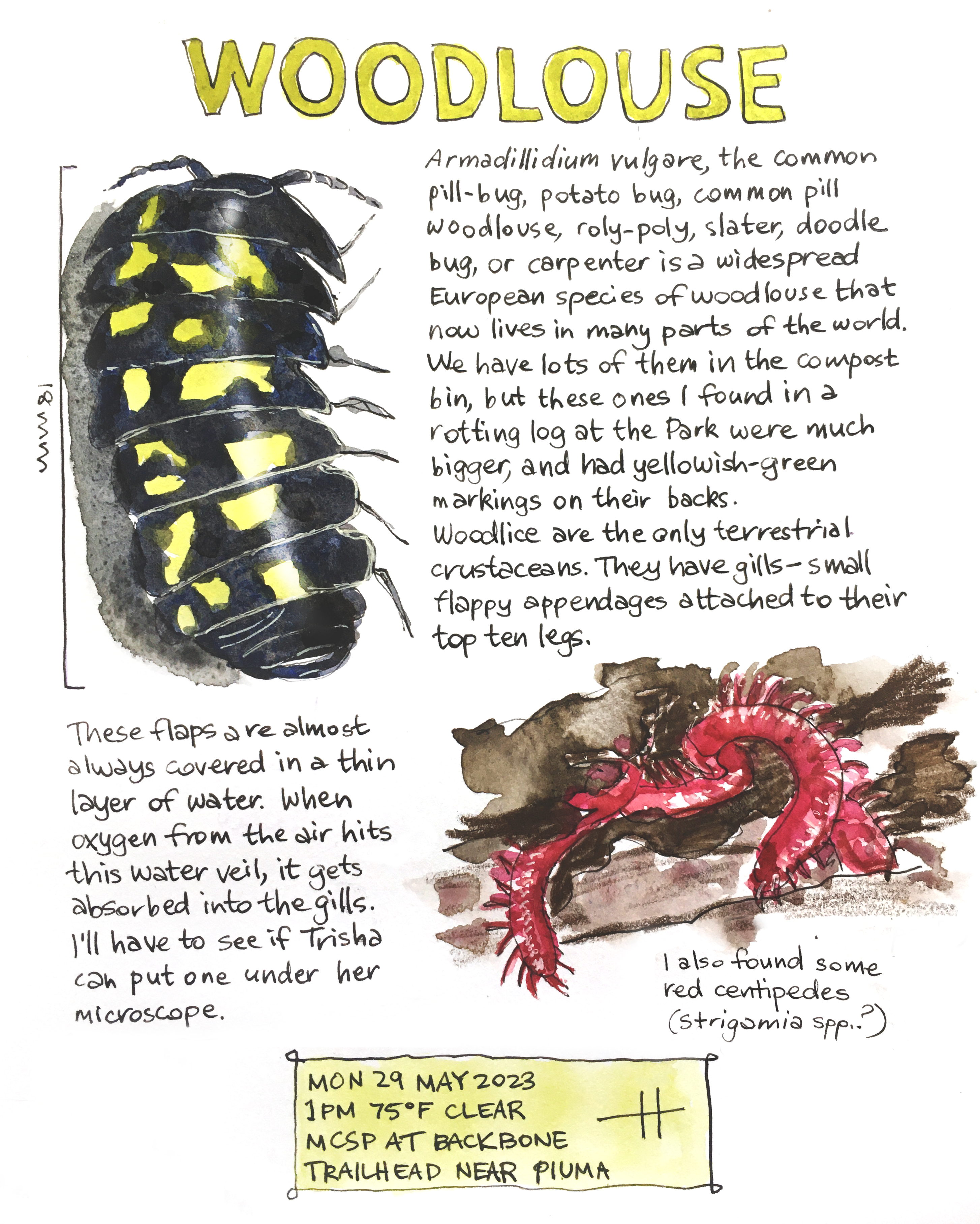
Poking around in some rotting logs, I found large woodlice and little red centipedes. Woodlice are crustaceans! They have gills! Learn something new every day.
 hashiworks