

Further to my post of March 29, it looks like the macadamia is pregnant!
Further to my post of March 29, it looks like the macadamia is pregnant!

We’ve all been excited about the digger bees at the Park, but we also have digger wasps actively nesting quite close to the Visitor Center.

Fun morning sighting. I only ever see one thrasher at a time, usually dashing across the driveway, so I don’t know if there are multiples here. But I’m always happy to spot this mockingbird relative.

I’ve been seeing the osprey hanging about this month, but my eyes and camera aren’t up to the task of recording the finer details. Big thanks to local birder-photographer Chris Tosdevin for this great original image; I had fun sketching it.
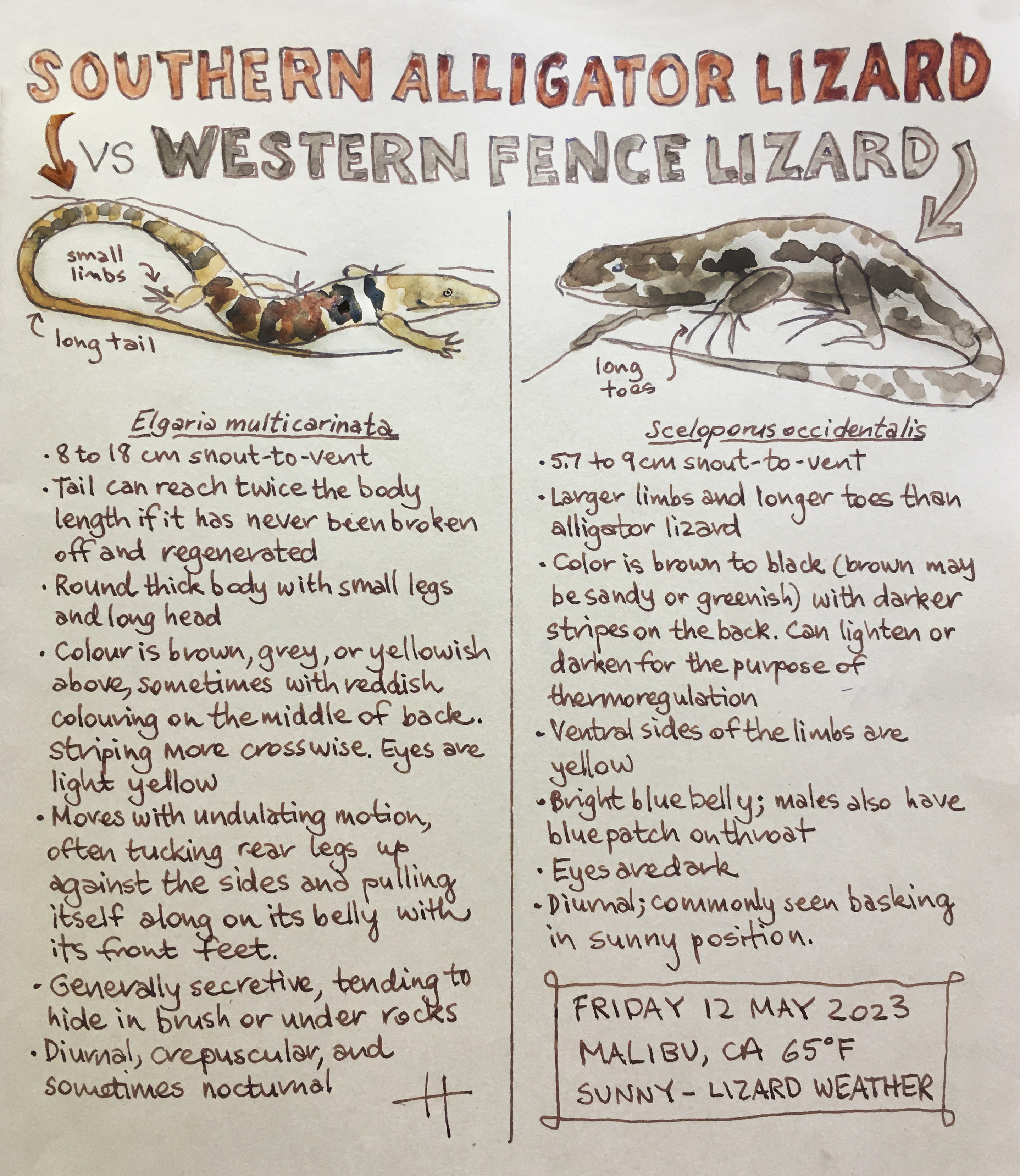
With our local lizards having such variable colouration, telling them apart is more about shape and behaviour than it is about colour or patterns. Our most commonly-seen reptile is the western fence lizard, who loves to bask in the sun, gripping with long toes or doing pushups. Alligator lizards are seen less frequently. They have long, slightly prehensile tails and a snake-like way of slithering. Now that I’ve journaled the differences, I don’t think I’ll ever get them confused.

Striped shore crabs (Pachygrapsus crassipes) live along the west coast of North America, from Baja California, Mexico, to central Oregon. Measuring 4 – 5 cm across the carapace, they can be found in estuaries, tide pools, mussel beds, or scuttling along shoreline rocks. These, and hermit crabs, are the most common crustaceans I see at my local tide pools.
Though they feed mostly on algae and phytoplankton, they are opportunistic and will also eat animals including dead fish, limpets, snails, isopods, worms, and mussels. They will even eat recently molted specimens of their own species. They are prey for seagulls, octopuses, rats, raccoons, and humans.
Though most crabs and many shore crabs spend the majority of their time underwater, P. crassipes is an exception. They apparently spend more than half their time on land, though they typically stay close to the water’s edge.

Spiny lobsters can produce a loud rasping sound by rubbing an extension of their antennae against a rigid part of their body below their eyes. This noise may be used to communicate with other lobsters or to ward off predators.
This was the most intact lobster shell I’ve ever seen at the beach. Sure, it was broken in half and was missing a few legs, but it was mostly there.

The wetlands in Legacy Park are alive with red-winged blackbirds, great-tailed grackles, mallards, coots and egrets. I like to sit by the tules and watch the interactions. Today there were a lot more drakes (9) than ducks (2); the females were getting persistently pursued and didn’t seem too happy about it.

I am admiring the vase of pretty purple chive flowers here on my table, and feeling inspired by the botanical illustrations of Swedish botanist Carl Lindman (1856-1928). There is so much to learn from artists like him.
Chives are widespread in nature across much of Europe, Asia, and North America. A. schoenoprasum is the only species of Allium native to both the New and the Old Worlds. As well as producing edible flowers, leaves and bulbs, chives have pest-repelling properties that make them a great companion plant for most other vegetables and herbs. The plant also provides a great deal of nectar for pollinators. Gotta love ’em!

What’s the equivalent of bed rest for a pregnant citrus tree? Compost and rock dust?
 hashiworks