I only had a few minutes to sketch before work, and in the time it took me to draw a Foothill Penstemon, the Merlin app identified 19 nearby bird songs. I can recognise seven (maybe eight) of those birds by ear; I plan to keep studying their calls, and one day know them all.
I should try to get bladderpod established on our block. It’s apparently easy to grow from seed (and readily self-seeds). It‘s drought-tolerant and fire-retardant, and it attracts native bees, butterflies and hummingbirds. And deer don’t eat it.
The only downside is that it hosts the harlequin beetle which can be a serious pest on brassicas, which I do like to grow in the veggie garden. I wonder how far apart that two kinds of plants would have to be, for this to not be a problem? Hmm, this warrants some further research.
A new-to-me waterbird at Legacy Park! I was delighted by the bright blue bill on this male ruddy duck.
I’ve read that ruddy ducks are very aggressive toward each other and toward other species, but this fellow was behaving peacefully. Apparently they will even chase rabbits feeding on the shore. During courtship, males beat their bill against their neck hard enough to create a swirl of bubbles in the water. Pretty intense!
The genus name Oxyura is derived from Ancient Greek oxus meaning “sharp”, and oura meaning “tail”. Ruddy ducks were imported into the UK in 1948 and have since spread to Europe, where they are considered invasive.
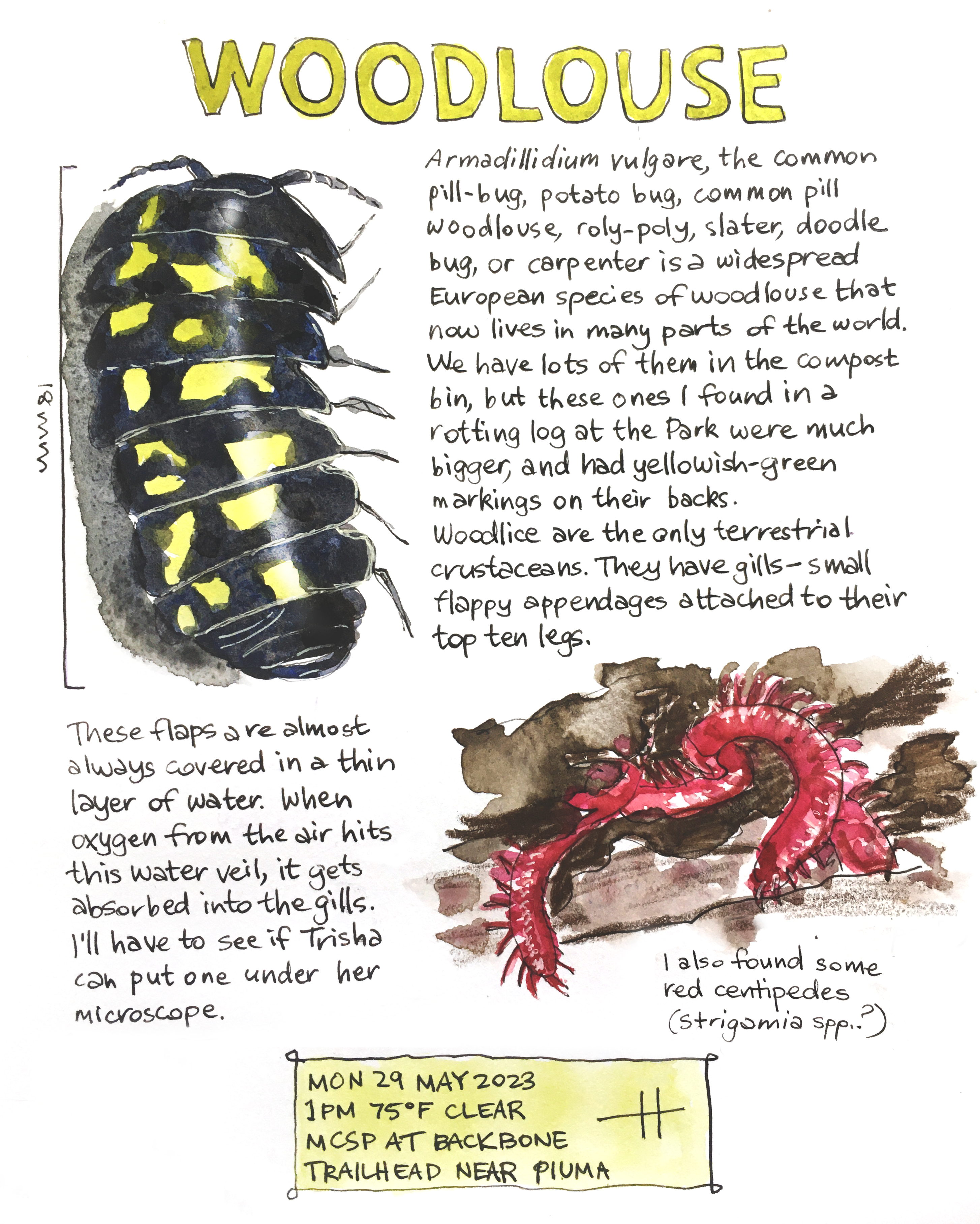
Poking around in some rotting logs, I found large woodlice and little red centipedes. Woodlice are crustaceans! They have gills! Learn something new every day.
We’re delighted to see a hummingbird nesting close by the house, though it means we have to creep past so as not to disturb her. Two years ago, when the lemonadeberry was bigger and closer to the pathway (and thus more easily disturbed), a hummer hatched two babies there, but they died before fledging. We never knew if our presence disturbed the mama too much, or there was some other reason for the fatalities. Fingers crossed for a successful raising this year.
The Allen’s hummingbird constructs her nest out of plant fibers and down, coating it with lichens and spider webs to give it structure. There’s likely one or two eggs, which she will incubate for 15 to 17 days. The young leave the nest about three weeks after hatching, so we might have another month of fun (cautious) viewing.




 hashiworks