

I asked my herpetologist buddy about this pulsing behaviour, and he said he had observed it in several species, including gopher snakes. No good theory on why they do it. He added that there’s a ton we don’t know about snake behaviour.
I asked my herpetologist buddy about this pulsing behaviour, and he said he had observed it in several species, including gopher snakes. No good theory on why they do it. He added that there’s a ton we don’t know about snake behaviour.

Since the oaks finished flowering, I’ve been checking on the baby acorns at every opportunity. The valley oaks have the lead at this point; they will eventually be much larger than the coast live oak acorns so that’s not surprising. It’s fun to peek among the leaves and see what I can spot — not every oak produces flowers/acorns every year so it’s a bit of a treasure hunt.

One of our “small-flowered candle” cacti is suffering from a little erectile dysfunction. Its aggressive spines have prohibited a close examination of the problem, so I can only guess at the cause.
(I got bored with drawing spines, so some of the cacti appear bald, but in reality they are all covered in a very sharp dense fuzz.)

K was exercising in the living room, when he suddenly yelped. It seemed he had somehow squashed a side-blotched lizard. Sad for the lizard, but good for me! If I get the opportunity to closely examine a critter, I’ll take it.
This little guy is named for the dark blue smear behind the front legs. More impressive is the iridescent turquoise speckling on the back.


I dropped my car at the mechanic and walked to the dentist. On the way, I noticed these two people sitting back to back outside a coffee shop — I wonder if their morning would have gone differently if they’d sat face to face? I sketched them for ten minutes or so, until they went their separate ways.
Arriving at the dentist waiting room, I had just enough time to sketch the ubiquitous fake plant before I was called in.
I am not loving this new sketchbook. The cold pressed paper is much more textured than I’m used to. But rather than putting it back on the shelf, unused, I plan to fill it up quickly so I can move on to a preferred sketchbook sooner. It might be time to bring out little-used art tools and indulge in more experimentation and play.

Augochlora pura is a solitary sweat bee found primarily in the Eastern United States. Its Latin name means “pure golden green“, a lovely description of its metallic green hue. It nests in rotting logs, and can produce up to three generations per year. Both males and females have been observed licking sweat from human skin, most likely seeking salt.
If you are being “foraged” by sweat bees, be careful to brush them from your elbow and knee joints before bending your limbs, or you may be inadvertently stung.
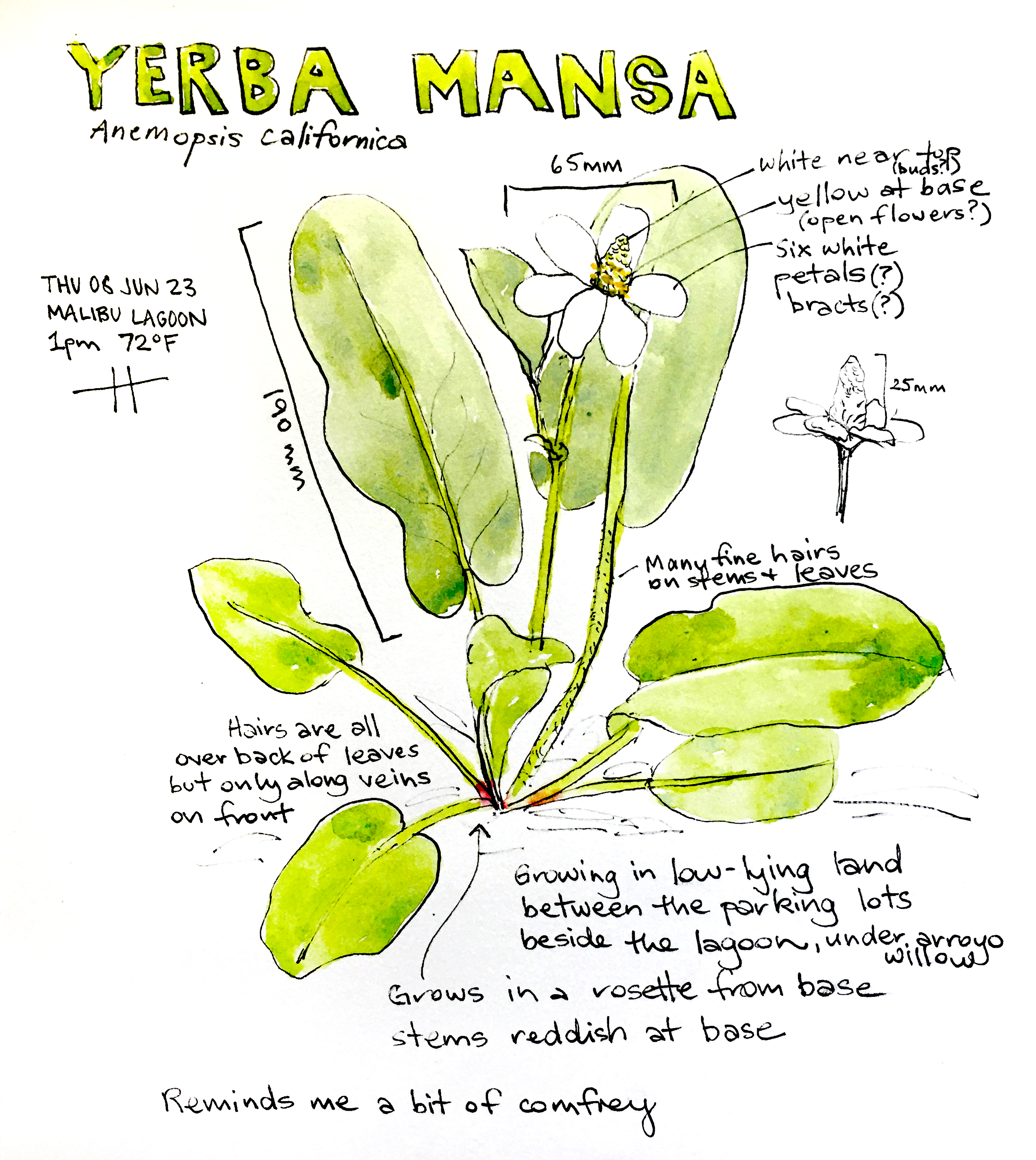
While visiting the lagoon, I was stopped in my tracks by these pretty flowers, and had to learn more about this striking plant.
Yerba Mansa, also known as Lizard Tail, is a perennial native to southwestern US. It prefers wet locations, especially alkaline or saline marshy places below 2000 metres.
The leaves and stems are covered in soft hairs. On the upper side of the leaves, the hairs follow the veins; on the underside they cover the whole surface.
What appears to be a single bloom is actually a dense cluster of individual small flowers borne in a conical inflorescence with five to ten large white bracts beneath it. The conical structure develops into a single, tough fruit with tiny, pepper-like seeds.
The root can be consumed raw or cooked; it has a peppery flavour. Pulverized seeds can be used to make bread or added into other dishes. The root and rhizome have been used to treat the common cold, influenza, pain, wounds, burns, gastrointestinal upsets and many other conditions, but, according to WebMD, there is no good scientific evidence to support these uses.

Continuous line drawing with sailor fude fountain pen.


We met to walk, but it was drizzling so we decided to get coffee instead. The last time I was in this building in Playa del Rey (c. 2001), it was a night club. It has more charm now.
 hashiworks