

Last day of Wild Wonder was a doozy. I especially liked learning more about scavengers, detritivores and decomposers from Robin Lee Carlson. I feel chock full of learning, inspiration, and screen overload. Time to get outside!!
Last day of Wild Wonder was a doozy. I especially liked learning more about scavengers, detritivores and decomposers from Robin Lee Carlson. I feel chock full of learning, inspiration, and screen overload. Time to get outside!!


Downy woodpeckers are native to the (mainly deciduous) forested areas of North America. They are the smallest of the woodpeckers in N. America —14 to 18 cm (5.5 to 7.1 in) in length. They mainly eat insects, but they also feed on seeds and berries. They are a natural predator of the European corn borer, a moth that costs the US agriculture industry more than $1 billion annually in crop losses and population control.
I had fun painting this one with Ian de Hoog as my instructor.

I always love a Jean Mackay class. Here in SoCal we don’t have many deciduous trees, so it’s not likely I’ll get to see a lot of abandoned nests in bare branches in the coming months. But I’ll be keeping my eyes open, just in case.

So many questions!


My mum used this cleaning product when I was a kid. She called it “Bon Amy”, but I go for the French pronunciation. I’m glad that my local small-town hardware store carries it; none of the supermarket chains do. It’s been around since 1886, and it’s more enviro-friendly than similar Big Brand powder cleansers. PLUS it’s Martha approved!
Is Martha Stewart, and her opinions, still relevant? I don’t know or care! I just like my good friend Bon Ami!

I had the best time at the first meetup of the Santa Monica Mountains Nature Journal Club. Thirteen of us (including some NJ newbies) got together at gorgeous King Gillette Ranch for nature journalling, food, art supply tryouts, and brainstorming. Can’t wait to do it again next month!

I need to do more crepuscular hiking. I’d love to see a burrowing owl!
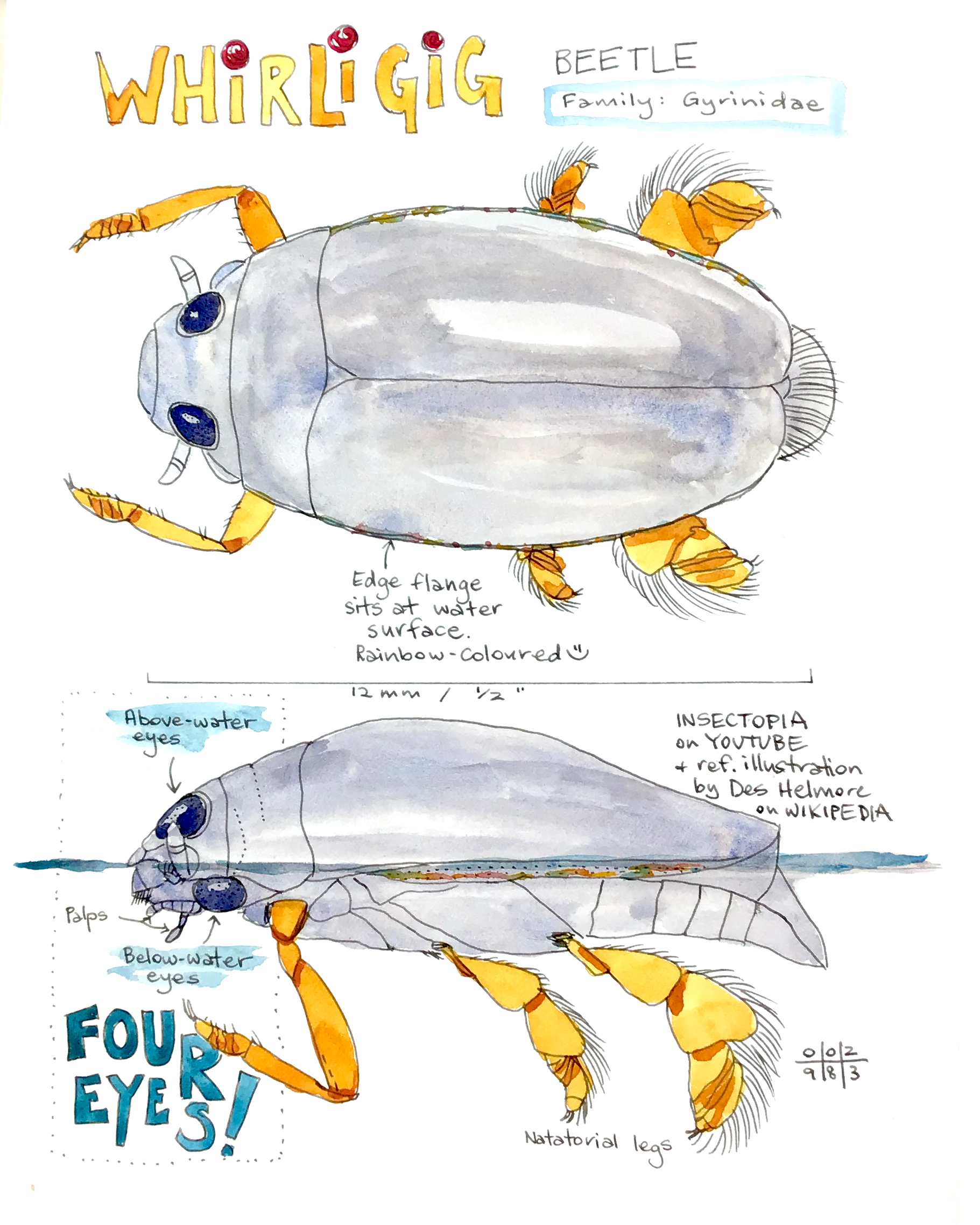
Here’s something strange: the compound eyes of a whirligig beetle are divided into a higher part that is above water level when the beetle is floating passively, and a lower part that sits below water level. Gyrinidae are the only type of beetle with this feature.
The antennae are also unusual among beetles, being short and plump, and placed about at water level.
Whirligigs get their common name from their habit of swimming rapidly in circles when alarmed. Adults carry an air bubble under the elytra at the tip of their abdomen, allowing them to breathe underwater. They are very social creatures, often found in large numbers swimming around on the water’s surface. There are about 700 species worldwide.
 hashiworks