Blog

big day out

Miss Ten’s chosen birthday treat was a train ride to the Museum and the Gallery of Modern Art, and a picnic at South Bank. A good time was had by all.

Re the sketched reptiles (seen at the museum): Green tree pythons (Morelia viridis) occur in rainforests on Cape York Peninsula, and also in New Guinea and Indonesia. Juveniles are bright yellow but change to emerald green as adults, coinciding with a shift in diet from ground-dwelling skinks to mammals. Primarily arboreal, M. viridis has a particular way of resting in the branches of trees; it loops a coil or two over the branches in a saddle position and places its head in the middle.

The perentie (Varanus giganteus) is Australia’s largest lizard, growing up to 2.5 metres (over 8 feet) long. Perenties are powerful diggers and shelter in extensive, complex burrows when they are not out and about hunting prey. They feed on reptiles (including their own species), small mammals such as bats, young kangaroos & other small marsupials, and rodents. Prey is typically swallowed whole, but if the animal is too large, chunks are ripped off for ease of consumption. Coastal and island individuals may eat a large number of sea turtle eggs and hatchlings, and hide under vehicles to ambush scavenging gulls. Wily!

Grallina cyanoleuca

The kids and I went for a wander by Freshwater Creek, them to play, me to count birds. We had some debate about whether the black-and-white bird whose mud nest Felix found was a peewee or a magpie-lark. We were both right.

We also saw (or heard) tawny frogmouths, pied currawongs, rainbow lorikeets, grey shrike-thrushes, spangled drongos, noisy miners, rock pigeons, brush-turkeys, crows, wood ducks and purple swamp hens.

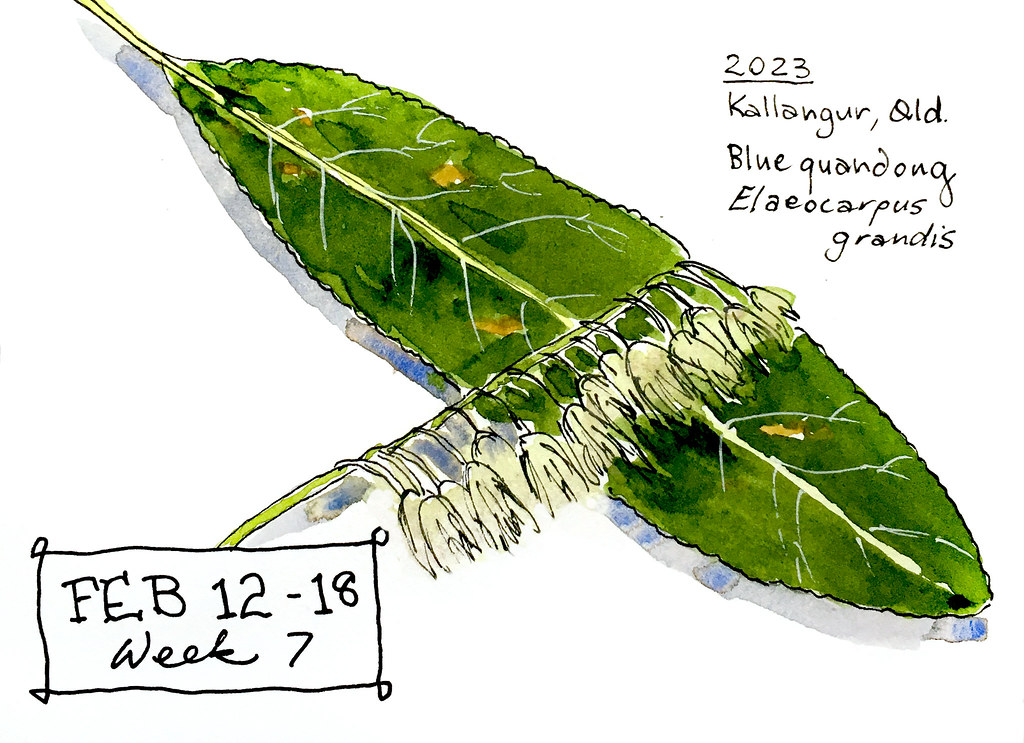
Elaeocarpus grandis

There’s a huge Elaeocarpus grandis tree in full flower in the park near my daughter’s house.

This rainforest tree commonly known as white quandong, blue quandong, silver quandong, blue fig or blueberry ash, is endemic to eastern Australia. It is a large tree with buttress roots at the base of the trunk, oblong to elliptic leaves with small teeth on the edges, racemes of greenish-white flowers and more or less spherical blue fruit, which are edible but bitter.

Indigenous Australians ate the fruit raw or buried the unripe fruit in sand for four days to make it sweeter and more palatable. Early settlers used the fruit for jams, pies and pickles. The fruit of E. grandis is eaten by birds, including the wompoo fruit-dove, southern cassowary and Australian brushturkey.

I have a vintage (1940s) Chinese Checkers set that belonged to my mother; the “marbles” are painted quandong seeds. It looks like this one. I am not sure if they are E. grandis seeds as there are at least a couple of dozen trees called quandong.