

Crested pigeons and noisy miners are both abundant in Queensland. This miner apparently thought that the flock of pigeons should move on, and let them know it in no uncertain terms.
Crested pigeons and noisy miners are both abundant in Queensland. This miner apparently thought that the flock of pigeons should move on, and let them know it in no uncertain terms.

The grandkids and I took an hour and a half to walk home from school (it usually takes them about half an hour). We saw lots of interesting things on the way, including a water dragon with two tails!
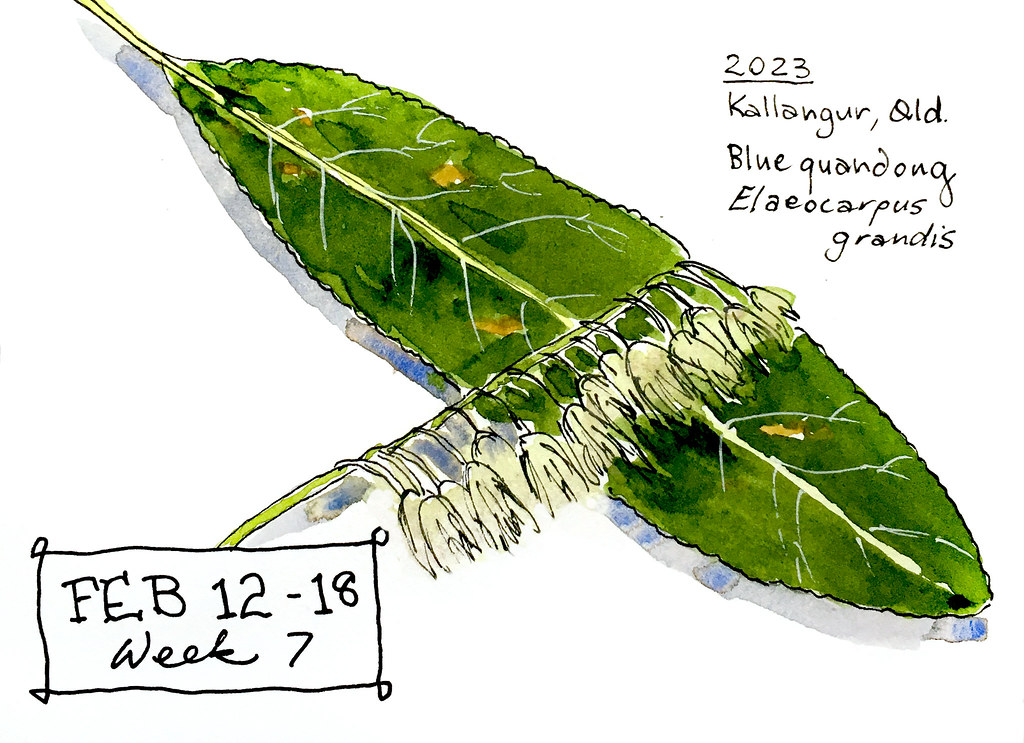
There’s a huge Elaeocarpus grandis tree in full flower in the park near my daughter’s house.
This rainforest tree commonly known as white quandong, blue quandong, silver quandong, blue fig or blueberry ash, is endemic to eastern Australia. It is a large tree with buttress roots at the base of the trunk, oblong to elliptic leaves with small teeth on the edges, racemes of greenish-white flowers and more or less spherical blue fruit, which are edible but bitter.
Indigenous Australians ate the fruit raw or buried the unripe fruit in sand for four days to make it sweeter and more palatable. Early settlers used the fruit for jams, pies and pickles. The fruit of E. grandis is eaten by birds, including the wompoo fruit-dove, southern cassowary and Australian brushturkey.
I have a vintage (1940s) Chinese Checkers set that belonged to my mother; the “marbles” are painted quandong seeds. It looks like this one. I am not sure if they are E. grandis seeds as there are at least a couple of dozen trees called quandong.

Next sketch will be from Australia 🙃

The veggie garden’s looking lush and happy, particularly the brassicas, which usually get seriously attacked by aphids and cabbage moths. It’s early days yet, but I’ve got fingers crossed that we get to eat homegrown broccoli and cabbage this year.

Musch Trail is one of the prettiest in Topanga State Park, but I don’t know how to pronounce it. Rhymes with bush? Or tusk? Or douche? Or crush? Was Musch a person? What’s his/her story? Can a local help me out?

I’m making up for the Covid years, and travelling to Australia for the second time in six months. I leave on Sunday afternoon; I’m hoping that most people will have chosen the Super Bowl over travel that day. Five weeks down under, here I come!

I very (very) rarely eat or drink out, but today I had to kill half a day in the city, so I enjoyed a light meal at Breakfast by Salt’s Cure. 💯 recommend the avocado toast.

Week 6 in the PerpJo.
Mirabilis laevis var. crassifolia is a native perennial herb found in coastal sage scrub, chaparral and woodlands habitats in California and Baja California. It’s fairly common, especially on rocky slopes with sandstone outcrops. It re-sprouts during winter after the first heavy rain and dies back after the rainy season.
The leaves are ovate to heart-shaped. The red-violet sepals look like petals but there are, in fact, no petals. These vivid, cheerful flowers are just starting to open here on our hill. Sweet!

 hashiworks